Fethullah Gulen: Turkey’s Eroding Democracy

 Hizmet supporters in Istanbul protesting the government’s harassment of journalists.   Credit Sedat Suna/European Pressphoto Agency
Hizmet supporters in Istanbul protesting the government’s harassment of journalists.
Credit Sedat Suna/European Pressphoto Agency

By Fethullah Gulen

SAYLORSBURG, Pa. — It is deeply disappointing to see what has become of Turkey in the last few years. Not long ago, it was the envy of Muslim-majority countries: a viable candidate for the European Union on its path to becoming a functioning democracy that upholds universal human rights, gender equality, the rule of law and the rights of Kurdish and non-Muslim citizens. This historic opportunity now appears to have been squandered as Turkey’s ruling party, known as the A.K.P., reverses that progress and clamps down on civil society, media, the judiciary and free enterprise.

Turkey’s current leaders seem to claim an absolute mandate by virtue of winning elections. But victory doesn’t grant them permission to ignore the Constitution or suppress dissent, especially when election victories are built on crony capitalism and media subservience. The A.K.P.’s leaders now depict every democratic criticism of them as an attack on the state. By viewing every critical voice as an enemy — or worse, a traitor — they are leading the country toward totalitarianism.

The latest victims of the clampdown are the staff, executives and editors of independent media organizations who were detained and are now facing charges made possible by recent changes to the laws and the court system. The director of one of the most popular TV channels, arrested in December, is still behind bars. Public officials investigating corruption charges have also been purged and jailed for simply doing their jobs. An independent judiciary, a functioning civil society and media are checks and balances against government transgressions. Such harassment sends the message that whoever stands in the way of the ruling party’s agenda will be targeted by slander, sanctions and even trumped-up charges.

Turkey’s rulers have not only alienated the West, they are also now losing credibility in the Middle East. Turkey’s ability to assert positive influence in the region depends not only on its economy but also on the health of its own democracy.

The core tenets of a functioning democracy — the rule of law, respect for individual freedoms — are also the most basic of Islamic values bestowed upon us by God. No political or religious leader has the authority to take them away. It is disheartening to see religious scholars provide theological justification for the ruling party’s oppression and corruption or simply stay silent. Those who use the language and symbols of religious observance but violate the core principles of their religion do not deserve such loyalty from religious scholars.

Speaking against oppression is a democratic right, a civic duty and for believers, a religious obligation. The Quran makes clear that people should not remain silent in the face of injustice: “O you who believe! Be upholders and standard-bearers of justice, bearing witness to the truth for God’s sake, even though it be against your own selves, or parents or kindred.”

For the past 50 years, I have been fortunate to take part in a civil society movement, sometimes referred to as Hizmet, whose participants and supporters include millions of Turkish citizens. These citizens have committed themselves to interfaith dialogue, community service, relief efforts and making life-changing education accessible. They have established more than 1,000 modern secular schools, tutoring centers, colleges, hospitals and relief organizations in over 150 countries. They are teachers, journalists, businessmen and ordinary citizens.

Read more in The New York Times/The Opinion Pages
Tyranny’s False Comfort: Why Rights Aren’t Wrong in Tough Times

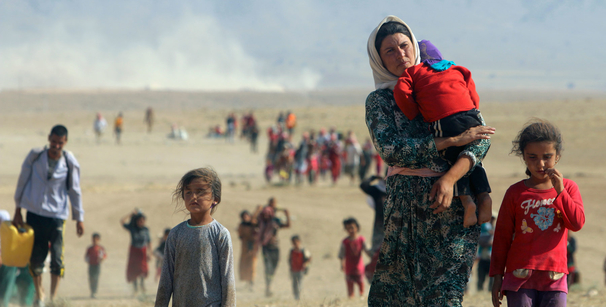
 Displaced people from the Yezidi sect, fleeing violence from forces linked to the extremist group Islamic State (also known as ISIS) in the northern Iraqi town of Sinjar, walk towards the Syrian border in August 2014. © 2014 Reuters

Displaced people from the Yezidi sect, fleeing violence from forces linked to the extremist group Islamic State (also known as ISIS) in the northern Iraqi town of Sinjar, walk towards the Syrian border in August 2014. © 2014 Reuters

By Kenneth Roth, Executive Director, Human Rights Watch

The world has not seen this much tumult for a generation. The once-heralded Arab Spring has given way almost everywhere to conflict and repression. Islamist extremists commit mass atrocities and threaten civilians throughout the Middle East and parts of Asia and Africa. Cold War-type tensions have revived over Ukraine, with even a civilian jetliner shot out of the sky. Sometimes it can seem as if the world is unraveling.

Many governments have responded to the turmoil by downplaying or abandoning human rights. Governments directly affected by the ferment are often eager for an excuse to suppress popular pressure for democratic change. Other influential governments are frequently more comfortable falling back on familiar relationships with autocrats than contending with the uncertainty of popular rule. Some of these governments continue to raise human rights concerns, but many appear to have concluded that today’s serious security threats must take precedence over human rights. In this difficult moment, they seem to argue, human rights must be put on the back burner, a luxury for less trying times.

That subordination of human rights is not only wrong, but also shortsighted and counterproductive. Human rights violations played a major role in spawning or aggravating most of today’s crises. Protecting human rights and enabling people to have a say in how their governments address the crises will be key to their resolution. Particularly in periods of challenges and difficult choices, human rights are an essential compass for political action.

Read the entire Keynote Address of the Human Rights Watch World Report 2015

Keystone Vote Fails in Senate

Ranking member Senator Maria Cantwell (D-WA) and committee chairman Senator Lisa Murkowski (R-AK) listen during a session of the Senate Energy and Natural Resources Committee on Capitol Hill January 8, 2015 in Washington, DC. The committee met for a markup of legislation to arrive the Keystone XL pipeline project. (BRENDAN SMIALOWSKI/AFP/Getty Images)

January 26, 2015 A key vote to advance legislation green-lighting the Keystone XL oil sands pipeline failed 53-39 in the Senate on Monday.

The vote aimed at cutting off debate on legislation to approve the controversial project fell short of 60 votes after Democrats, angry at Republicans for blocking debate on a slate of Democratic amendments last week, blocked the measure.

“Last Thursday night the majority decided that they would not allow for debate,” Democratic Sen. Ed Markey said on the floor ahead of the vote, echoing a complaint that a number of Democrats expressed on Monday after the Senate reconvened to debate the bill.

Senate Republicans have instigated a “gag-a-thon,” said Sen. Barbara Boxer, D-Calif.

Democratic Sen. Tom Carper of Delaware said he voted against ending debate because of the “failure of the majority to follow through on the open amendment process,” taking aim at Senate Majority Leader Mitch McConnell.

Read more at the National Journal

RNC Turns Deaf Ear To Questions About Trip Funded by Hate Group

Gage Skidmore [CC BY-SA 3.0], via Wikimedia Commons
Republican National Committee Chairman Reince Priebus photo attribution: Gage Skidmore [CC BY-SA 3.0], via Wikimedia Commons

Last week, the Southern Poverty Law Center (SPLC) faxed and sent letters to every member of the Republican National Committee (RNC) regarding an upcoming trip to Jerusalem being organized by RNC Chair Reince Priebus.

The letters expressed concern about the organization paying for the trip, the American Family Association (AFA), which the SPLC has listed as an anti-LGBT hate group since 2010.

In particular, the letters asked RNC members not to lend their good offices to an organization with a long track record of making anti-LGBT, anti-Muslim and other hateful statements. An email to Priebus’ director of communications about this matter was not responded to.

In early December, Time reported that 60 members, or about a third, of the RNC had decided to travel to Israel. But you wouldn’t know that from the calls we made. We left dozens of voicemails and sent many, many emails, none of which were replied to.

In Illinois, Indiana, Iowa, Oklahoma and Tennessee, communications directors were unaware of the trip and promised to speak with RNC members and get back to us. They did not. Other state communications directors, like those in Maryland and Louisiana, said they knew nothing of the trip and could not answer questions. In Idaho, a communications staffer told us she had no idea what we were talking about, but that she would have known about a trip if there was one.

Read more at the Southern Poverty Law Center

Well, well. It seems that the fascists have been planning a nice little putsch. Speak of strange bedfellows.

Second crude pipeline spill in Montana wreaks havoc on Yellowstone River

konigludwig's avatarWorld News Forum

 Second crude pipeline spill in Montana wreaks havoc on Yellowstone River
Second crude pipeline spill in Montana wreaks havoc on Yellowstone River

By Nate Schweber

Environmental damage from recent oil leak ranges from contaminated water supply to polluted farmland

GLENDIVE, Montana — When an oil pipeline burst in July 2011 and poured 63,000 gallons of crude into the Yellowstone River 200 miles upstream from Dena Hoff’s farm of wheat, beans and corn on the Great Plains in Glendive, she felt disgusted.

When it happened again Saturday, she felt terror. This pipeline breach was underneath the Yellowstone River, just a few feet from her sheep pasture. The new spill poured out some 50,000 gallons of crude oil. Leaders of this small riverside farming and ranching community in northeastern Montana warned residents not to drink their tap water, because benzene, a carcinogen, was found in the municipal water system. Oil slicked the river for dozens of miles, almost to the border with North…

View original post 136 more words

Majority of U.S. public school students are in poverty

The advocacy of quality public education has long been a core progressive cause. For progressives, the relationship of education, of social and economic opportunity, to the sustained viability of a democracy have always seemed clear and obvious.

This newly released study by the Southern Education Foundation underscores the significance of these relationships. The growth of economic inequality in the United States now threatens the very foundations of our society by destroying and diminishing the prospects for the future success of our youngest citizens–and of our nation.

jward199's avatarWorld News Forum

Three-year-old Saria Amaya waits with her mother after receiving shoes and school supplies during a charity event in October to help more than 4,000 underprivileged children at the Fred Jordan Mission in the Skid Row area of Los Angeles. Children from low-income families now make up a majority of public school students in the nation, according to a new report. (Mark Ralston/AFP/Getty Images)

By Lyndsey Layton

For the first time in at least 50 years, a majority of public school students across the country are considered “low-income”, according to a new study by the Southern Education Foundation. While poor children are spread across the country, concentrations are highest in the South and in the West.

For the first time in at least 50 years, a majority of U.S. public school students come from low-income families, according to a new analysis of 2013 federal data, a statistic that has profound implications…

View original post 390 more words

As Syria’s Revolution Sputters, a Chaotic Stalemate

 TORN BY WAR The view from a mosque in Homs, Syria, that has served as a rallying point for insurgents.  Credit Sergey Ponomarev for The New York Times
TORN BY WAR The view from a mosque in Homs, Syria, that has served as a rallying point for insurgents. Credit Sergey Ponomarev for The New York Times

By Anne Barnard in The New York Times

ANTAKYA, Turkey — It was a victory that President Bashar al-Assad’s opponents had dreamed of: Insurgents seized a key army base in northern Syria after more than a year of trying. But the mood in this Turkish border town, flooded with Syrians who have fled both government bombings and extremist insurgents, was more bitter than celebratory.

The assault this month was led by the Nusra Front, Al Qaeda’s arm in Syria, which claimed the spoils. By contrast, many of the first Syrians to rise up against Mr. Assad in 2011 — civilian demonstrators and army defectors alike — followed the battle from the sidelines here, unable to enter Syria under threat of death from the extremists of Nusra and its rival group, the Islamic State.

As Syria’s war heads toward its fourth year, the complex battleground is increasingly divided between the government and the extremists, leaving many Syrians feeling that the revolution on which they gambled their lives and livelihoods has failed.

Different insurgent groups battle one another, even as they fight against Mr. Assad’s forces and his allies, foreign Shiite militias. A chaotic stalemate reigns in a war that has killed more than 200,000 people and wounded one million.

In northern and eastern Syria, where Mr. Assad’s opponents won early victories and once dreamed of building self-government, the nationalist rebel groups calling themselves the Free Syrian Army are forced to operate under the extremists’ umbrellas, to go underground or to flee, according to Syrian insurgents, activists and two top commanders of the American-financed F.S.A. groups.

Read more at The New York Times

Why Merav Michaeli Is Upbeat About the Israeli Left

 Photograph via flickr
Photograph via flickr

Merav Michaeli, the Israeli journalist and women’s rights activist-turned-Knesset member for the Labor Party, is a sign of hope for a progressive future in Israel. Last Tuesday, she tried to convince an exclusive crowd of worried Jewish leftists gathered in an apartment on Manhattan’s Upper West Side that there was hope for the upcoming elections and for the future of a democratic Israel. The talk was sponsored by the progressive Zionist organization Ameinu, and also included journalists, professors, high-ranking members of the New Israel Fund and Encounter, along with representatives from Hillel, Habonim Dror, and others. What followed was a passionate, sometimes heated, and surprisingly optimistic discussion of the future of the Jewish State and the role American Jews can play.

*The first question asked was about the nationality bill, the controversial proposed law to officially declare Israel the “Nation-State of the Jewish People.” This question proved an easy one—since there is no Knesset, there will be no nationality bill. When there is a new Knesset, its makeup will likely be so different that it won’t even be proposed again.

*On the coming elections slated for March 17: Though the mood in the room suggested I was not alone in hearing virtually nothing but terrifying predictions of a rout by the right and another term for Netanyahu, if not a first term for the ultra-nationalist Jewish Home Party’s Naftali Bennett, she was hopeful. For the first time in a long time, she said, there was actually a good chance a center-left coalition headed by her Labor Party will take power, meaning Labor leader Isaac Herzog and not Bibi Netanyahu would be Prime Minister. “The feeling towards Netanyahu right now, there is so much grudge and hatred, people are sick of him. His approval ratings are very, very low,” she said.

To capitalize on this, Labor is busy forming a center-left bloc of parties that will include the recently-fired former justice minister Tzipi Livni and former defense secretary and chief of staff Shaul Mofaz to give Herzog an additional vote of confidence among the public. Though the political climate in Israel is notoriously quick to change, polls show that if the election were held today, this coalition would win the majority of votes. The goal, she said, is to create, “One address for people who want to restore a more democratic Israel, one that works towards narrowing gaps in society.”

Read more at The Jewish Daily Forward

Brave New Turkey

Gobierno de Chile [CC BY 3.0 cl (http://creativecommons.org/licenses/by/3.0/cl/deed.en)], via Wikimedia Commons
President Recep Tayyip Erdogan of Turkey Gobierno de Chile [CC BY 3.0 cl], via Wikimedia Commons

By Andrew Finkel in The New York Times

ISTANBUL — Freedom House, the democracy watchdog, earlier this year downgraded the Turkish press from being “partly free” to “not free.” Now it may have to create a new category: “not free at all.”

On Sunday, Dec. 14, Turkish police raided the headquarters of Zaman, the country’s most widely circulated daily, and a major television station, taking into custody at least 24 people, including the paper’s editor-in-chief and the station’s director. (The editor has since been released.) They were detained on suspicions of “establishing a terrorist group.” But the New York-based Committee to Protect Journalists said the raids smacked “of political vengeance.”

A decade ago Recep Tayyip Erdogan, then Turkey’s prime minister, was the most likely candidate to lead the Islamic world. He had managed to keep Turkey out of the 2003 Iraq War, was grooming it for membership in the European Union, and was getting on with economic reform. Ordinary Turks were feeling prosperous, proud and hopeful. So why is the Turkish government now going off the rails when it has been perfectly popular doing the right things?

Today Mr. Erdogan is the president, and his style is in-your-face confrontational. He is revered by enough people to get his party re-elected, but many others loathe him (remember the protests in Gezi Park?), and some of his eccentricities have made him a favorite of headline writers. Like a potentate of some Sacha Baron Cohen parody, he has had a presidential palace with over a thousand rooms built for himself. No one knows how much it cost: The government agency responsible for the construction says the sum is a state secret because its disclosure would damage the economy.

Read more at The New York Times

George Stinney’s Conviction Tossed Out … 70 Years After Execution

 George Stinney in 1944. Credit SC Department of Archives and History, via Associated Press
George Stinney in 1944. Credit SC Department of Archives and History, via Associated Press

By Jesse Wegman in The New York Times

Seventy years after he was executed in South Carolina, George Stinney’s conviction was vacated by a state judge Wednesday on the grounds that he had not received a fair trial.

Stinney, a 14-year-old black boy, was arrested in March 1944 for the murder of two white girls in Clarendon County, S.C. In less than three months, he was tried, convicted and put to death.

He was the youngest person to be executed in the U.S. in the 20th century. Reports from the execution chamber said he was so small that the jolt of electricity knocked the mask from his face.

In a 28-page order, Judge Carmen T. Mullen — who heard testimony on the case in January — did not rule on the merits of the murder charges against Stinney, but found that there were “fundamental, constitutional violations of due process” across the board.

Indeed, nothing about Stinney’s case came close to meeting basic constitutional requirements.

He was arrested without a warrant and questioned without a lawyer.

The lawyer eventually appointed to defend him was a tax commissioner who had never before represented a criminal defendant.

The only evidence against him was the word of the local police chief who said he had confessed.

Stinney’s entire capital trial lasted three hours. His lawyer neither cross-examined the prosecution’s witnesses nor called any witnesses for the defense.

The jury — all white in a county that was almost three-quarters black — convicted and condemned him in 10 minutes. There were no appeals.

Read more at The New York Times