Clyde Snow, a Sleuth Who Read Bones From King Tut’s to Kennedy’s, Is Dead at 86

By ROBERT D. McFADDENMAY 16, 2014

Clyde Snow in 1986. Credit David Longstreet/Associated Press

With ghoulish geniality, Clyde Snow liked to say that bones made good witnesses, never lying, never forgetting, and that a skeleton, no matter how old, could sketch the tale of a human life, revealing how it had been lived, how long it had lasted, what traumas it had endured and especially how it had ended.

He was a legendary detective of forensic anthropology, the esoteric science of extracting the secrets of the dead from skeletal remains. His subjects included President John F. Kennedy, the Nazi war criminal Josef Mengele, the “disappeared” who were exhumed from mass graves in Argentina, victims of the serial killer John Wayne Gacy, and even Tutankhamen, the pharaoh who lived 3,300 years ago.

Dr. Snow in 2000 in El Salvador, where his team found the skeletons of 136 infants and children killed by army squads. Credit Victor Ruiz/Associated Press

More, Dr. Snow, who testified against Saddam Hussein and other tyrants, was the father of a modern movement that has used forensic anthropology in human rights drives against genocide, war crimes and massacres in Kosovo, Bosnia, Rwanda, Chile and elsewhere.

He died at 86 on Friday at a hospital in Norman, Okla., where he lived. His wife, Jerry Whistler Snow, said the cause was cancer and emphysema.

Read more at The New York Times

The World Is Full of Holocaust Deniers

A new survey suggests that many Asians, Africans, Middle Easterners, young people, Muslims, and Hindus believe that facts about the genocide have been distorted.

Child survivors photographed at Auschwitz in 1945. (Wikimedia)

Only 54 percent of the world’s population has heard of the Holocaust.

54 percent.

This is the most staggering statistic in a new survey by the Anti-Defamation League (ADL) of more than 53,000 people in over 100 countries, conducted by First International Resources. But that figure speaks to only those who have heard of it: Only a third of the world’s population believe the genocide has been accurately described in historical accounts. Some said they thought the number of people who died has been exaggerated; others said they believe it’s a myth. Thirty percent of respondents said it’s probably true that “Jews still talk too much about what happened to them in the Holocaust.”

Seventy years after the liberation of Auschwitz, two-thirds of the world’s population don’t know the Holocaust happened—or they deny it.

Read more at The Atlantic

Fools of Fascism

(Image: Jared Rodriguez / Truthout)

By Manash Bhattacharjee

The most crucial thing to note about fascism is that it doesn’t need thinking. That’s why, be it in Germany or India, fascist thought failed to inspire or include any brilliant mind. The only brilliant thinkers during Hitler’s regime were the suffering Jews and anti-fascist Germans. Barring Martin Heidegger’s momentary mad folly, those whom Nazism could inspire were merely henchmen in thought and practice. In India, all that Savarkar and Golwalkar did was to define India as a nation as strictly as possible, borrowing Western intellectual sources, so that Muslims could have no claim over it. Thinking in reverse, having fixed your conclusions in advance, is the martyrdom of thinking.

Read more at Truthout

Support progressive journalism. Donate to Truthout.

Found after 500 years, the wreck of Christopher Columbus’s flagship the Santa Maria

Archaeology correspondent David Keys reveals a remarkable discovery off the coast of Haiti

More than five centuries after Christopher Columbus’s flagship, the Santa Maria, was wrecked in the Caribbean, archaeological investigators think they may have discovered the vessel’s long-lost remains – lying at the bottom of the sea off the north coast of Haiti. It’s likely to be one of the world’s most important underwater archaeological discoveries.

“All the geographical, underwater topography and archaeological evidence strongly suggests that this wreck is Columbus’ famous flagship, the Santa Maria,” said the leader of a recent reconnaissance expedition to the site, one of America’s top underwater archaeological investigators, Barry Clifford.

“The Haitian government has been extremely helpful – and we now need to continue working with them to carry out a detailed archaeological excavation of the wreck,” he said.

So far, Mr. Clifford’s team has carried out purely non-invasive survey work at the site – measuring and photographing it.

Tentatively identifying the wreck as the Santa Maria has been made possible by quite separate discoveries made by other archaeologists in 2003 suggesting the probable location of Columbus’ fort relatively nearby. Armed with this new information about the location of the fort, Clifford was able to use data in Christopher Columbus’ diary to work out where the wreck should be.

Read more at The Independent

U.S. Climate Has Already Changed, Study Finds, Citing Heat and Floods

Rising Temperatures
1991-2012 average temperature compared with 1901-1960 average

The effects of human-induced climate change are being felt in every corner of the United States, scientists reported Tuesday, with water growing scarcer in dry regions, torrential rains increasing in wet regions, heat waves becoming more common and more severe, wildfires growing worse, and forests dying under assault from heat-loving insects.

Such sweeping changes have been caused by an average warming of less than 2 degrees Fahrenheit over most land areas of the country in the past century, the scientists found. If greenhouse gases like carbon dioxide and methane continue to escalate at a rapid pace, they said, the warming could conceivably exceed 10 degrees by the end of this century.

“Climate change, once considered an issue for a distant future, has moved firmly into the present,” the scientists declared in a major new report assessing the situation in the United States.

“Summers are longer and hotter, and extended periods of unusual heat last longer than any living American has ever experienced,” the report continued. “Winters are generally shorter and warmer. Rain comes in heavier downpours. People are seeing changes in the length and severity of seasonal allergies, the plant varieties that thrive in their gardens, and the kinds of birds they see in any particular month in their neighborhoods.”

The report is the latest in a series of dire warnings about how the effects of global warming that had been long foreseen by climate scientists are already affecting the planet. Its region-by-region documentation of changes occurring in the United States, and of future risks, makes clear that few places will be unscathed — and some, like northerly areas, are feeling the effects at a swifter pace than had been expected.

Alaska in particular is hard hit. Glaciers and frozen ground in that state are melting, storms are eating away at fragile coastlines no longer protected by winter sea ice, and entire communities are having to flee inland — a precursor of the large-scale changes the report foresees for the rest of the United States.

The study, known as the National Climate Assessment, was prepared by a large scientific panel overseen by the government and received final approval at a meeting Tuesday.

Read more at The New York Times

There’s no humane way to carry out the death penalty

By Eugene Robinson in the Washington Post

No one who supports the death penalty should have the slightest problem with the way Clayton Lockett died.

Lockett, a convicted murderer, spent 43 minutes in apparent agony Tuesday night as the state of Oklahoma tried to execute him by injecting an untested cocktail of drugs. Instead of quickly losing consciousness, he writhed in obvious distress and attempted to speak. Witnesses described what they saw as horrific.

Prison authorities halted the procedure — they were going to revive Lockett so they could kill him at a later date, presumably in a more aesthetically pleasing manner — but the condemned man suffered a heart attack and died.

The state postponed a second execution that had been scheduled for the same night, but I wonder why. We fool ourselves if we think there is a “humane” way to … kill someone. Sure, the second inmate, Charles Warner, probably would have suffered an equally agonizing death. But isn’t this the whole point?

When I read about the crimes Lockett committed, I wish I could support capital punishment. When I read about what Warner did, I want to strangle him with my own hands. But revenge is not the same thing as justice, and karmic retribution is not a power I trust government to exercise. The death penalty has no place in a civilized society.

Lockett raped, brutalized and murdered an 19-year-old woman who had graduated from high school just two weeks earlier, shooting her and then burying her alive. Lockett and his accomplices also beat and robbed a 23-year-old man and raped an 18-year-old woman. The crimes took place in 1999; Lockett has been awaiting execution since 2000.

Warner, the other man who was to die in the Oklahoma execution chamber Tuesday, was convicted in 1999 of raping and murdering an 11-month-old child who was the daughter of his live-in girlfriend. The baby suffered unspeakable abuse.

The question is not whether Lockett and Warner deserve to die; clearly they do, as far as I’m concerned. The question is whether our society, acting through the instrument of government, should kill them. I believe there is no way to impose capital punishment without betraying the moral standards that our justice system is theoretically designed to uphold. Put simply, when we murder we become murderers.

Perhaps the most powerful argument against the death penalty is that it is irreversible. Sometimes, judges and juries make honest mistakes and innocent people may be condemned to death. Some studies have shown an apparent racial bias in the way capital punishment is meted out, with blacks who kill whites more likely than other defendants to end up on death row.

Read more at The Washington Post

Executioners first used ‘Old Sparky’ in 1915

Prisoner being strapped into the electric chair at Sing Sing Prison in New York, circa 1900. Image via Wikimedia Commons, public domain.

By Debbie Jackson with contributions from Hilary Pittman, in the Tulsa World

With two jolts of electricity, Oklahoma in 1915 executed its first man condemned to die by electrocution.

Oklahoma’s method of execution has been in the headlines again recently. State officials say they have obtained from a manufacturer the drugs necessary for two executions scheduled for this month.

State law allows electrocution if lethal injection is found unconstitutional, and the use of a firing squad if the electric chair is banned.

Also known as “Old Sparky,” the electric chair was used to execute 82 condemned inmates from 1915 to 1966.

The relic remains at the Oklahoma State Penitentiary in McAlester.

The last inmate to die in Oklahoma’s electric chair was killer James D. French, but do you know who was first?

He was Henry Bookman, a 28-year-old black man who was convicted of killing a white McIntosh County farmer on April 2, 1915. Bookman said he acted in self-defense but there was scant evidence of his motive for the brutal crime.

Justice was swift in 1915. Within two months of his arrest, Bookman was convicted and sentenced to death by electrocution. After two delays, he was executed on Dec. 10, 1915.

Following the execution, the World reported that prison officials waited four days for word from Bookman’s family.

Receiving none, they buried him in a pauper’s grave at the penitentiary. The story said no funeral was held, but black convicts were planning a memorial service the following Sunday.

The story reported that Bookman was the seventh person legally executed since statehood (and six of the seven were black). Also, 22 others had been hanged by mobs.

Read more at the Tulsa World

The myth of Obama’s failure in the Middle East

US President Barack Obama waves after addressing Israeli students at the International Convention Center in Jerusalem, March 21, 2013. (photo by REUTERS/Baz Ratner)

It has become an article of faith that President Barack Obama’s Middle East policy, along with the rest of his foreign policy, is adrift. According to a slew of would-be policymakers and pundits, the United States is “weak” and “feckless.” These criticisms are not exclusive to the Obama administration’s adversaries in Washington, but also routinely heard among officials and pundits in Abu Dhabi, Cairo, Jerusalem​ and Riyadh. Such critics believe that Washington has not “done enough” to meet the challenges of the region, portending disaster for America’s national security and its allies in the region. Has it really?

Calamity and misfortune may be the future of the Middle East, at least in the short run, but the region’s problems are not the result of the White House’s policy choices. Lost among the complaints about what the administration is or is not doing and demands for leadership is an appreciation of just how difficult the region has become or what demonstrating “leadership” actually means.

The Obama administration has had its problems, no doubt. The White House got itself into trouble with its now-infamous Syrian “red line” on the use of chemical weapons, confusing friends and emboldening enemies. It is fair to say that since August-September 2013, when the administration reneged on its vow to respond to the Syrian regime’s use of such weapons, President Bashar al-Assad has prosecuted the civil war with even greater impunity.

In regard to Egypt, Washington has sought to split the difference between its strategic interests and efforts to hold leaders there accountable to their own democratic commitments as they engage in a harsh crackdown on the Muslim Brotherhood and all other dissenters. As a result, Washington’s Egypt policy is muddled.

When it comes to prosecuting the war against terrorists, the White House’s overreliance on drones has led to the deaths of a number of civilians, needlessly antagonizing innocents and ensuring that generations of Yemenis and others will harbor resentment and anger toward the United States. Despite the administration’s bold effort to reach a “grand bargain” with Iran, hard-liners in both Washington and Iran may still block a final deal from reaching fruition.

Even taking into account these problems, much of the Washington-based criticism is rooted in politics rather than an objective analysis of what is happening in the Middle East. After Tunisia’s Zine El Abidine Ben Ali and Egypt’s Hosni Mubarak fell and protests began in Bahrain, Libya, Yemen and Syria, Washington policy geeks and journalists began to ask if they were witnessing a Middle Eastern version of the Eastern and Central European revolutions of 1989 or maybe the Arab analogue to 1848’s Springtime of Nations. These are interesting analogies that may offer analysts some general insights about political change, but there is no precedent or policy playbook for the historic changes underway in the Arab world.

It has almost become a cliche that Arabs are engaged in battles over the hearts and soul of their countries, but that is precisely what is happening. The uprisings in Tunisia, Egypt, Yemen and Libya were successful in chasing long-time authoritarian leaders from power, but since then, the struggles to shape new and more just political orders have produced instability, uncertainty and violence. Even Tunisia, which pundits and analysts consider the most promising prospect for a democratic transition, confronts significant economic challenges that could threaten political progress.

Then there is Bahrain, which, with the help of Saudi Arabia and the United Arab Emirates (UAE), has suppressed demands for political change. The Bahraini leadership along with the Saudis and Emiratis clearly believe that these demands and the demonstrations that have accompanied them are part of an allegedly broad sectarian struggle playing out in the region. With the prevailing unstable circumstances in North Africa and the perception of threat in the Gulf, where local political actors think they are engaged in existential struggles, it is unclear how US “leadership” can alter the calculations of the Muslim Brotherhood, the Egyptian military, Libyan militias, the Bahraini ruling family or King Abdullah of Saudi Arabia.

Read more at Al-Monitor

China Revises Environmental Law

FILE – Commuters wearing masks make their way amid thick haze in the morning in Beijing. China’s north is suffering a pollution crisis, with the capital Beijing itself shrouded in acrid smog. Authorities have introduced anti-pollution policies.

HONG KONG — After almost two years of debate, China’s parliament has passed a new law that analysts say is a positive step in addressing the country’s systemic problems with the environment. Environmental groups say that although implementation may prove difficult, the revision gives them a legal framework to challenge polluters.

The new law gives more punitive powers to environmental authorities, allows a broader range of actions for environmental organizations and defines geographical “red lines” where the area’s ecology requires special protection.

It is the first time the environmental protection law has been revised since 1989.

Lawmaker Xin Chunying, told a news briefing Thursday that the revision will have an important effect on the future of China’s environmental protection efforts. “The revision of the environmental law is a heavy blow [in the fight against] our country’s harsh environmental realities, and an important systemic construct,” said Xin.

China has suffered from the effects of its rapid development, which has lifted hundreds of millions of people out of poverty but heavily damaged the environment.

Air, water and soil pollution have reached alarming levels, becoming one of the key sources of discontent for many Chinese.

Despite official pronouncements to put the environment first, local governments have for decades been judged solely on their economic performance.

Read more at Voice of America

Mistrust and Hate: The Frightening New Lives of Homosexuals in Uganda

By Jan Puhl in Kampala, Uganda

image-684265-square353-kcnx
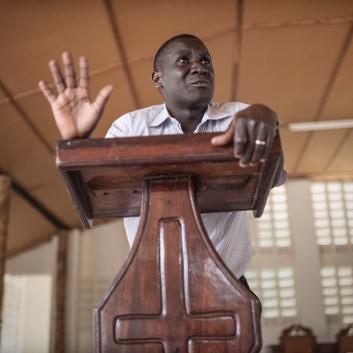
On February 24, Ugandan President Yoweri Museveni signed a law allowing for life sentences for homosexuals. Michael Kawuba is one of the many in the country who supports the measure. He spends much of his free time preaching against what he sees as the evils of homosexuality.

Michael Kawuba is sitting in his church office reflecting on tumescence. “We Ugandans get an erection when we see a beautiful woman,” he says. “Anything else is unnatural.”

During the day, Kawuba works as a financial advisor, but once he is finished, he rejoins the battle against homosexuality. A friendly man of 31, Kawuba is married and has three children — and he is not one to rant. But every second Sunday, he preaches to the Kakumba congregation. “The Bible forbade homosexuality. God rained down fire onto Sodom and Gomorrah” — he continues in this vein for hours at a time, standing behind a wooden pulpit. The sanctuary is spacious with a roof made of palm fronds. A band including guitar, bass and drums players pumps out gospel music while worshippers sing along, sway to the rhythm and stretch their arms heavenward as they call out “praise the Lord!”

On Feb. 24, God would seem to have finally heard their entreaties. That was the day that President Yoweri Museveni signed a law making “aggravated homosexuality” punishable with sentences of up to life in prison. A first draft of the law had even called for the death penalty. Michael Kawuba invited friends over for the event and they watched their head of state sign the new statute. “We cheered like we were watching football,” Kawuba says.

According to one survey, 96 percent of all Ugandans find homosexuality unacceptable and many are in favor of locking away gays, lesbians and transsexuals. Uganda has long been a model country in Africa: Though the regime is authoritarian, the country is stable and economically successful. Now, it has one of the most draconian anti-gay laws on the continent, trailing only Nigeria’s Muslim north, Mauretania, Somalia and Sudan. Now, homosexuality is a punishable offense in 36 of Africa’s 54 countries.

Afraid of Attacks

The international community was horrified: The United States slashed development aid to Uganda, the Europe Union threatened to impose sanctions and the United Nations warned the country to uphold human rights. But the reactions have done little to help the gays and lesbians in Uganda: Many have gone into hiding or fled the country. They believe that a wave of arrests is pending. Most of all, though, they are afraid of attacks from anti-gay activists.

There are thousands of congregations like that of lay-preacher Michael Kawuba. They tend to be small, but are often radical. Many of them, including Kakumba Church, maintain close contacts with evangelicals in the US whose self-proclaimed mission is that of bashing homosexuals. In 2009, for example, the ultra-right-wing activist Scott Lively traveled to Uganda claiming, among other things, that gays are to be blamed for the Holocaust.

The new law, following years of debate, has led to an increase in hate in the country. Though homosexuality has long been forbidden in Uganda, and gays and lesbians were often the target of abuse, nobody was locked away for it. There were even bars and clubs where they could go undisturbed. But that has now changed.

‘No Chance Against a Mob’

Attacks against gays and lesbians now occur on an almost daily basis, with human rights activists counting more than 70 cases since the law was signed. Dennis Wamala’s boyfriend, an actor, decided to stay in France following a theater trip to the country — out of fear. “We aren’t so much afraid of the police,” Wamala says. “When you get arrested, you can get yourself a lawyer. But you don’t have a chance against a mob. Many in Uganda would prefer to see us dead.” He says that the new legislation is a green light for people to take the law into their own hands.

Read more at Der Spiegel