The Cruelest Pregnancy

Frank Bruni

WHAT would Marlise Munoz have made of all of this?

We’ll never know. She can no longer form words. Can no longer form thoughts. It’s arguable that we shouldn’t even be referring to a “she,” to a “her,” because if she’s brain-dead, as her family has consistently said, then she meets the legal criteria for death in all 50 states, and what’s been tethered to machines in a hospital in Fort Worth for the last seven weeks isn’t exactly a mother. It’s an artificially maintained ecosystem, an incubator for a fetus that has somehow been given precedence over all other concerns: the pain of Marlise’s husband and parents; their wishes to put an end to this; their best guess about what her desires would have been; her transformation, without any possibility of her consent, into a mere vessel.

“A host,” her father, Ernest Machado, called her in an interview with Manny Fernandez of The Times. He used equally chilling language to describe her stillness and the rubbery feel of her skin, saying that she reminded him of “a mannequin.”

Ben Wiseman

Is her fate really what we mean when we speak of “valuing life” or “the sanctity of life,” to summon two phrases tossed around too quickly and simplistically? It seems to me that several lives are being devalued in the process, and that while there are no happy outcomes here, there’s also no sense or dignity on the chilling road that this Texas hospital is taking us down.

In late November, Marlise, 33, was found unconscious on the kitchen floor by her husband, Erick. She had apparently suffered a pulmonary embolism. At the hospital, according to Erick’s subsequent statements, it was determined that she was brain-dead, and he requested that she be disconnected from the machines that keep her vital organs functioning. He and she had both worked as paramedics and had discussed such end-of-life decisions, he said, and so he knew that she wouldn’t have wanted any extraordinary measures taken. The woman he loved was gone. It was time to come to bitter terms with that, and to say goodbye.

Hospital officials, supposedly acting on behalf of the state, won’t let him. They went ahead with extraordinary measures, because Marlise was 14 weeks pregnant, and while that fell well within the window when abortion is legal, a Texas law compels hospitals to provide life support for terminally ill patients with fetuses developing inside them.

Read more at The New York Times

Support quality journalism. Subscribe to The New York Times

Law’s Expanded Medicaid Coverage Brings a Surge in Sign-Ups

Sharon Mills, of Welch, W.Va., has a list of ailments that require treatment that she cannot afford. She has been eagerly waiting on the benefits of the Affordable Care Act. Sam Dean for The New York Times

WELCH, W.Va. — Sharon Mills, a disabled nurse, long depended on other people’s kindness to manage her diabetes. She scrounged free samples from doctors’ offices, signed up for drug company discounts and asked for money from her parents and friends. Her church often helped, but last month used its charitable funds to help repair other members’ furnaces.

Ms. Mills, 54, who suffered renal failure last year after having irregular access to medication, said her dependence on others left her feeling helpless and depressed. “I got to the point when I decided I just didn’t want to be here anymore,” she said.

So when a blue slip of paper arrived in the mail this month with a new Medicaid number on it — part of the expanded coverage offered under the Affordable Care Act — Ms. Mills said she felt as if she could breathe again for the first time in years. “The heavy thing that was pressing on me is gone,” she said.

As health care coverage under the new law sputters to life, it is already having a profound effect on the lives of poor Americans. Enrollment in private insurance plans has been sluggish, but sign-ups for Medicaid, the federal insurance program for the poor, have surged in many states. Here in West Virginia, which has some of the shortest life spans and highest poverty rates in the country, the strength of the demand has surprised officials, with more than 75,000 people enrolling in Medicaid.

While many people who have signed up so far for private insurance through the new insurance exchanges had some kind of health care coverage before, recent studies have found, most of the people getting coverage under the Medicaid expansion were previously uninsured. In West Virginia, where the Democratic governor agreed to expand Medicaid eligibility, the number of uninsured people in the state has been reduced by about a third.

America ranks near the bottom of developed countries in health and longevity, and many public health experts believe that improving that ranking will be impossible without paying more attention to poor Americans. It is still an open question whether access to health insurance will improve the health of the disadvantaged in the long run, experts say, but the men and women getting the coverage here say the mere fact of having it has drastically improved their mental health.

Waitresses, fast food workers, security guards and cleaners described feeling intense relief that they are now protected from the punishing medical bills that have punched holes in their family budgets. They spoke in interviews of reclaiming the dignity they had lost over years of being turned away from doctors’ offices because they did not have insurance.

Read more at The New York Times

Kentucky governor sees health law as chance to heal an ailing state

Kentucky Gov. Steve Beshear is overseeing a promising rollout of the healthcare law. Defying bitter GOP opposition, he says it’s medicine the state needs.

FRANKFORT, Ky. — Relations between President Obama and Kentucky Gov. Steve Beshear have not always been friendly. When Obama paid his first presidential visit in May 2011, his fellow Democrat was somewhere else. Later, Beshear lashed out at the administration’s environmental regulators, telling them to “get off our backs.”

But leading one of the nation’s poorest, sickest states, Beshear has improbably overseen one of the most successful rollouts of Obama’s troubled healthcare overhaul and become, deep in his long public career, a hero to Democrats grasping to find a redeeming figure amid the political wreckage.

He’s an unlikely champion, not least because Kentucky’s two U.S. senators are both implacable opponents of the program.

“I knew if I was going to make a huge difference in the health status of Kentucky, it was going to take some kind of transformational tool to do that, and that’s what the Affordable Care Act is for me,” Beshear, white-haired and greyhound-lean, said as he sat behind a big maple desk in his office. “I think we’ve started something here,” he later added, “that a generation from now you’ll see a very different Kentucky than what you see today.”

For now, Kentuckians may feel understandably whiplashed.

While Beshear, serving his second and final term, has become one of the foremost proponents of Obamacare, the state’s senior senator, Republican leader Mitch McConnell, has been an even more visible foe. Facing a tough 2014 reelection fight, he calls the law “a disaster,” “a huge mistake” and “a monstrosity” that “needs to be pulled out root and branch.” The sentiment is seconded by Kentucky’s junior senator, Republican Rand Paul, who was elected in 2010 in a tea party fever born of seething opposition to the president and his healthcare plan.

Read more at the Los Angeles Times

Sometimes ‘Nazi’ Is the Right Word

By ETGAR KERETJAN. 17, 2014

TEL AVIV — “NAZI” is a short word. It has only two syllables, like “rac-ist” or “kill-er.” “Democracy,” on the other hand, is a long word with lots of syllables that is very tiring to say. It may not be as tiring as saying “freedom of expression” or “social justice,” but still, there is something really exhausting about it.

People in Israel use “Nazi” when they want the most vicious curse possible, and it’s usually directed at someone they perceive as belligerent. It could be a cop, a soldier or an elected official who, in their opinion, is acting like a bully.

Such usage is offensive and infuriating. As the son of Holocaust survivors, I find it particularly rankling. This week the Knesset gave preliminary approval to a bill that would criminalize saying “Nazi” under inappropriate circumstances. The government views the word as a weapon of mass destruction no less lethal than an Iranian nuclear bomb, and so it insists on Israel’s basic right to protect itself from the threat.

Many Israelis think that passing a law against a word is stupid and juvenile; others see it as fascist and anti-democratic. Incidentally, saying “fascist” or “anti-democratic” is also seen as insulting and offensive. And I wouldn’t be surprised if someone tried to outlaw those words in the future, too.

Imagine a different state of Israel, one very much like our own: This other Israel would also be sunny, with golden beaches, roadblocks in the territories, targeted killings, and rockets hitting the southern towns. The only difference between this new Israel and the current one would be that in the new Hebrew language that would be spoken there, you could say anything except “Nazi,” “fascist” and “anti-democratic.” Wouldn’t that be a better place to live than our current Israel?

And now that we’re exercising our imaginations, let’s picture yet another new Israel — one where the word “Nazi” is permitted but the government genuinely wants a peace accord and its members do not treat the Palestinians like “shrapnel in your butt” — as our economy minister, Naftali Bennett, recently put it — but rather as neighbors seeking freedom and self-determination.

Read more at The New York Times

Support quality journalism. Subscribe to the The New York Times.

Justice or Peace? Hariri Trial Could Spark Further Unrest in Lebanon

Twenty-two other people died in the attack on Hariri, which took place on Valentine’s Day in 2005. The investigation into the bombing has been extremely political and full of errors.

Proceedings in the case of murdered ex-Lebanese Prime Minister Rafik Hariri are set to being in the Netherlands this week. The trial could cause further unrest in a country that is already on the verge of chaos.

Rarely has there been a case like this one. The crime was both dramatic and brutal, the investigation was plagued by shocking errors and surprising twists. And rarely has a criminal case had such geopolitical significance. On Thursday, the Special Tribunal for Lebanon will begin hearing the case in an unimposing building in the Dutch town of Leidschendam near The Hague. The outcome is uncertain.

Former Lebanese Prime Minister Rafik Hariri was killed in an attack in Beirut almost nine years ago. Twenty-two bodyguards and passersby also lost their lives in the explosion. Six-and-a-half years ago, the United Nations decided to investigate the murder and established the Special Tribunal for Lebanon, also known as the STL. In the intervening years, the tribunal, which is funded by 28 countries, Germany included, has spent more than a quarter-billion dollars in its quest for truth.

Scandals have accompanied the investigation from the very beginning. High-ranking UN deputies have stepped down, for “private reasons.” Others have been duped by dubious witnesses. In Lebanon, there are many who believe the tribunal has a Western bias; in the West, on the other hand, people worry that the UN body has withheld facts that could be uncomfortable for the Arab world.

Scandals have accompanied the investigation from the very beginning. High-ranking UN deputies have stepped down, for “private reasons.” Others have been duped by dubious witnesses. In Lebanon, there are many who believe the tribunal has a Western bias; in the West, on the other hand, people worry that the UN body has withheld facts that could be uncomfortable for the Arab world.

Read more at Der Spiegel

Democracy needs dogged local journalism

By Rachel Maddow, Wednesday, January 15, 7:55 PM

If you type “Shawn Boburg” into your Web browser address bar, a strange thing happens. Boburg is a reporter for The Record newspaper, in Bergen County, N.J. But ShawnBoburg.com sends visitors to The Record’s rival, Newark’s Star-Ledger.

The man who bought the rights to Boburg’s online name — and who presumably engineered the nasty little redirect — is David Wildstein, who last week became the country’s most high-profile political appointee. After his high school classmate Chris Christie was elected governor of New Jersey in 2009, Wildstein was appointed to the Port Authority of New York and New Jersey for a highly paid position that, conveniently, had no job description.

Wildstein, who has since resigned, was held in contempt last week by a state legislature committee for refusing to answer questions about his role in the four-day traffic disaster that gridlocked the town of Fort Lee, N.J., last September.

According to reporting in The Record, Wildstein has made a habit of buying the Web addresses of people who cross his path in New Jersey politics — including the Democratic candidate for lieutenant governor in 2012 and a mid-level official at the Federal Aviation Administration who helped forge a firefighting agreement with the Port Authority that Wildstein disliked. While he was at the Port Authority, Wildstein bought the online names of New York Gov. Andrew Cuomo’s top appointees to the agency, including Executive Director Pat Foye, who sounded the alarm about the Fort Lee scheme. Wildstein’s redirect on PatFoye.com sends visitors to the Web site of the New York Yankees.

It’s one thing for public officials to subject one another to that kind of low-level, neener-neener harassment, but in New Jersey, reporters have been targeted too. Wildstein snatched up and redirected ShawnBoburg.com after Boburg wrote a (not terribly unflattering) profile of the intensely private Wildstein last year and an article on Christie’s patronage hiring.

The long knives that New Jersey politicians have out for each other was the stuff of legend (and excellent TV drama) well before the bridge scandal. But the documents released thus far show how much the governor’s staff and appointees hated not only rival public officials but also the press.

Read more at The Washington Post

Support quality journalism. Subscribe to the The Washington Post

What Your Cat Is Thinking

Cat owners speak to their cats, attribute many complex emotions to them and chide them when they bring small dead rodents into the house. People don’t pause to ask what is going on in the mind of the cat during these interactions, and perhaps that’s just as well. The role of a pet is to be relentlessly anthropomorphized.

But for any who may wonder what their feline companions are really thinking, “Cat Sense,” by John Bradshaw, provides the best answers that science can give for the time being.

Dr. Bradshaw, a biologist at the University of Bristol in England, has studied animal behavior and cats in particular for the last 30 years. The starting point of his analysis is that cats are still essentially wild animals. They wandered into our encampments when we first started to store harvested grains, which attracted mice.

Unlike dogs, which have been greatly changed by domestication from their wolf ancestor, cats have almost never been bred for a purpose. They caught mice well enough, and their kittens made attractive companions. So cats have stayed much the same, with any evolutionary trend toward domestication constrained by frequent interbreeding with wild cats.

To this day the population of domestic cats is maintained in a semiferal state by the practice of neutering. About the only males available for domestic female cats to breed with are the wildest and least people-friendly tomcats who have escaped into the feral cat population. Some 85 percent of all cat matings, Dr. Bradshaw writes, are arranged by cats themselves, meaning with feral cats.

Read more at The New york Times

The War on Poverty

http://www.youtube.com/watch?v=oWvHr-0BXhc&feature=plcp
Syrian refugees in Lebanon (image via Wikipedia Commons)

Poor people are being murdered, beheaded, raped and terrorized by well armed gangs of mostly young men in Syria and in Mexico. What do these places and people have in common? Almost nothing. Is it about religion? Obviously not. I will bet you that most Mexican drug cartel members consider themselves Christians and have Christian symbols tattooed on their bodies. Muslims and Buddhists are no different, and depending upon where you are in the world, a Buddhist is as likely as a Muslim or a Christian to be involved in the murder or persecution of another person simply because they are of another ethnic or religious identification. The common denominator here is poverty. That’s what it is really all about. These people have no hope, no chance at a good education, a good job, or a decent life. They are hopelessly ignorant. Violence and criminality are their only alternatives. Recognizing and understanding this simple fact, we can see that the real war is of the wealthy against the poor, and that this war is an international war that knows no borders and no boundaries. By understanding and joining forces with ordinary people around the world who are also struggling for existence, we take the just fight to a higher level. When we help a poor person in Egypt, we help ourselves. When we help the poorest among us, we help ourselves. Sounds like something Jesus would have said, doesn’t it? That’s because he did. “What you do unto the least of my brothers…”

© 2014 by Paul Kennedy

I Wear the Badge of Socialist With Honor

The full text of the new Seattle city council member’s inauguration speech.

kshama_sawant_inauguration_ap_img

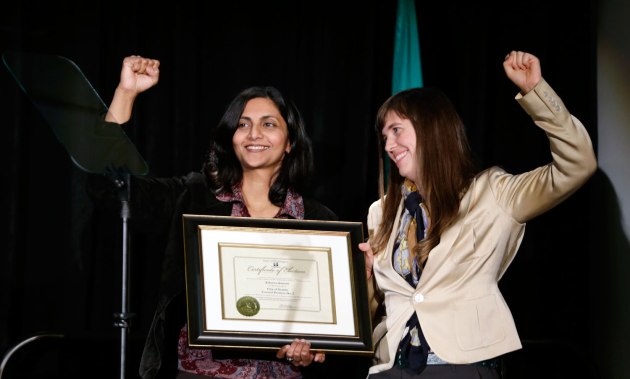
New Seattle Council member Kshama Sawant, left, stands with Nicole Grant, who assisted in a ceremonial swearing-in. (AP Photo/Elaine Thompson)

Editor’s note: At a ceremonial swearing-in on Monday, Kshama Sawant became Seattle’s first socialist city council member in almost a century. The full text of her inauguration speech is below.

My brothers and sisters,

Thank you for your presence here today.

This city has made glittering fortunes for the super wealthy and for the major corporations that dominate Seattle’s landscape. At the same time, the lives of working people, the unemployed and the poor grow more difficult by the day. The cost of housing skyrockets, and education and healthcare become inaccessible.

This is not unique to Seattle. Shamefully, in this, the richest country in human history, fifty million of our people—one in six—live in poverty. Around the world, billions do not have access to clean water and basic sanitation and children die every day from malnutrition.

This is the reality of international capitalism. This is the product of the gigantic casino of speculation created by the highway robbers on Wall Street. In this system the market is God, and everything is sacrificed on the altar of profit. Capitalism has failed the 99%.

Despite recent talk of economic growth, it has only been a recovery for the richest 1%, while the rest of us are falling ever farther behind.

The Nation

The Invisible Psychopath

By the time you identify the charming sociopath, it may already be too late.

The word “psychopath” gets thrown around a lot, but in psychiatry it has a specific meaning. Psychopaths are aggressively narcissistic and impulsive and feel a relentless urge for sensation-seeking. They lack empathy and compulsively manipulate others through bullying or deceit. They believe that they are exempt from the rules and show a marked predilection for lying, even when it is not advantageous for them.

Earlier this year Harvard Medical School psychiatrist Ronald Schouten published a book, Almost a Psychopath, in which he and co-author Jim Silver describe the ways that people can exhibit quite a few of the symptoms of psychopathy without satisfying the full diagnostic criteria. Such people can be highly deceptive, manipulative, callous, and self-serving, and yet manage to maintain a façade on normality. One of Schouten’s goals in writing the book is to point out how such a person’s colleagues, friends and partners might not suspect for years that they have a profound psychological disturbance.

This, for me, is perhaps the most disturbing thing about psychopathy: its invisibility. With the benefit of hindsight, I can see that a number of people have crossed my paths who at first seemed delightful and charming, but who wound up leaving a trail of wreckage—people who I now recognize were clearly psychopaths, or at least “almost psychopaths,” as Schouten styles them. Once burned, twice shy, you would hope; but no, having been tormented by one or two, I still managed to subsequently fall into others’ charming clutches.

Read more at Psychology Today