I’ve been reluctant to use the “f” word to describe Donald Trump because it’s especially harsh, and it’s too often used carelessly.
But Trump has finally reached a point where parallels between his presidential campaign and the fascists of the first half of the 20th century – lurid figures such as Benito Mussolini, Joseph Stalin, Adolf Hitler, Oswald Mosley, and Francisco Franco – are too evident to overlook.
It’s not just that Trump recently quoted Mussolini (he now calls that tweet inadvertent) or that he’s begun inviting followers at his rallies to raise their right hands in a manner chillingly similar to the Nazi “Heil” solute (he dismisses such comparison as “ridiculous.”)
The parallels go deeper.
As did the early twentieth-century fascists, Trump is focusing his campaign on the angers of white working people who have been losing economic ground for years, and who are easy prey for demagogues seeking to build their own power by scapegoating others.
Trump’s incendiary verbal attacks on Mexican immigrants and Muslims – even his reluctance to distance himself from David Duke and the Ku Klux Klan – follow the older fascist script.
That older generation of fascists didn’t bother with policy prescriptions or logical argument, either. They presented themselves as strongmen whose personal power would remedy all ills.
They created around themselves cults of personality in which they took on the trappings of strength, confidence, and invulnerability – all of which served as substitutes for rational argument or thought.
The media’s telescopic gaze following the death of Supreme Court Justice Scalia last week was, true to form, pointing in exactly the wrong direction. Scalia’s death prompted a breathless flood of pundit analysis focused on whether the Republican Party is violating Senate protocol or the Constitution itself by refusing to vote on the nomination of a new Supreme Court Justice in President Obama’s final year in office. Much chatter was devoted to rehashing the deliberate obstruction this president has had to cope with. While undoubtedly true, this misses the forest for the trees. It doesn’t matter so much what Republicans’ “excuse” is—or even whether it violates the clear intent of the Constitution—it does.
What really matters is why they’re doing it, and who it serves. The answer to that question leads straight to their donor base. Although it scarcely bears repeating, the Republican Senate and (to an even greater extent) the Republican House of Representatives now exists to serve the economic interests of a tiny group of very, very wealthy people, people who now stand to either gain or lose hundreds of millions, even billions of dollars spent complying with environmental, finance and labor laws and regulations, depending on who replaces Scalia. That is what this fight is all about. For the GOP and the billionaires who pull their strings, much ballyhooed rhetoric about abortion, affirmative action, union rights and voting rights are all subsidiary to this main event.
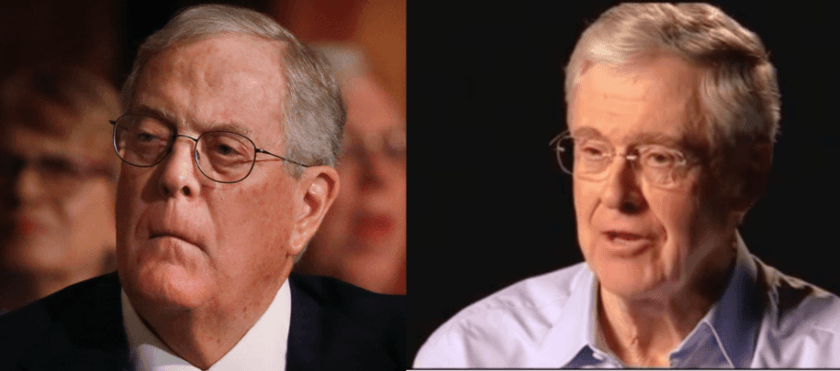
The two most prominent members of this tiny group of people are Charles and David Koch:
“In this election cycle… the Kochs have publicly stated that they and their compatriots will spend $889 million, more than either the Republican or Democratic parties spent last time around. According to a recent analysis in Politico, their privatized political network is backed by a group of several hundred extremely rich fellow donors who often meet at off-the-record conclaves organized by the Kochs at desert resorts. It has at least 1,200 full-time staffers in 107 offices nationwide, or three and a half times as many as the Republican National Committee. They may be the most important unelected political figures in American history.”
The future of American democracy depends on our response to the legacy of Martin Luther King, Jr. And that legacy is not just about defending civil rights; it’s also about fighting to fix our rigged economy, which yields grotesque wealth inequality; our narcissistic culture, which unleashes obscene greed; our market-driven media, which thrives on xenophobic entertainment; and our militaristic prowess, which promotes hawkish policies around the world. The fundamental aim of black voters—and any voters with a deep moral concern for our public interest and common good—should be to put a smile on Martin’s face from the grave.
The conventional wisdom holds that, in the Democratic primary, Hillary Clinton is the candidate who will win over African-American voters—that her rival, Bernie Sanders, performed well in Iowa and won New Hampshire on account of those states’ disproportionate whiteness, and that Clinton’s odds are better in the upcoming contests in South Carolina and Nevada, two highly diverse states.
But in fact, when it comes to advancing Dr. King’s legacy, a vote for Clinton not only falls far short of the mark; it prevents us from giving new life to King’s legacy. Instead, it is Sanders who has championed that legacy in word and in deed for 50 years. This election is not a mere campaign; it is a crusade to resurrect democracy—King-style—in our time. In 2016, Sanders is the one leading that crusade.
Clinton has touted the fact that, in 1962, she met King after seeing him speak, an experience she says allowed her to appreciate King’s “moral clarity.” Yet two years later, as a high schooler, Clinton campaigned vigorously for Barry Goldwater—a figure King called “morally indefensible” owing to his staunch opposition to the Civil Rights Act of 1964. And she attended the Republican convention in 1968! Meanwhile, at this same moment in history, Sanders was getting arrested for protesting segregation in Chicago and marching in Washington with none other than King itself. That’s real moral clarity.
Tea Party rebels are exposing the deep rifts between country-club elites and social-issue hard-liners.
Speaker of the House Rep. John Boehner, R-Ohio, walks away from the microphone during a news conference after a House GOP meeting on Capitol Hill on Tuesday, Oct. 15, 2013 in Washington. The federal government remains partially shut down and faces a first-ever default between Oct. 17 and the end of the month. (AP Photo/ Evan Vucci)
By William Greider
Fresh chatter among Washington insiders is not about whether the Republican Party will win in 2016 but whether it will survive. Donald Trump—the fear that he might actually become the GOP nominee—is the ultimate nightmare. Some gleeful Democrats are rooting (sotto voce) for the Donald, though many expect he will self-destruct.
Nevertheless, Republicans face a larger problem. The GOP finds itself trapped in a marriage that has not only gone bad but is coming apart in full public view. After five decades of shrewd strategy, the Republican coalition Richard Nixon put together in 1968—welcoming the segregationist white South into the Party of Lincoln—is now devouring itself in ugly, spiteful recriminations.
The abrupt resignation of House Speaker John Boehner was his capitulation to this new reality. His downfall was loudly cheered by many of his own troops—the angry right-wingers in the House who have turned upon the party establishment. Chaos followed. The discontented accuse party leaders of weakness and betraying their promises to the loyal rank and file.
At the heart of this intramural conflict is the fact that society has changed dramatically in recent decades, but the GOP has refused to change with it. Americans are rapidly shifting toward more tolerant understandings of personal behavior and social values, but the Republican Party sticks with retrograde social taboos and hard-edged prejudices about race, gender, sexual freedom, immigration, and religion. Plus, it wants to do away with big government (or so it claims).
The party establishment, including business and financial leaders, seems to realize that Republicans need to moderate their outdated posture on social issues. But they can’t persuade their own base—especially Republicans in the white South—to change. The longer the GOP holds out, the more likely it is to be damaged by the nation’s changing demographics—the swelling impact of Latinos and foreign-born citizens, and the flowering influence of millennials, the 18-to-30-year-olds who are more liberal and tolerant than their elders.
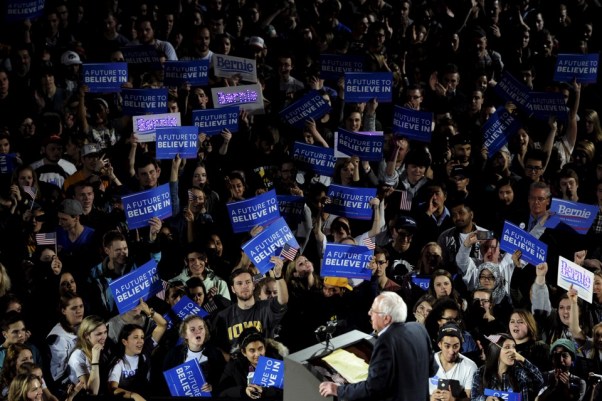
The crowd cheers as U.S. Democratic presidential candidate Bernie Sanders speaks at a campaign rally and concert at the University of Iowa in Iowa City, Iowa January 30, 2016. REUTERS/Mark Kauzlarich – RTX24R4K
By Molly Ball
MASON CITY, Iowa—They say this Democratic candidate for president—the one running against Hillary Clinton—can’t possibly win a national election. But Susan Sarandon, the Oscar-winning liberal actress, was here to remind the people of this small Iowa town that they’d heard that line before.
“Last time, the people of Iowa didn’t listen to the machine,” Sarandon said, russet-colored hair framing her famous face as she looked out on the Music Man Square, an indoor fake streetscape commemorating the birthplace of the famous musical’s author. “They said he was unelectable—a black man with a funny last name. Well, here we are again, facing the machine.”
In Sarandon’s telling, the unkempt socialist senator from Vermont is the Barack Obama of 2016. To many Sanders supporters, Obama’s successes—from the Iowa caucuses to tough [sic] two national elections—render moot the argument Clinton is once again making that she’s the only one who can win.
“I think he’s more radical than the other people we’ve had, and I like that about him,” Taylor Raska, a 28-year-old bartender with a nose ring, mismatched earrings, and lines of cursive writing tattooed on her arms, told me. An ardent environmentalist who’s tired of politicians, Raska believes the old system must be smashed for a new order to take its place. “Everything’s going to change!” she said, savoring the beautiful thought. “We are in this amazing period—it’s awesome to be a part of. Everything is changing!”
People who feel like they’re struggling against long odds are fed up with the solutions that have been tried. There was a plant in Mason City that made filters, but it went to Mexico some years ago, a 62-year-old named Sue McKee told me. She teaches the GED class that the laid-off men in their 40s, 50s, and 60s come to, desperate to work again and needing a high-school diploma for the first time in their lives. “We shouldn’t make it so hard for people,” she said. On Monday, she planned to register with the Democratic Party and caucus for the first time in her life.
From Therapists Confirm Trump’s Narcissistic Personality Disorder
Concerned therapists break silence to warn the public
Republican presidential candidate Donald Trump
By Randi Kreger
A few mental health professionals were concerned about my last blog, “Does Donald Trump Have Narcissistic Personality Disorder? Their concern was that American Psychiatric Association’s guidelines warn clinicians they should not diagnose public figures.
I’ve pointed out that I am not a therapist but one [of] many journalists who have explored whether Trump has a personality disorder characterized by grandiosity; an expectation that others will recognize one’s superiority; a lack of empathy, lack of truthfulness, and the tendency to degrade others. If clinicians cannot explore these things, thank goodness that journalists can.
However, his continued popularity has some concerned prominent clinicians ignoring the “Goldwater rule,” which declares it unethical for psychiatrists to comment on an individual’s mental state without examining him personally and having the patient’s consent to make such comments.
“That mental-health professionals are even willing to talk about Trump in the first place may attest to their deep concern about a Trump presidency” writes Henry Alford in a November 11 edition of Vanity Fair. His psychological profile Donald Trump Actually a Narcissist? Therapists Weigh In! (link is external)quotes a variety of clinicians who are confident that the billionaire’s high profile and documented history of grandiose behavior makes the diagnosis obvious.
Rauner makes me long for Blagojevich, who tried to sell Obama’s senate seat, or Quinn, one of the most incompetent governors in Illinois history. Hell, I’d take Ryan over Rauner, given the choice. Illinois politics suck more than at anytime I can remember, in the 61 years I have lived in Illinois (all my life!). Personally, I want Rauner to be impeached or otherwise forced from office.
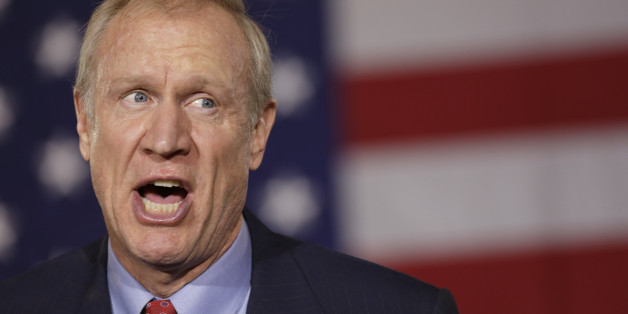
Last fall, Illinois GOP candidate Bruce Rauner spent $63.9 million — $27.3 million of his own money — to buy the right to occupy the Illinois Governor’s mansion.
Now that he’s in office his first moves have confirmed that he is the poster boy for the War on the Middle Class.
Rauner is a hybrid of the worst traits of Mitt Romney and Wisconsin Governor Scott Walker. In fact, you could say he personally embodies the reason why — even…
With integrity and principle, the Vermont senator is calling Americans to a political revolution.
Senator Bernie Sanders greets supporters at a campaign rally outside the New Hampshire State House on November 5, 2015. Reuters/Brian Snyder
By the Editors of The Nation
A year ago, concerned that ordinary citizens would be locked out of the presidential nominating process, The Nation argued that a vigorously contested primary would be good for the candidates, for the Democratic Party, and for democracy. Two months later, Senator Bernie Sanders formally launched a campaign that has already transformed the politics of the 2016 presidential race. Galvanized by his demands for economic and social justice, hundreds of thousands of Americans have packed his rallies, and over 1 million small donors have helped his campaign shatter fund-raising records while breaking the stranglehold of corporate money. Sanders’s clarion call for fundamental reform—single-payer healthcare, tuition-free college, a $15-an-hour minimum wage, the breaking up of the big banks, ensuring that the rich pay their fair share of taxes—have inspired working people across the country. His bold response to the climate crisis has attracted legions of young voters, and his foreign policy, which emphasizes diplomacy over regime change, speaks powerfully to war-weary citizens. Most important, Sanders has used his insurgent campaign to tell Americans the truth about the challenges that confront us. He has summoned the people to a “political revolution,” arguing that the changes our country so desperately needs can only happen when we wrest our democracy from the corrupt grip of Wall Street bankers and billionaires.
Americans are fed up and fighting back. Seen in isolation, the Fight for $15, Black Lives Matter, the climate-justice movement, the immigrant-rights movement, the campaign for a financial-transactions tax, and the renewed push for single-payer healthcare may seem like unrelated causes. Taken together, they form a rising chorus of outrage over a government that caters to the demands of the super-wealthy, while failing to meet the needs of the many. They share a fury at a politics captured by special interests and big money, where pervasive corruption mocks the very notion of democracy.
In Bernie Sanders, these movements for greater equality and justice have found an ally and a champion. In contrast to the right-wing demagogues who exploit these crises to foment division, the Vermont senator has reached into a proud democratic-socialist tradition to revive the simple but potent notion of solidarity. We must turn to each other, not on each other, Sanders says, and unite to change the corrupted politics that robs us all. His campaign’s funding reflects this commitment, spurning the support of corporate super-PACS and relying instead on millions of grassroots donors. Thanks to his campaign’s integrity, Sanders alone has the potential to unite the movements emerging across the country into one loud, irresistible demand for systemic political change.
The progressive group says it will “mobilize aggressively” for the Vermonter in Iowa and New Hampshire.
Democratic presidential candidate Bernie Sanders, and wife, Jane, smile as the crowd cheers at a town hall on January 9, 2016, in Des Moines, Iowa. (AP Photo / Jae C. Hong)
By John Nichols
With polls suggesting that the Democratic race is getting tighter in the first-caucus state of Iowa and the first-primary state of New Hampshire, Bernie Sanders has won the support of one of the nation’s most prominent progressive networks.
The activist group MoveOn endorsed the Vermont senator after 78.6 percent of its members backed him last week in an online “primary”—which drew 340,665 votes, a greater total than is likely to participate in the February contests in Iowa and New Hampshire.
“This is a massive vote in favor of Bernie Sanders, showing that grassroots progressives across the country are excited and inspired by his message and track record of standing up to big money and corporate interests to reclaim our democracy for the American people,” MoveOn.org Political Action Executive Director Ilya Sheyman said Tuesday. “MoveOn members are feeling the Bern. We will mobilize aggressively to add our collective people power to the growing movement behind the Sanders campaign, starting with a focus on voter turnout in Iowa and New Hampshire.”








 The Progressive Democrat
You must be logged in to post a comment.