The “middle class” myth: Here’s why wages are really so low today

(Credit: AP/Darron Cummings)

Let me tell you the story of an “unskilled” worker in America who lived better than most of today’s college graduates. In the winter of 1965, Rob Stanley graduated from Chicago Vocational High School, on the city’s Far South Side. Pay rent, his father told him, or get out of the house. So Stanley walked over to Interlake Steel, where he was immediately hired to shovel taconite into the blast furnace on the midnight shift. It was the crummiest job in the mill, mindless grunt work, but it paid $2.32 an hour — enough for an apartment and a car. That was enough for Stanley, whose main ambition was playing football with the local sandlot all-stars, the Bonivirs.

Stanley’s wages would be the equivalent of $17.17 today — more than the “Fight For 15” movement is demanding for fast-food workers. Stanley’s job was more difficult, more dangerous and more unpleasant than working the fryer at KFC (the blast furnace could heat up to 2,000 degrees). According to the laws of the free market, though, none of that is supposed to matter. All that is supposed to matter is how many people are capable of doing your job. And anyone with two arms could shovel taconite. It required even less skill than preparing dozens of finger lickin’ good menu items, or keeping straight the orders of 10 customers waiting at the counter. Shovelers didn’t need to speak English. In the early days of the steel industry, the job was often assigned to immigrants off the boat from Poland or Bohemia.

“You’d just sort of go on automatic pilot, shoveling ore balls all night,” is how Stanley remembers the work.

So why did Rob Stanley, an unskilled high school graduate, live so much better than someone with similar qualifications could even dream of today? Because the workers at Interlake Steel were represented by the United Steelworkers of America, who demanded a decent salary for all jobs. The workers at KFC are represented by nobody but themselves, so they have to accept a wage a few cents above what Congress has decided is criminal.

The argument given against paying a living wage in fast-food restaurants is that workers are paid according to their skills, and if the teenager cleaning the grease trap wants more money, he should get an education. Like most conservative arguments, it makes sense logically, but has little connection to economic reality. Workers are not simply paid according to their skills, they’re paid according to what they can negotiate with their employers. And in an era when only 6 percent of private-sector workers belong to a union, and when going on strike is almost certain to result in losing your job, low-skill workers have no negotiating power whatsoever.

Read more at Salon

The incredible shrinking deficit

There are still quite a few politicians who claim, just a matter of course, that in the Obama era, the United States runs “a trillion-dollar deficit every year.” It’s clearly time for them to update their talking points.

Closing the books on a fiscal year in which the federal budget deficit fell more sharply than in any year since the end of World War II, the Treasury Department reported on Thursday that the deficit for 2013 dropped to $680 billion, from about $1.1 trillion the previous year.

In nominal terms, that is the smallest deficit since 2008, and signals the end of a five-year stretch beginning with the onset of the recession when the country’s fiscal gap came in at more than $1 trillion each year. As a share of the nation’s economy, the budget deficit fell to about 4.1 percent, from a high of more than 10 percent during the depths of the Great Recession.

The sharp reduction in the deficit last year was boosted in large part by increased government revenue. At the start of the year, the wealthiest taxpayers began paying slightly higher taxes – a policy Republicans said would slow the economy and cause lower federal receipts. We now know GOP policymakers had it backwards: “The Treasury said revenue climbed $324 billion, to $2.8 trillion, from 2012 to 2013. That is growth of around 12.9 percent, reflecting both higher income tax rates and the strengthening economy.”

But congressional Republicans – the folks who had no qualms about rising deficits during the Bush/Cheney era – continue to insist deficit reduction must take priority over pressing national needs. Yesterday, GOP senators went so far as to block a bill on expanded veterans’ benefits, partly out of fears the proposal might increase the deficit a little.

Read more at The MaddowBlog

“Everyone is entitled to his own opinion, but not to his own facts.”
– United States Senator Daniel Patrick Moynihan

The Magical World Where McDonald’s Pays $15 an Hour? It’s Australia

Even in countries with a high minimum wage, the golden arches manage to turn a profit. Here’s how.

Last week, fast-food workers around the United States yet again walked off the job to protest their low pay and demand a wage hike to $15 an hour, about double what many of them earn today. In doing so, they added another symbolic chapter to an eight-month-old campaign of one-day strikes that, so far, has yielded lots of news coverage, but not much in terms of tangible results.

So there’s a certain irony that in Australia, where the minimum wage for full-time adult workers already comes out to about $14.50 an hour, McDonald’s staffers were busy scoring an actual raise. On July 24, the country’s Fair Work Commission approved a new labor agreement between the company and its employees guaranteeing them up to a 15 percent pay increase by 2017.

And here’s the kicker: Many Australian McDonald’s workers were already making more than the minimum to begin with.

The land down under is, of course, not the only high-wage country in the world where McDonald’s does lucrative business. The company actually earns more revenue out of Europe than than it does from the United States. France, with its roughly $12.00 hourly minimum, has more than 1,200 locations. (Australia has about 900).

So how exactly do McDonald’s and other chains manage to turn a profit abroad while paying an hourly wage their American workers can only fantasize about while picketing? Part of the answer, as you might expect, boils down to higher prices. Academic estimates have suggested that, worldwide, worker pay accounts for at least 45 percent of a Big Mac’s cost. In the United States, industry analysts tend to peg the figure a bit lower—labor might make up anywhere from about a quarter of all expenses at your average franchise to about a third.* But generally speaking, in countries where pay is higher, so is the cost of two all-beef patties, as shown in the chart below by Princeton economist Orley Ashenfelter. Note Western Europe way out in the upper-right hand corner, with its high McWages and high Big Mac prices.

Read more at The Atlantic

Too many of America’s working poor have become victims of a bizarre kind of socioeconomic Stockholm Syndrome. I’m talking about poor people who vote the interests of rich people. They’re like dogs begging for scraps from the table of a master who has no intention of sharing anything. But I’m being unfair to dog owners. Most dog owners treat their pets better than some of America’s wealthiest treat their fellow citizens.

Sen. Elizabeth Warren Proposes Replacing Payday Lenders With the Post Office

Senator Elizabeth Warren (AP Photo/Jacquelyn Martin)

The Postal Service (USPS) could spare the most economically vulnerable Americans from dealing with predatory financial companies under a proposal endorsed over the weekend by Sen. Elizabeth Warren (D-MA).

“USPS could partner with banks to make a critical difference for millions of Americans who don’t have basic banking services because there are almost no banks or bank branches in their neighborhoods,” Warren wrote in a Huffington Post op-ed on Saturday. The op-ed picked up on a report from the USPS’s Inspector General that proposed using the agency’s extensive physical infrastructure to extend basics like debit cards and small-dollar loans to the same communities that the banking industry has generally ignored. The report found that 68 million Americans don’t have bank accounts and spent $89 billion in 2012 on interest and fees for the kinds of basic financial services that USPS could begin offering. The average un-banked household spent more than $2,400, or about 10 percent of its income, just to access its own money through things like check cashing and payday lending stores. USPS would generate savings for those families and revenue for itself by stepping in to replace those non-bank financial services companies.

Those companies are among the most predatory actors in the money business. Payday loans with annual interest rates well north of 100 percent suck paying $520 to borrow $375. After decades of operating in a regulatory blind spot and ducking state-level reforms, the payday lending business now faces a crackdown from the Consumer Financial Protection Bureau. The threat of new rules for short-term cash loans in general has caused traditional banks to stop offering deposit-advance loans with similar features.

Read more at ThinkProgress Link via Moyers and Company

Elizabeth Warren Comes Down Hard Against Global Warming, Separates Herself From Hillary Clinton On Climate Change

United States Senator Elizabeth Warren
By Consumer Financial Protection Bureau (Community Banks Roundtable) [Public domain], via Wikimedia Commons

On Friday, December 20th, Democratic U.S. Senator Elizabeth Warren finally separated herself clearly from former U.S. Secretary of State Hillary Clinton, regarding the issue of climate change and global warming. Here is the story:TransCanada Corporation wants to build the Keystone XL Pipeline to carry oil from Alberta Canada’s tar sands to two refineries owned by Koch Industries near the Texas Gulf Coast, for export to Europe; and Hillary Clinton has helped to make that happen, but Elizabeth Warren has now taken the opposite side.

Secretary of State Clinton, whose friend and former staffer Paul Elliot is a lobbyist for TransCanada, had worked behind the scenes to ease the way for commercial exploitation of this, the world’s highest-carbon-emitting oil, 53% of which oil is owned by America’s Koch Brothers. (Koch Industries owns 63% of the tar sands, and the Koch brothers own 86% of Koch Industries; Elaine Marshall, who is the widow of the son of the deceased Koch partner J. Howard Marshall, owns the remaining 14% of Koch Iindustries.)

David Goldwyn, who “served as Secretary of State Hillary Clinton’s Special Envoy and Coordinator for International Energy Affairs,” is yet another lobbyist for TransCanada. So, TransCanada has two of Hillary’s friends working for them. Misters Elliot and Goldwyn thus worked intimately with Hillary’s people to guide them on selecting a petroleum industry contractor (not an environmental firm, much less any governmental agency) to prepare the required environmental impact statement for this proposed pipeline.

Hillary Clinton as the Secretary of State had already displayed a record of carrying out the policies that were being promoted by her lobbyist friends, when she did everything possible, early in President Obama’s first term, to support U.S. funding for the fascist junta in Honduras that perpetrated a coup d’etat on 28 June 2009 overthrowing that nation’s popular progressive democratically elected President, and who then installed their own regime, and promptly placed their country into a continuing violent terror that caused Honduras ever since to be the nation with the highest murder rate in the world. Hillary’s lobbyist friend in that particular matter was Lanny Davis, who also is an occasional Fox News contributor.

Secretary Clinton’s State Department thus allowed the environmental impact statement on the proposed Keystone XL Pipeline to be performed by a petroleum industry contractor that was chosen by the company that was proposing to build and own the pipeline, TransCanada. That contractor had no climatologist, and their resulting report failed even at its basic job of estimating the number of degrees by which the Earth’s climate would be additionally heated if this pipeline is built and operated. Their report ignored that question, and instead evaluated the impact that climate change would have on the pipeline, which was estimated to be none.

President Obama himself is now trying to force the European Union to relax their anti-global-warming regulations so as to permit them to import the Kochs’ dirty oil. His agent in this effort is his new U.S. Trade Representative, Michael Froman, from Wall Street.

But on December 20th, Senator Warren signed onto a letter criticizing the Obama Administration’s apparent effort to force the European Union to agree to purchase this oil. As the Huffington Post’s Kate Sheppard reported, “Six senators and 16 House members, all Democrats, wrote a letter to Froman on Friday asking him to elaborate on his position on the matter. ‘If these reports are accurate, USTR’s [the U.S. Trade Representative’s] actions could undercut the EU’s commendable goal of reducing greenhouse gas emissions in its transportation sectors,” these 22 Democratic lawmakers wrote.

Read more at the Huffington Post

Libertarianism is Very Strange

John Locke 1631-1704 (Image from the Library of Congress – public domain) Wikimedia Commons.

Libertarianism is on the rise, thanks in good measure to many newly politicized techies who have married their live-and-let-live views about lifestyle to leave-me-alone views about taxes and government.I viscerally understand the libertarian mystique, but, outside the fantasy novels of Ayn Rand and Robert Heinlein, libertarianism does not make much anthropological or historical sense. As a philosophy, it may; one can build a coherent moral system from almost any starting point, be it God’s breath upon the waters; the first self-replicating, “selfish” gene; or autonomous individuals signing a social contract. And versions of libertarianism have a fierce logical consistency. Robert Nozick’s starting point is the “fact of our separate existences”; “there is no social entity . . . . there are only individual people.” Charles Murray proclaims, “Freedom is first of all our birthright.” America’s founding revolutionists, inhaling the earliest wafts of libertarianism in the 1700s, declared that we are created with “unalienable rights”; that is, people cannot sell themselves into slavery even if they want to, so fundamental is the independence of the individual.

Great ideas, to be sure, but historically odd ones. Clifford Geertz pointed out that “the Western conception of the person as a bounded, unique . . . center of awareness, emotion, judgment, and action . . . is, however incorrigible it may seem to us, a rather peculiar idea within the context of the world’s cultures.” For most of history, including Philadelphia, 1776, more humans were effectively property than free. Children, youth, women, slaves, and servants belonged to patriarchs; many patriarchs were themselves serfs to chiefs and lords. And selling oneself into slavery was routine for the poor in many societies. Most world cultures have treated the individual as a limb of the household, lineage, or tribe. We moderns abhor the idea of punishing the brother or child of a wrongdoer, but in many cultures collective punishment makes perfect sense, for each person is just part of the whole.

What difference does this history and anthropology make to libertarian arguments about the good life? Plenty. If libertarians would move real-world policy in their direction, then their premises about humans and human society should be at least remotely plausible; we are not playing SimCity here. Instead, libertarian premises arise from a worldview that was strange at its origin and is strange now, after the global triumph of liberalism.

Read more at the Boston Review

Support quality journalism. Subscribe to the Boston Review.

Republican Congressional Candidate Touts Progressive Minimum Wage Fix

GOP nominee in FL-13 David Jolly CREDIT: AP

An unlikely advocate for one of the most progressive minimum wage proposals emerged last week: Republican congressional candidate David Jolly.

Democratic nominee Alex Sink supports raising the minimum wage to $10.10, as is currently being considered in Congress, while Jolly opposes it. However, in explaining his position to the Tribune, Jolly actually advocated another progressive proposal: indexing the minimum wage so it automatically increases every year.

“Minimum wage should be indexed to inflation or subject to a cost-of-living adjustment like any other federal income program,” Jolly said. “That means some years it may go up, other years it may stay static. Barack Obama is not an economist, neither is the Congress.”

The purchasing power of the minimum wage has significantly lagged the rate of inflation over the past four decades. In 1968, the federal minimum wage was $1.60 per hour. Had it kept up with inflation since then, it would currently be set at $10.50, 45 percent higher than its current rate of $7.25.

In addition, if Jolly preferred tying the minimum wage to increases in worker productivity, it would currently be $18.30 per hour, according to a study from the Economic Policy Institute.

Indexing the minimum wage is a strongly progressive proposal because it would give low-income workers a raise every year without having to rely on Congress, which has only voted for an increase once in the last decade.

Read more at ThinkProgress

Support quality journalism. Subscribe to ThinkProgress

Marx Is Back

The global working class is starting to unite — and that’s a good thing.


The inscription on Karl Marx’s tombstone in London’s Highgate Cemetery reads, “Workers of all lands, unite.” Of course, it hasn’t quite ended up that way. As much buzz as the global Occupy movement managed to produce in a few short months, the silence is deafening now. And it’s not often that you hear of shop workers in Detroit making common cause with their Chinese brethren in Dalian to stick it to the boss man. Indeed, as global multinational companies have eaten away at labor’s bargaining power, the factory workers of the rich world have become some of the least keen on helping out their fellow wage laborers in poor countries. But there’s a school of thought — and no, it’s not just from the few remaining Trotskyite professors at the New School — that envisions a type of global class politics making a comeback. If so, it might be time for global elites to start trembling. Sure, it doesn’t sound quite as threatening as the original call to arms, but a new specter may soon be haunting the world’s 1 percent: middle-class activism.

Karl Marx saw an apocalyptic logic to the class struggle. The battle of the vast mass against a small plutocracy had an inevitable conclusion: Workers 1, Rich Guys 0. Marx argued that the revolutionary proletarian impulse was also a fundamentally global one — that working classes would be united across countries and oceans by their shared experience of crushing poverty and the soullessness of factory life. At the time Marx was writing, the idea that poor people were pretty similar across countries — or at least would be soon — was eminently reasonable. According to World Bank economist Branko Milanovic, when The Communist Manifesto was written in 1848, most income inequality at the global level was driven by class differences within countries. Although some countries were clearly richer than others, what counted as an income to make a man rich or condemn him to poverty in England would have translated pretty neatly to France, the United States, even Argentina.

But as the Industrial Revolution gained steam, that parity changed dramatically over the next century — one reason Marx’s prediction of a global proletarian revolution turned out to be so wrong. Just a few years after The Communist Manifesto was published, wages for workers in Britain began to climb. The trend followed across the rest of Europe and North America. The world entered a period of what Harvard University economist Lant Pritchett elegantly calls “divergence, big time.” The Maddison Project database of historical statistics suggests that per capita GDP in 1870 (in 1990 dollars, adjusting for purchasing power) was around $3,190 in Britain — compared with an African average of $648. Compare that with Britain in 2010, which had a per capita GDP of $23,777; the African average was $2,034. One hundred and forty years ago, the average African person was about one-fifth as rich as his British comrade. Today, he’s worth less than one-tenth.

Although many Americans get worked up about absurdly inflated CEO salaries and hedge fund bonuses, a hard economic fact has been overlooked: As the West took off into sustained growth, the gap in incomes among countries began to dwarf the income gaps within countries. That means a temp in East London may still struggle to make ends meet, but plop her down in Lagos and she’ll live like a queen. If you’re feeling bad about your nonexistent year-end bonus, consider this: Milanovic estimates that the average income of the richest 5 percent in India is about the same as that of the poorest 5 percent in the United States.

Like banks and multinationals, wealth and poverty are now globalized. The lowest municipal workers in Europe and the United States are far richer than their counterparts in poor developing countries (even when purchasing power parity is taken into account), and they’re almost infinitesimally better off than the majority of people in those countries who still survive off the earnings of small farms or microenterprises.

Read more at Foreign Policy

Support quality journalism. Subscribe to Foreign Policy

The War on Poverty

http://www.youtube.com/watch?v=oWvHr-0BXhc&feature=plcp
Syrian refugees in Lebanon (image via Wikipedia Commons)

Poor people are being murdered, beheaded, raped and terrorized by well armed gangs of mostly young men in Syria and in Mexico. What do these places and people have in common? Almost nothing. Is it about religion? Obviously not. I will bet you that most Mexican drug cartel members consider themselves Christians and have Christian symbols tattooed on their bodies. Muslims and Buddhists are no different, and depending upon where you are in the world, a Buddhist is as likely as a Muslim or a Christian to be involved in the murder or persecution of another person simply because they are of another ethnic or religious identification. The common denominator here is poverty. That’s what it is really all about. These people have no hope, no chance at a good education, a good job, or a decent life. They are hopelessly ignorant. Violence and criminality are their only alternatives. Recognizing and understanding this simple fact, we can see that the real war is of the wealthy against the poor, and that this war is an international war that knows no borders and no boundaries. By understanding and joining forces with ordinary people around the world who are also struggling for existence, we take the just fight to a higher level. When we help a poor person in Egypt, we help ourselves. When we help the poorest among us, we help ourselves. Sounds like something Jesus would have said, doesn’t it? That’s because he did. “What you do unto the least of my brothers…”

© 2014 by Paul Kennedy

I Wear the Badge of Socialist With Honor

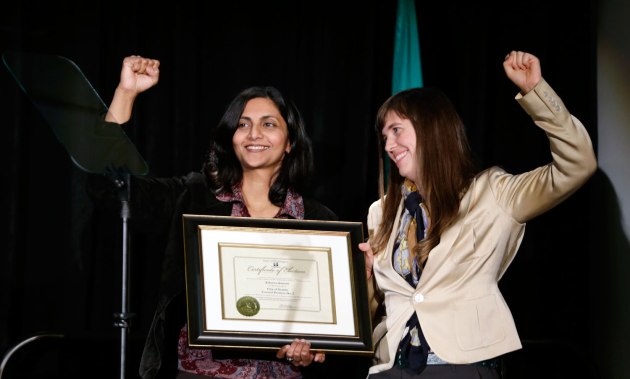
The full text of the new Seattle city council member’s inauguration speech.

kshama_sawant_inauguration_ap_img

New Seattle Council member Kshama Sawant, left, stands with Nicole Grant, who assisted in a ceremonial swearing-in. (AP Photo/Elaine Thompson)

Editor’s note: At a ceremonial swearing-in on Monday, Kshama Sawant became Seattle’s first socialist city council member in almost a century. The full text of her inauguration speech is below.

My brothers and sisters,

Thank you for your presence here today.

This city has made glittering fortunes for the super wealthy and for the major corporations that dominate Seattle’s landscape. At the same time, the lives of working people, the unemployed and the poor grow more difficult by the day. The cost of housing skyrockets, and education and healthcare become inaccessible.

This is not unique to Seattle. Shamefully, in this, the richest country in human history, fifty million of our people—one in six—live in poverty. Around the world, billions do not have access to clean water and basic sanitation and children die every day from malnutrition.

This is the reality of international capitalism. This is the product of the gigantic casino of speculation created by the highway robbers on Wall Street. In this system the market is God, and everything is sacrificed on the altar of profit. Capitalism has failed the 99%.

Despite recent talk of economic growth, it has only been a recovery for the richest 1%, while the rest of us are falling ever farther behind.

The Nation