Tyranny’s False Comfort: Why Rights Aren’t Wrong in Tough Times

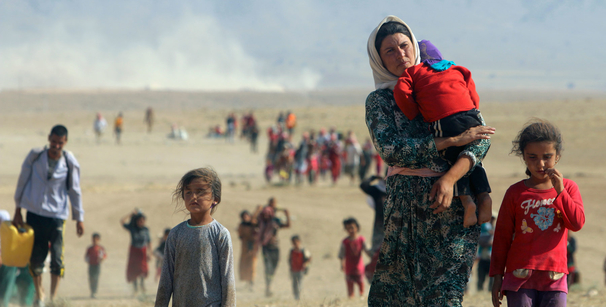
 Displaced people from the Yezidi sect, fleeing violence from forces linked to the extremist group Islamic State (also known as ISIS) in the northern Iraqi town of Sinjar, walk towards the Syrian border in August 2014. © 2014 Reuters

Displaced people from the Yezidi sect, fleeing violence from forces linked to the extremist group Islamic State (also known as ISIS) in the northern Iraqi town of Sinjar, walk towards the Syrian border in August 2014. © 2014 Reuters

By Kenneth Roth, Executive Director, Human Rights Watch

The world has not seen this much tumult for a generation. The once-heralded Arab Spring has given way almost everywhere to conflict and repression. Islamist extremists commit mass atrocities and threaten civilians throughout the Middle East and parts of Asia and Africa. Cold War-type tensions have revived over Ukraine, with even a civilian jetliner shot out of the sky. Sometimes it can seem as if the world is unraveling.

Many governments have responded to the turmoil by downplaying or abandoning human rights. Governments directly affected by the ferment are often eager for an excuse to suppress popular pressure for democratic change. Other influential governments are frequently more comfortable falling back on familiar relationships with autocrats than contending with the uncertainty of popular rule. Some of these governments continue to raise human rights concerns, but many appear to have concluded that today’s serious security threats must take precedence over human rights. In this difficult moment, they seem to argue, human rights must be put on the back burner, a luxury for less trying times.

That subordination of human rights is not only wrong, but also shortsighted and counterproductive. Human rights violations played a major role in spawning or aggravating most of today’s crises. Protecting human rights and enabling people to have a say in how their governments address the crises will be key to their resolution. Particularly in periods of challenges and difficult choices, human rights are an essential compass for political action.

Read the entire Keynote Address of the Human Rights Watch World Report 2015

Keystone Vote Fails in Senate

Ranking member Senator Maria Cantwell (D-WA) and committee chairman Senator Lisa Murkowski (R-AK) listen during a session of the Senate Energy and Natural Resources Committee on Capitol Hill January 8, 2015 in Washington, DC. The committee met for a markup of legislation to arrive the Keystone XL pipeline project. (BRENDAN SMIALOWSKI/AFP/Getty Images)

January 26, 2015 A key vote to advance legislation green-lighting the Keystone XL oil sands pipeline failed 53-39 in the Senate on Monday.

The vote aimed at cutting off debate on legislation to approve the controversial project fell short of 60 votes after Democrats, angry at Republicans for blocking debate on a slate of Democratic amendments last week, blocked the measure.

“Last Thursday night the majority decided that they would not allow for debate,” Democratic Sen. Ed Markey said on the floor ahead of the vote, echoing a complaint that a number of Democrats expressed on Monday after the Senate reconvened to debate the bill.

Senate Republicans have instigated a “gag-a-thon,” said Sen. Barbara Boxer, D-Calif.

Democratic Sen. Tom Carper of Delaware said he voted against ending debate because of the “failure of the majority to follow through on the open amendment process,” taking aim at Senate Majority Leader Mitch McConnell.

Read more at the National Journal

RNC Turns Deaf Ear To Questions About Trip Funded by Hate Group

Gage Skidmore [CC BY-SA 3.0], via Wikimedia Commons
Republican National Committee Chairman Reince Priebus photo attribution: Gage Skidmore [CC BY-SA 3.0], via Wikimedia Commons

Last week, the Southern Poverty Law Center (SPLC) faxed and sent letters to every member of the Republican National Committee (RNC) regarding an upcoming trip to Jerusalem being organized by RNC Chair Reince Priebus.

The letters expressed concern about the organization paying for the trip, the American Family Association (AFA), which the SPLC has listed as an anti-LGBT hate group since 2010.

In particular, the letters asked RNC members not to lend their good offices to an organization with a long track record of making anti-LGBT, anti-Muslim and other hateful statements. An email to Priebus’ director of communications about this matter was not responded to.

In early December, Time reported that 60 members, or about a third, of the RNC had decided to travel to Israel. But you wouldn’t know that from the calls we made. We left dozens of voicemails and sent many, many emails, none of which were replied to.

In Illinois, Indiana, Iowa, Oklahoma and Tennessee, communications directors were unaware of the trip and promised to speak with RNC members and get back to us. They did not. Other state communications directors, like those in Maryland and Louisiana, said they knew nothing of the trip and could not answer questions. In Idaho, a communications staffer told us she had no idea what we were talking about, but that she would have known about a trip if there was one.

Read more at the Southern Poverty Law Center

Well, well. It seems that the fascists have been planning a nice little putsch. Speak of strange bedfellows.

Second crude pipeline spill in Montana wreaks havoc on Yellowstone River

konigludwig's avatarWorld News Forum

 Second crude pipeline spill in Montana wreaks havoc on Yellowstone River
Second crude pipeline spill in Montana wreaks havoc on Yellowstone River

By Nate Schweber

Environmental damage from recent oil leak ranges from contaminated water supply to polluted farmland

GLENDIVE, Montana — When an oil pipeline burst in July 2011 and poured 63,000 gallons of crude into the Yellowstone River 200 miles upstream from Dena Hoff’s farm of wheat, beans and corn on the Great Plains in Glendive, she felt disgusted.

When it happened again Saturday, she felt terror. This pipeline breach was underneath the Yellowstone River, just a few feet from her sheep pasture. The new spill poured out some 50,000 gallons of crude oil. Leaders of this small riverside farming and ranching community in northeastern Montana warned residents not to drink their tap water, because benzene, a carcinogen, was found in the municipal water system. Oil slicked the river for dozens of miles, almost to the border with North…

View original post 136 more words

As Syria’s Revolution Sputters, a Chaotic Stalemate

 TORN BY WAR The view from a mosque in Homs, Syria, that has served as a rallying point for insurgents.  Credit Sergey Ponomarev for The New York Times
TORN BY WAR The view from a mosque in Homs, Syria, that has served as a rallying point for insurgents. Credit Sergey Ponomarev for The New York Times

By Anne Barnard in The New York Times

ANTAKYA, Turkey — It was a victory that President Bashar al-Assad’s opponents had dreamed of: Insurgents seized a key army base in northern Syria after more than a year of trying. But the mood in this Turkish border town, flooded with Syrians who have fled both government bombings and extremist insurgents, was more bitter than celebratory.

The assault this month was led by the Nusra Front, Al Qaeda’s arm in Syria, which claimed the spoils. By contrast, many of the first Syrians to rise up against Mr. Assad in 2011 — civilian demonstrators and army defectors alike — followed the battle from the sidelines here, unable to enter Syria under threat of death from the extremists of Nusra and its rival group, the Islamic State.

As Syria’s war heads toward its fourth year, the complex battleground is increasingly divided between the government and the extremists, leaving many Syrians feeling that the revolution on which they gambled their lives and livelihoods has failed.

Different insurgent groups battle one another, even as they fight against Mr. Assad’s forces and his allies, foreign Shiite militias. A chaotic stalemate reigns in a war that has killed more than 200,000 people and wounded one million.

In northern and eastern Syria, where Mr. Assad’s opponents won early victories and once dreamed of building self-government, the nationalist rebel groups calling themselves the Free Syrian Army are forced to operate under the extremists’ umbrellas, to go underground or to flee, according to Syrian insurgents, activists and two top commanders of the American-financed F.S.A. groups.

Read more at The New York Times

George Stinney’s Conviction Tossed Out … 70 Years After Execution

 George Stinney in 1944. Credit SC Department of Archives and History, via Associated Press
George Stinney in 1944. Credit SC Department of Archives and History, via Associated Press

By Jesse Wegman in The New York Times

Seventy years after he was executed in South Carolina, George Stinney’s conviction was vacated by a state judge Wednesday on the grounds that he had not received a fair trial.

Stinney, a 14-year-old black boy, was arrested in March 1944 for the murder of two white girls in Clarendon County, S.C. In less than three months, he was tried, convicted and put to death.

He was the youngest person to be executed in the U.S. in the 20th century. Reports from the execution chamber said he was so small that the jolt of electricity knocked the mask from his face.

In a 28-page order, Judge Carmen T. Mullen — who heard testimony on the case in January — did not rule on the merits of the murder charges against Stinney, but found that there were “fundamental, constitutional violations of due process” across the board.

Indeed, nothing about Stinney’s case came close to meeting basic constitutional requirements.

He was arrested without a warrant and questioned without a lawyer.

The lawyer eventually appointed to defend him was a tax commissioner who had never before represented a criminal defendant.

The only evidence against him was the word of the local police chief who said he had confessed.

Stinney’s entire capital trial lasted three hours. His lawyer neither cross-examined the prosecution’s witnesses nor called any witnesses for the defense.

The jury — all white in a county that was almost three-quarters black — convicted and condemned him in 10 minutes. There were no appeals.

Read more at The New York Times

The Eric Garner case’s sickening outcome

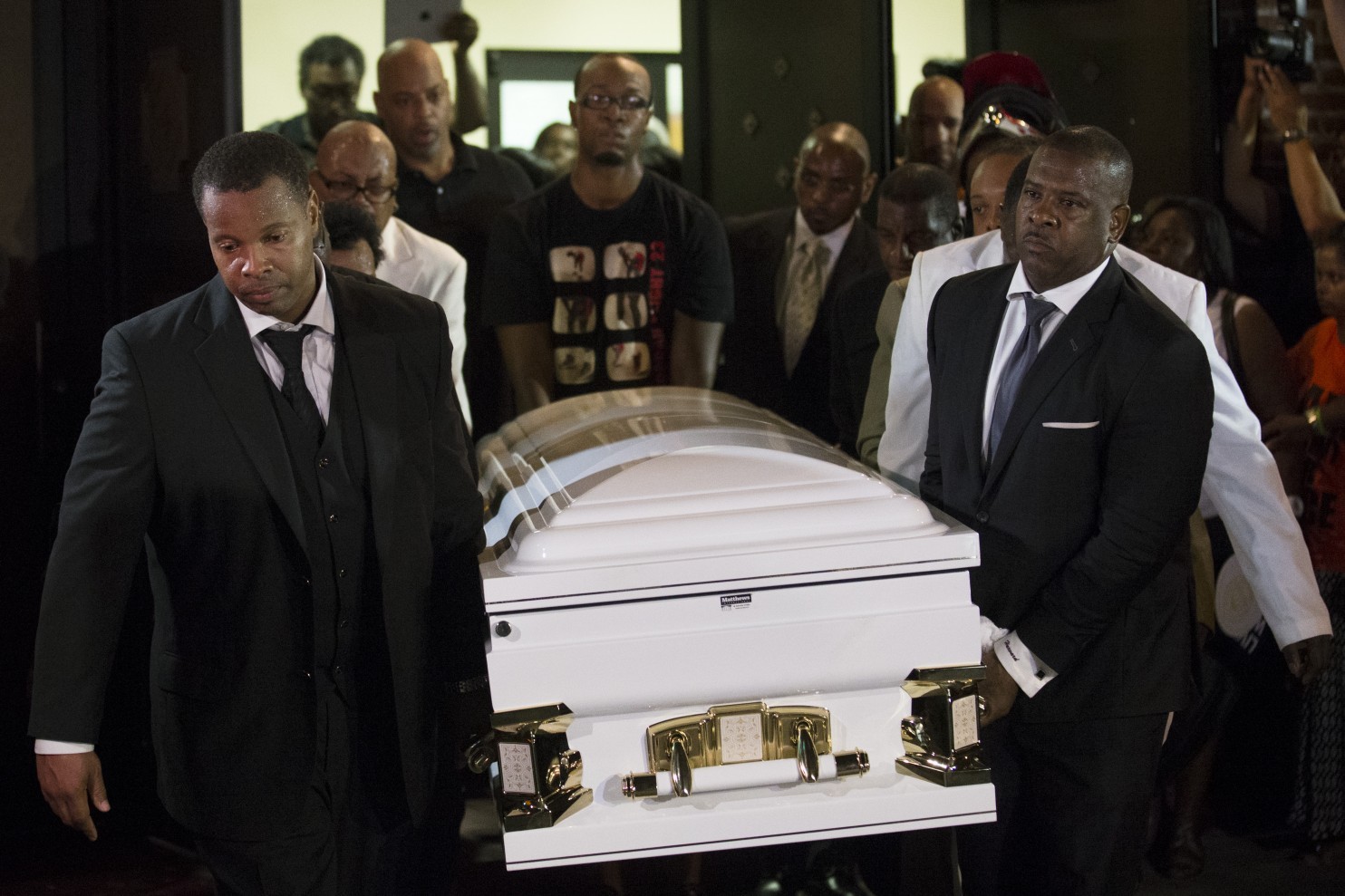
 Pallbearers carry the casket of Eric Garner at Bethel Baptist Church following his funeral service, Wednesday, July 23, 2014, in the Brooklyn borough of New York. (John Minchillo/AP)
Pallbearers carry the casket of Eric Garner at Bethel Baptist Church following his funeral service, Wednesday, July 23, 2014, in the Brooklyn borough of New York. (John Minchillo/AP)

Eugene Robinson in The Washington Post

I can’t breathe.

Those were Eric Garner’s last words, and today they apply to me. The decision by a Staten Island grand jury to not indict the police officer who killed him takes my breath away.

In the depressing reality series that should be called “No Country for Black Men,” this sick plot twist was shocking beyond belief. There should have been an indictment in the Ferguson case, in my view, but at least the events that led to Michael Brown’s killing were in dispute. Garner’s homicide was captured on video. We saw him being choked, heard him plead of his distress, watched as no attempt was made to revive him and his life slipped away.

This time, there were literally millions of eyewitnesses. Somebody tell me, just theoretically, how many does it take? Is there any number that would suffice? Or is this whole “equal justice before the law” thing just a cruel joke?

African American men are being taught a lesson about how this society values, or devalues, our lives. I’ve always said the notion that racism is a thing of the past was absurd — and that those who espoused the “post-racial” myth were either naive or disingenuous. Now, tragically, you see why.

Garner, 43, was an African American man. On July 17, he allegedly committed the heinous crime of selling individual cigarettes on the street. A group of New York City police officers approached and surrounded him. As seen in cellphone video footage recorded by an onlooker, Garner was puzzled that the officers seemed to be taking him into custody for such a piddling offense. He was a big man, but at no point did he strike out at the officers or show them disrespect.

Read more at The Washington Post

Obama, Down but Not Out, Presses Ahead

By PETER BAKER and JULIE HIRSCHFELD DAVISNOV in The New York Times

 President Obama on Thursday attended a meeting of leaders of Southeast Asian nations in Myanmar’ s capital, Naypyidaw.   Credit Christophe Archambault/Agence France-Presse — Getty Images
President Obama on Thursday attended a meeting of leaders of Southeast Asian nations in Myanmar’ s capital, Naypyidaw. Credit Christophe Archambault/Agence France-Presse — Getty Images

WASHINGTON — President Obama emerged from last week’s midterm election rejected by voters, hobbled politically and doomed to a final two years in office suffering from early lame-duck syndrome. That, at least, was the consensus in both parties. No one seems to have told Mr. Obama.

In the 10 days since “we got beat,” as he put it, by Republicans who captured the Senate and bolstered control over the House, Mr. Obama has flexed his muscles on immigration, climate change and the Internet, demonstrating that he still aspires to enact sweeping policies that could help define his legacy.

The timing of the three different decisions was to some extent a function of separate policy clocks, not simply a White House political strategy. Mr. Obama, for example, had been scheduled to travel to China for a summit meeting in mid-November, and American officials have been trying for most of the year to negotiate a climate agreement for him to announce while in Beijing.

Still, even if by happenstance, the back-to-back moves have reinforced Mr. Obama’s desire to assert himself in a period when his poll numbers and political capital are at their lowest ebbs. While losing Congress was a grievous blow that will further challenge his capacity to govern, advisers said that he feels liberated. He can now pursue his long-term agenda, they said, without being tethered to the short-term electoral concerns of his party’s leadership in Congress.

In the process, though, Mr. Obama has angered Republicans who accuse him of essentially defying the message sent by the electorate. All of the talk by the White House in recent days of working together with the new Congress seems belied by a president who has wasted little time advancing some of the same policies that were renounced just a week ago, Republicans said.

“The president is completely ignoring the will of the American voters, who turned out on Election Day and overwhelmingly elected people who wanted to change the direction of the country,” Senator John Barrasso of Wyoming, chairman of the Senate Republican Policy Committee, said in an interview. “Even today, the new polls show Americans would rather have Republicans make the agenda changes than the president.”

Read more at The New York Times

Bored voters produce lowest California voter turnout ever

 Dan Kysor's guide dog, Harry, lies next to him as poll workers help him vote using an adaptive computer at the California Museum in Sacramento, California, November 4, 2014.

Dan Kysor’s guide dog, Harry, lies next to him as poll workers help him vote using an adaptive computer at the California Museum in Sacramento, California, November 4, 2014.

SACRAMENTO —Democrats won every statewide office and a comfortable majority of the congressional delegation and legislative seats. Yet at Capitol Weekly’s election postmortem confab Thursday, Republicans were giddy and many Democrats were, well, agitated.

Even for California Republicans, Tuesday was heavenly. To start, they spent Tuesday night watching the GOP make big gains nationally — a happy change of pace. In state, it’s true as Democratic strategist Jason Kinney pronounced, Dems had a “wildly successful year.” The Dems won every statewide office on the ballot and the majority of legislative districts. Still, the GOP well may have poached three Democratically controlled congressional seats. Longtime incumbent Rep. Jim Costa, D-Fresno, was trailing against a little-known Republican dairy farmer named Johnny Tacherra — even though Costa’s seat was not on politicos’ watch lists.

Republicans picked up seats and prevented the Democrats from holding supermajorities in both houses of the Legislature. It’s the first time, wrote California Target Book publisher Allan Hoffenblum, that any Democratic incumbents were defeated since 1994. What’s more, the GOP put three Asian American women in the Legislature.

So the Dems should have been high-fiving each other, right? Instead, California Democratic Party Chief Financial Officer Angie Tate told the audience that people juggling two jobs and families didn’t feel like they had time to vote. And: “Did we lose some races? Most definitely. Did we know coming in we’d lose some races? Duh.”

The folks who watch these things believe that when all the ballots are counted, the turnout will be lower than the state’s record low turnout of 50.6 percent of registered voters in November 2002. Panelists predicted a new low, a turnout below 40 percent. Sacramento has passed a rash of laws to make it almost automatic to register, as easy as going to the mailbox to pick up your ballot, and Californians are increasingly less likely to vote.

And that is the big takeaway from the 2014 midterm election: Even where it was easier than ever to register and vote, people didn’t.

Read more at the San Francisco Chronicle

You Can’t Quarantine Stupid: Ebola & Unconstitutional Health Policy

WWI propaganda poster warning soldiers against catching venereal diseases

The year was 1918. After two and a half years of uneasy neutrality, America had finally entered The Great War and had committed over 4 million men to the war effort. As one would expect—or at least hope—the United States government took great care to prepare newly enlisted men for military service, making sure that those who had no prior military experience would be adequately trained and ready to fight when they reached Europe. However, the United States government understood that their soldiers would not only face dangers abroad, but at home as well, and worked tirelessly to keep them safe from that most dreaded of all military foes: syphilis.

Yes, at the beginning of the 20th century, venereal diseases were a massive problem for the US military, with 13% of all Americans drafted by Uncle Sam for WWI testing positive for syphilis or gonorrhea. At the time, there was a more intensely moral stigma around venereal diseases than there is today, and the primary mode of transmission for such diseases was widely thought to reside solely in sex acts that occurred outside of traditional marriage, the most pernicious of these sex acts being prostitution. In response to this, US, state and local governments eschewed the simple solution of providing their soldiers-in-training with prophylactics should they purchase a few moments of a woman’s time and tried to take away the opportunity for soldiers to contract the diseases by dismantling the prostitution trade.

In the summer of 1918, US Congress took matters into its own hands and passed the highly unconstitutional Chamberlain-Kahn Act, which granted the military $1 million to be used in a “civilian quarantine and isolation fund” that could be used to indefinitely detain prostitutes and “promiscuous women and girls.” The exact number of women who were unjustly detained as the result of this program is unknown, but estimates generally suggest a number somewhere around 30,000. The women were held in quarantine for an average of 70 days in federal detention centers and 1 year in reformatories near Army and Navy training camps.

Only 1/3 of the women that were held in these detention centers and reformatories were ever charged with prostitution. The other 2/3 were simply detained for having a venereal disease or for a host of arbitrary reasons ranging from how they dressed to the way they danced. In no way were any of the decisions on who to quarantine based on the most recent scientific findings or public health concerns. Rather, these decisions revolved around the personal moral judgements of men in power concerning women who had little or no rights. As a member of the military’s newly formed Commission on Training Camp Activities from New Jersey described after “investigating” the behavior of local women, “the manner of dancing by certain of these girls was so suggestive as to constitute almost positive proof of their indulging in sexual intercourse.” In other words, they’re whores because we say they’re whores.

The most egregious example of this pseudo-scientific posturing is from the bipartisan duo of New York and New Jersey Governors Andrew Cuomo and Chris Christie, who apparently obtained masters degrees in Public Health overnight and have enacted strict quarantine policies for people returning from West Africa who have had contact with Ebola patients. Governor Christie echoed the inane violations of civil rights perpetrated nearly a century ago on prostitutes and “impure” women by quarantining Kaci Hickox, a nurse who had been working with Médecins Sans Frontières (Doctors Without Borders) to help people in Sierra Leone who were enduring the ravages of Ebola. Upon landing in New Jersey, Hickox, who was asymptomatic for Ebola or any other disease for that matter, was promptly detained and quarantined in a tent equipped with the luxury of a portable toilet, but without a shower or television.

Read more at the Daily Kos