Jim Crow returns: Millions of minority voters threatened by electoral purge

Elderly voters board a van that will take them to a polling station in Atlanta on the first day of early voting, Oct. 13, 2014. via Al Jazeera America

Election officials in 27 states, most of them Republicans, have launched a program that threatens a massive purge of voters from the rolls. Millions, especially black, Hispanic and Asian-American voters, are at risk. Already, tens of thousands have been removed in at least one battleground state, and the numbers are expected to climb, according to a six-month-long, nationwide investigation by Al Jazeera America.

At the heart of this voter-roll scrub is the Interstate Crosscheck program, which has generated a master list of nearly 7 million names. Officials say that these names represent legions of fraudsters who are not only registered but have actually voted in two or more states in the same election — a felony punishable by 2 to 10 years in prison.

Until now, state elections officials have refused to turn over their Crosscheck lists, some on grounds that these voters are subject to criminal investigation. Now, for the first time, three states — Georgia, Virginia and Washington — have released their lists to Al Jazeera America, providing a total of just over 2 million names.

The Crosscheck list of suspected double voters has been compiled by matching names from roughly 110 million voter records from participating states. Interstate Crosscheck is the pet project of Kansas’ controversial Republican secretary of state, Kris Kobach, known for his crusade against voter fraud.

Based on the Crosscheck lists, officials have begun the process of removing names from the rolls — beginning with 41,637 in Virginia alone. Yet the criteria used for matching these double voters are disturbingly inadequate.

There are 6,951,484 names on the target list of the 28 states in the Crosscheck group; each of them represents a suspected double voter whose registration has now become subject to challenge and removal. According to a 2013 presentation by Kobach to the National Association of State Election Directors, the program is a highly sophisticated voter-fraud-detection system. The sample matches he showed his audience included the following criteria: first, last and middle name or initial; date of birth; suffixes; and Social Security number, or at least its last four digits.

In North Carolina, Republican officials are loudly proclaiming their hunt for alleged double voters using Crosscheck. But in nearby Georgia, Democratic leaders say they are shocked that they have been kept in the dark about the state’s use of Crosscheck lists — and the racial profile of the targeted voters.

“It’s biased, I think, both in form and intent,” says Rep. Stacey Abrams, leader of the Democrats in the Georgia state legislature. “But more concerning to me is the fact this is being done stealthfully. … We have never had this information presented to us.”

Abrams, in her second role as founder of New Georgia Project, a nonpartisan voter registration group, has, in coordination with the NAACP, already sued Georgia’s Republican secretary of state, Brian Kemp, on behalf of 56,001 voters who filled out registration forms but have yet to see their names appear on voter rolls.

Al Jazeera America showed the Crosscheck lists to Martin Luther King III, who succeeded his father and Lowery to lead the SCLC. He notes that using shoddily put-together lists of supposed matches is not a new tactic. The capture of common names is certain to ensnare black voters, he says, and reminds him of the presidential race of 2000, when Florida Secretary of State Katherine Harris wrongly purged voters from a list of nearly 58,000, many of them African-American. They were purged on the grounds that they were felons and thus banned from voting, which helped to hand the presidency to George W. Bush. Yet not one was found guilty of voting illegally. Once again, King notes, this minority-heavy list falsely flags fraudulent voters. Compared to the prior purge, this new one is more sophisticated, he says. “I hate to characterize it as a trick [but] it really is. It really is about trying to control who can and cannot vote.”

With millions of suspects, one question keeps arising: Why have there been no mass convictions? Kobach proudly proclaims that Kansas has “referred” 14 voters for prosecution for double voting. And none of them has been convicted.

Yet demands to purge lists of double voters have reached a histrionic volume. In April of this year, former presidential counselor Dick Morris told Fox TV audiences that “probably over a million people that voted twice in [the 2012] election. This is the first concrete evidence we’ve ever had of massive voter fraud.”

In North Carolina, state officials have hired former FBI agent Charles W. “Chuck” Stuber, who played a major role in the campaign finance fraud case brought against former North Carolina Sen. John Edwards, to, in the words of their press release, “investigate cases of possible voter fraud identified by an interstate cross-check comparing election records from 28 states.”

But despite knowing the names and addresses of 192,207 supposed double voters in the state, Stuber has not nabbed a single one in his five months on the job. Josh Lawson, a spokesman for the board of elections, says, “This agency has made no determination as to which portion of these [lists] represent data error or voter fraud.” In fact, to date, Lawson admits that Stuber has found only errors and not one verified fraudulent voter.

But Lawson did shine a light on the great benefit of the Crosscheck manhunt to the state’s Republican Party, now locked in a tight battle over the U.S. Senate seat of incumbent Democrat Kay Hagan. While the use of Crosscheck has yet to produce a single indictment of a double voter, Lawson says, the program could be used for “list maintenance.” That is, voters on the list, proven guilty or not, could be subject to a process of removal from the voter rolls.

Read more at Al Jazeera America

The Republican Party’s electoral philosophy: Cheating wins

The explosion and enforcement of restrictive voter ID laws make this one thing very clear

Rick Scott, Karl Rove, Rick Perry (Credit: AP/J. Scott Applewhite/LM Otero/Rich Pedroncelli/Photo montage by Salon)

Last week, the Supreme Court upheld a law that could disenfranchise 600,000 Texans. But the effects of the law won’t fall equally: African-Americans and Latinos are 305 percent and 195 percent less likely (respectively) to have the necessary forms of identification than whites. The Republican party is increasingly unpopular, and relies almost exclusively on white voters. The charts below show the 2008 if only white men voted and if only people of color voted (source). Since 2008, people of color become a growing share of the voting population while the GOP has, if anything, moved further to the right. It has further alienated voters of color with racist attacks and laws. But as they say: if you can’t beat ‘em, make sure they don’t vote. Over the last four years the Republicans have gone through elaborate attempts to make sure populations that don’t support them don’t get a chance to vote.

sean-voter-id-1

Since 2006, Republicans have pushed through voter ID laws in 34 states. Such laws did not exist before 2006, when Indiana passed the first voter ID law. The laws were ostensibly aimed at preventing voter fraud, but a News21 investigation finds only 2,068 instance of alleged fraud since 2000 (that is out of over 146 million voters). They estimate that there is one accusation of voter fraud for every 15 million voters. As Mother Jones notes, instances of voter fraud are more rare than UFO sightings. There have been only 13 instances of in-person voter fraud (the sorts that a voter ID law would reduce), while 47,000 people claim to have seen a UFO.

On the other hand, research by the Brennan Center for Justice finds that, “as many as 11 percent of eligible voters do not have government-issued photo ID.” Those who do not have ID are most likely to be “ seniors, people of color, people with disabilities, low-income voters, and students” — i.e.. people who vote Democratic (chart source).

sean-voter-id-2

There is now a large literature studying the effects of voter ID laws. James Avery and Mark Peffley find, “states with restrictive voter registration laws are much more likely to be biased toward upper-class turnout.” The GAO finds that voter ID laws reduce turnout among those between ages 18-23 and African-Americans (two key Democratic constituencies). A 2013 study finds that the proposal and passage of voter ID laws are “highly partisan, strategic, and racialized affairs.” They write, “Our findings confirm that Democrats are justified in their concern that restrictive voter legislation takes aim along racial lines with strategic partisan intent.” [Italics in original] The authors also find that increases in low-income voter turnout triggered voter ID laws. A more recent study finds, “where elections are competitive, the furtherance of restrictive voter ID laws is a means of maintaining Republican support while curtailing Democratic electoral gains.” That is, not all Republican legislatures propose voter ID laws — only those that face strong competition from Democrats. If Republicans are concerned about election integrity, why do they only pass voter ID laws when they’re about to lose an election? Because they’re cheaters.

Voter ID laws are also racially motivated. A recent study finds that voters are significantly more likely to support a voter ID law when they are shown pictures of black people voting than when shown white people voting. One voter ID group had a picture on their website showing a black inmate voting and a man wearing a mariachi outfit — clearly playing off racial stereotypes.

Read more at Salon

How the Statue of Liberty Almost Ended Up in Egypt

By Dora Hasan Mekouar in Voice of America

The Statue of Liberty looks out on the lower Manhattan skyline, January 2014. (AP)

Instead of imploring the world to “give me your tired, your poor”, the Statue of Liberty’s welcoming message might well have been “as-salamu alaykum”, the Arabic greeting used by Muslims around the world.

That’s right, the world’s most recognized symbol of freedom and the American dream, was originally intended for Egypt, which ultimately rejected it for being too old fashioned.

The decision came as a disappointment to Lady Liberty’s creator, Frédéric Auguste Bartholdi, who’d envisioned the Suez Canal as the ideal venue for his mammoth harbor structure.

The decision came as a disappointment to Lady Liberty’s creator, Frédéric Auguste Bartholdi, who’d envisioned the Suez Canal as the ideal venue for his mammoth harbor structure.
Statue of Liberty creator Frédéric Auguste Bartholdi’s original design for the mouth of the Suez Canal in Egypt.

“He was inspired by the Sphinx and the pyramids and the idea you could create something massive that could almost be eternal,” said Elizabeth Mitchell, who brings Bartholdi’s quest to life in her book Liberty’s Torch: The Great Adventure to Build the Statue of Liberty.

Mitchell was motivated to write the book after coming across Bartholdi’s diaries at the New York City Public Library. That’s when she first realized the iconic symbol wasn’t a gift from France as many Americans believe.

“In fact, the true story is more moving because what you have is this individual artist who had a vision and he really wanted to make this happen,” Mitchell said, “and he really had to go through every machination to get this thing built.”

After his failure in Egypt, the artist shifted his attention to America, which was prospering after the end of the Civil War.

“Maybe no other country at the time would understand the excitement and importance of having this bigger-than-life, colossal symbol,” Mitchell said.

Read more at Voice of America

Out of control: How the world’s health organizations failed to stop the Ebola disaster

 Two people lay dead on the floor Sept. 20 inside a ward at the Redemption Hospital, which has become a transfer and holding center for Ebola patients in the New Kru Town slum of Monrovia, Liberia.

Two people lay dead on the floor Sept. 20 inside a ward at the Redemption Hospital, which has become a transfer and holding center for Ebola patients in the New Kru Town slum of Monrovia, Liberia.

Tom Frieden remembers the young woman with the beautiful hair, dyed a rusty gold and braided meticulously, elaborately, perhaps by someone who loved her very much. She was lying facedown, half off the mattress. She had been dead for hours, and flies had found the bare flesh of her legs.

Two other bodies lay nearby. Bedridden patients who had not yet succumbed said of the dead, “Please, get them out of here.”

Frieden, the director of the U.S. Centers for Disease Control and Prevention (CDC), knew it was no simple matter to properly carry away a body loaded with Ebola virus. It takes four people wearing protective suits, one at each corner of the body bag. On that grim day near the end of August, in a makeshift Ebola ward in Monrovia, Liberia, burial teams already had lugged 60 victims to a truck for the trip to the crematorium.

Frieden had seen plenty of death over the years, but this was far worse than he expected, a plague on a medieval scale. “A scene out of Dante,” he called it.

Shaken, he flew back to the United States on Aug. 31 and immediately briefed President Obama by phone. The window to act was closing, he told the president in the 15-minute call.

That conversation, nearly six months after the World Health Organization (WHO) learned of an Ebola outbreak in West Africa, was part of a mounting realization among world leaders that the battle against the virus was being lost. As of early September, with more than 1,800 confirmed Ebola deaths in Guinea, Liberia and Sierra Leone, there was still no coordinated global response. Alarmed U.S. officials realized they would need to call in the military.

Obama eventually ordered 3,000 military personnel to West Africa; about 200 had arrived by the beginning of this month. They will be joined by health workers from countries such as Britain, China and Cuba. Canada and Japan are sending protective gear and mobile laboratories. Nonprofit organizations such as the Gates Foundation also are contributing. But it’s not at all clear that this belated muscular response will be enough to quell the epidemic before it takes tens of thousands of lives.

This is an open-ended crisis involving a microscopic threat on the move. This week came the unsettling news that the Ebola epidemic has now reached across the Atlantic Ocean to a hospital in Texas, where a Liberian man has tested positive for the virus.

So how did the situation get so horribly out of control?

Read more at The Washington Post

The Moral Siege

The militarization of Jewish supremacism in Israel

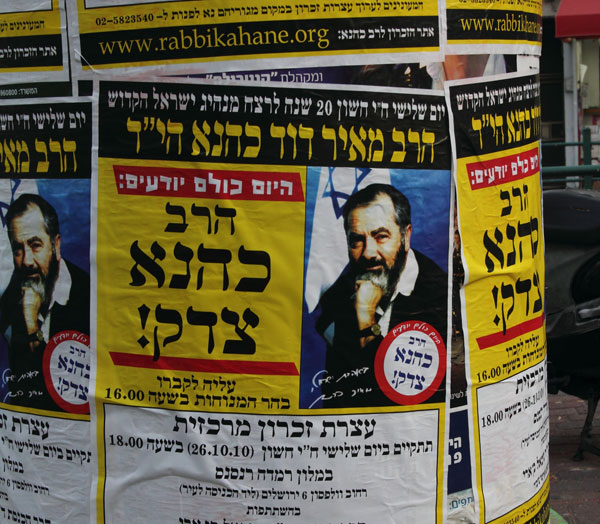
Bills posted for a Rabbi Meir Kahane memorial rally. Photograph: Yossi Gurvitz

By Assaf Sharon in the Boston Review

Addressing Israel’s offensive in Gaza, John Kerry said: “Israel is under siege by a terrorist organization.” Living in Israel, I found the secretary’s comment baffling. In my city, Jerusalem, the sirens have sounded only three times. Tel Aviv and its vicinity has had it worse, with three dozen sirens or so over the last month. Yet daily routine has not been greatly affected. In the south, near the Gaza strip, things are different. With numerous rockets daily, life in some Israeli towns and villages has become what happens between one rush to the shelter to the next. This is certainly not acceptable, but it is not a siege either. In Jewish history, the archetypical siege is the Roman siege of Jerusalem, described by the first-century historian, Josephus, thus: “Throughout the city people were dying of hunger in large numbers, and enduring unspeakable sufferings. In every house the merest hint of food sparked violence, and close relatives fell to blows, snatching from one another the pitiful supports of life.” In Zionist history, the paradigm comes from 1948, when Jerusalem was once again stricken with hunger and want of basic supplies. Here is how one mother described it in a letter to her son who was fighting in the north: “Whoever doesn’t have food simply goes hungry. There’s no gas for cooking, people gather wood and cook in the street. Other than bread, (and this too only 200 grams per person daily) there’s almost nothing to buy…. Water is delivered in a carriage with an allowance of 1.5 cans per person for a week (can=eighteen liters), which is precious little. And as there is no fuel for cars, the water must be brought (from great distance) from wells.” Today, this description is more suitable to Gaza than to Israel.

But there is another siege haunting Israel today. This siege is internal rather than external, moral rather than physical. The murder of sixteen-year-old Muhhamad Abu-H’deir, burned alive by Jewish extremists on July 2, made headlines worldwide. But the context in which this crime was hatched receives less attention. The day before, as the three Israeli youths kidnapped and murdered three weeks earlier were being buried, hundreds of extremists gathered in Jerusalem under the banner “We want Revenge!” And their slogans clarified: “Death to Arabs” and “Death to Leftists.” As the mob marched to the city center, they pounded on store fronts, demanding Arab blood. A large group gathered outside McDonald’s shouting for its Arab employees to be brought out. Smaller groups roamed the streets looking for Arabs to abuse. A wave of racist violence has been washing the streets since then. Organized mobs of extremists have been marching through the streets of Jerusalem shouting racist slogans, calling, “Death to Arabs!” Like scenes taken from revolutionary films, they block cars and busses mid-street, checking whether there are Arabs inside. If found, they are assaulted verbally as well as physically. Many Palestinians refrain from traveling on the city’s light rail because it has become a regular venue for racist attacks.

Sadly, Jerusalem is not unique. An anti-war demonstration in Tel Aviv was attacked by hundreds of right-wing hooligans led by a rapper going by the nickname “the shadow.” Some of them were wearing the “Good Night Left Side” T-shirts popular among white-supremacist and neo-Nazi groups in Europe. A week later this violent scene recurred in Haifa, where right-wing hooligans assaulted an Arab deputy mayor and his son as they were approaching an anti-war demonstration. In Jerusalem’s old city, a mother and her two young children survived an attempted stabbing by Jewish extremists. Amir Shawiki and Ahmed Kasuani, twenty-year-old Jerusalemites, were less fortunate. Both were severely beaten by a Jewish mob simply because they were Arabs. Omar Diwani, a city bus driver in Jerusalem, was hospitalized after four young men assaulted him upon detecting his Arab accent. Dozens of similar attacks against Arabs and “lefties” have taken place recently in the streets, in cafes, in shopping centers, on busses and trains. Israel’s radical right is on the rise.

Jewish radicalism is not a new phenomenon. Its current incarnation traces back to Rabbi Meir Kahane, who, after forming the militant Jewish Defense League in the United States, emmigrated to Israel and founded the ultra-nationalist Kach party. Kahane advocated the forced eviction of all Palestinians residing west of the Jordan river, subordinating state law to Jewish religious law (Halakha), and revenge as punitive policy. Although strongly liberal on economic issues, his ethics were utterly collectivist: the moral agents were not individuals but nations. Any harm to a Jew was an affront to the nation, and revenge should be taken not necessarily on the perpetrator but on “the Arabs.” I vividly remember classmates of mine who, under his influence, would retaliate against random Palestinians following attacks on Israelis. Retaliation quickly morphed into preemption and then into naked aggression. In his short tenure in the Knesset, Kahane proposed outrageous legislation, such as revoking the citizenship of all non-Jews, or criminalizing sexual relations between Jews and Arabs. The core of his ideology was a militant form of Jewish supremacism, best expressed in the slogan frequently heard these days “a Jew is a soul, an Arab the son of a whore.” But with Kahane the medium was more significant than the message. Fusing populist rhetoric with strong-man authoritarianism, he appealed both to religious zealots and to underpriviledged Israelis. Playing on their resentment, he riled them against the “elites,” whom he portrayed simultaneously as all-powerful—controlling the media, the education system, and the courts—and as weak and degenerate. Weak in their treatment of the Arab enemy, and degenerate in their morality, which for him meant the loss of their Jewish fiber. His hostility toward Arabs, however, sometimes seemed second to his loathing of the left. These “fifth column” “destroyers of Israel,” as he biblically labeled them, were subject not only to derision but also to very thinly disguised threats.

Read more at the Boston Review

The Syrian Front: Waiting to Die in Aleppo

konigludwig's avatarWorld News Forum

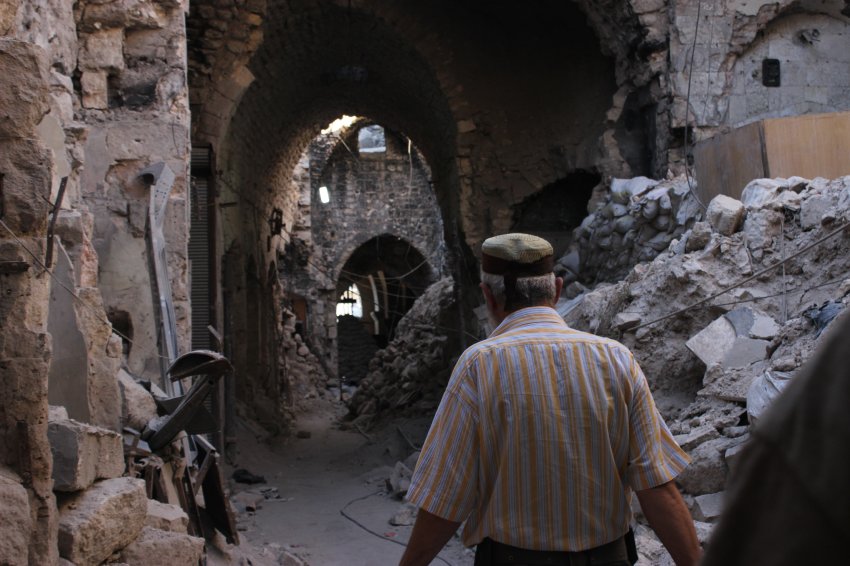
By Christoph Reuter in Der Spiegel A typical street scene in Aleppo. The front lines in the city are no longer the scene of intense fighting, as the focus of the battle has moved elsewhere. But the city remains divided and death commonplace.

Driving through the outer districts of the city, a ghostly wasteland begins. The streets and the half-destroyed residential buildings are empty and the only sounds come from shredded metal signs moving in the wind — and the occasional thunder of distant artillery.

Eastern Aleppo has been virtually abandoned, as have most residential districts located away from the front. Those left in the city prefer to crowd into housing right up against the battle lines, which have remained virtually static in the last two years. Paradoxically, people feel safest living within range of enemy tank and sniper fire. Such are the rules of Aleppo.

The reasons are pragmatic…

View original post 248 more words

Either With Us or Against Us

As Turkey’s ruling party consolidates its power, the space for free expression narrows.

Turkish President Recep Tayyip Erdogan
(By Randam (Own work) [GFDL or CC-BY-SA-3.0-2.5-2.0-1.0], via Wikimedia Commons

“A militant in the guise of a journalist — a shameless woman. Know your place!” This is how three-term Turkish prime minister Recep Tayyip Erdogan chose to describe Amberin Zaman, the Economist’s longtime Turkey correspondent, during a campaign rally on Aug. 7, just three days before he won the country’s first-ever direct presidential election. Erdogan lashed out at Zaman for having allegedly “insulted” Muslims in an interview with opposition leader Kemal Kilicdaroglu on the 24-hour TV news channel CNN Turk — and she was likewise vilified in the conservative press and aggressively harassed online by Erdogan supporters.

The next day, Enis Berberoglu, editor in chief of Hurriyet, one of the country’s highest-circulating dailies, abruptly resigned. Because Hurriyet is owned by Dogan, the same media group that owns CNN Turk, many doubted that Berberoglu’s move was coincidental. Erdogan went on to win the election with 52 percent of the vote. By the time of his inauguration at the end of August, several journalists at other newspapers had also lost their jobs — for reasons widely regarded as political.

These events followed a pattern that has become disturbingly familiar in recent years. As Erdogan’s Justice and Development Party (AKP) has grown increasingly entrenched since it first came to power in 2002, the space for free expression has narrowed perceptibly. This trend has been particularly evident over the past 15 months, starting with the protests that began in Istanbul’s Gezi Park and which then swept the country in the summer of 2013, when dozens of journalists were fired or forced to resign after expressing critical viewpoints. Most recently, Turkey’s trouble with press freedom made headlines this weekend when Erdogan denounced the New York Times for, he said, implying that the Turkish state was connected with Islamic State (IS) militants.

In 2013, Turkey remained the world’s top jailer of journalists (followed by Iran and China) for the second year in a row. As of the end of the year there were 40 reporters behind bars — one of several factors that led Freedom House to downgrade the country from “partly free” to “not free” in its 2014 press freedom rankings. Turkey came in 134th out of 197 countries.

Social media has not been spared. In the lead-up to local elections on March 30, the Turkish government shut down Twitter for two weeks and YouTube for 67 days in an effort to suppress the leak of damning wiretapped recordings that surfaced in a police and judicial investigation into government corruption at the highest levels.

“The main problem is that pro-AKP media is not only the dominant media, it’s the obligatory media,” said one Turkish journalist who asked not to be named. “If you’re not with them, you’re against them.”

Read more at Foreign Policy

Archaeologists Discover Nazi Extermination Camp Gas Chambers in Poland

A rusty road sign outside the perimeter of a Nazi death camp in Sobibor, Poland, on Sept. 18, 2014. (Reuters/Kacper Pempel)

From “Archaeologists unearth hidden death chambers used to kill a quarter-million Jews at notorious camp”

By Terrence McCoy in The Washington Post

Few sites across war-torn Poland harbor more secrets of atrocity and horror than the Nazi concentration camp of Sobibor. Different from Auschwitz, which almost immediately yielded the full scope of the crimes committed there, the history of Sobibor in eastern Poland was initially hidden and opaque.

Unlike Auschwitz, the fate of Sobibor wasn’t liberation. It was obliteration. The Nazis who had run the camp tried to extinguish every remnant of it in 1943, painting over its grounds with a farm, trees and asphalt. Besides a railroad track and the commander’s house, Haaretz noted, nothing remained of the camp. Save for the testimonies of the few survivors, who could only provide scant recollections of small areas of the camp, Sobibor had been lost to history.

But now, more than 70 years later, relics of genocide have surfaced, bringing more clarity to the murder of an estimated 250,000 Jews there than ever before. Buried beneath an asphalt road were a series of well-preserved gas chamber walls that archaeologists say will help elucidate the secrets of Sobibor. Beneath the road were brick rows, stacked four deep — the exoskeleton of four gas chambers.

“The discovery of the gas chambers at Sobibor is a very important finding in Holocaust research,” historian David Silberklang, editor of Yad Vashem Studies, said in a statement. “It is important to understand that there were no survivors from among the Jews who worked in the area of the gas chambers. Therefore, these findings are all that is left of those murdered there, and they open a window onto the day-to-day suffering of these people.”

Read more at The Washington Post

DNA Evidence Identifies Jack the Ripper

Gruesome: A contemporary engraving of a Jack the Ripper crime scene in London’s Whitechapel

It is the greatest murder mystery of all time, a puzzle that has perplexed criminologists for more than a century and spawned books, films and myriad theories ranging from the plausible to the utterly bizarre.

But now, thanks to modern forensic science, The Mail on Sunday can exclusively reveal the true identity of Jack the Ripper, the serial killer responsible for at least five grisly murders in Whitechapel in East London during the autumn of 1888.

DNA evidence has now shown beyond reasonable doubt which one of six key suspects commonly cited in connection with the Ripper’s reign of terror was the actual killer – and we reveal his identity.

Read more at the Daily Mail, UK

Syria in Revolt

Understanding the Unthinkable War

By Sadik J. Al-Azm in the Boston Review

Burning Syria, Tammam Azam

The people’s intifada in Syria, against the military regime and police state of the Assad family, took me by surprise. I was fearful at first that the regime would crush it almost instantly, given its legendary ferocity and repressiveness. Like other Syrian intellectuals, I felt total impotence before this devouring monster, which precluded any thought of an imminent, or even possible, collective “no.”

I was surprised by the revolution, but I should not have been. Daily experiences and recurrent observations foretold a crisis that many Syrians tried hard to deny. And deny we did. Let me explain.

After the violent suppression of the Damascus Spring in 2001–2002 and again after the assassination of former Lebanese Prime Minister Rafiq Hariri in Beirut in 2005, which led to the humiliating withdrawal of Assad’s troops from Lebanon, angst spread throughout Syria. I was working in Damascus, where the trepidation was especially pronounced. The country, it seemed, was teetering on the edge of an abyss.

But life flowed routinely on the surface. Talking about the situation publicly was out of the question. Even hinting at it was dangerous. When someone did speak up, others quickly changed the subject. A conspiracy of silence was the order of the day.

This period marked a palpable deterioration in relations among Syrians. Sectarian lines hardened, undermining long-standing friendships, harmony among colleagues, and the daily interactions of citizens. Even our way of joking changed.

Like many in Damascus, I found myself beginning, almost unconsciously, to weigh every word according to the religious affiliations of passing acquaintances and close friends alike. Social engagements lost spontaneity. Confidence and trust evaporated, and offense was taken more quickly than ever before. An unusual dose of suspicion seeped into the Syrian intelligentsia’s traditional solidarity against oppression.

By 2009–2010, it was impossible to go about the day without repeatedly hearing from working people expressions such as, “All it needs is a match to ignite,” “It needs a spark to flare up,” and “All it needs is a fire-cracker to explode.”

More educated Syrians, particularly intellectuals, had their own favorite metaphors. Mine was a pressure cooker, where the heat is mounting and the safety valves have been destroyed. Yasine Haj Saleh, a former political prisoner and the most prominent underground commentator and critic on behalf of the revolution, as well as a fine writer of prison literature, warned that if the people did not quickly find a way of letting their “Syrianness” prevail, the country would be in for the worst. The cartoonist Ali Ferzat said in a 2007 Newsweek interview, “Either reform or le deluge.” In 2011 Ferzat was assaulted by regime thugs and left for dead on the side of the road, but he survived.

A prominent colleague and friend in the philosophy department emphasized the inevitability of a civil war because the worst had already happened: the antagonistic Sunni-Alawi divide in Syrian society is a fait accompli, he told me. War was preordained.

Others maintained that one thing could be said for the regime: it alone was holding Syrians back from massacring each other.

Had you asked me what would happen if the tsunami that started in Tunisia reached Syria, I would have answered: the Sunni of Hama would sharpen their knives and pour out into the neighboring Alawi villages to take revenge for the rape and destruction of their city by Assad’s storm troopers in 1982.

But sectarian slaughter did not come to pass. Instead, the unthinkable happened: a people’s revolution against the regime.

Read more at the Boston Review