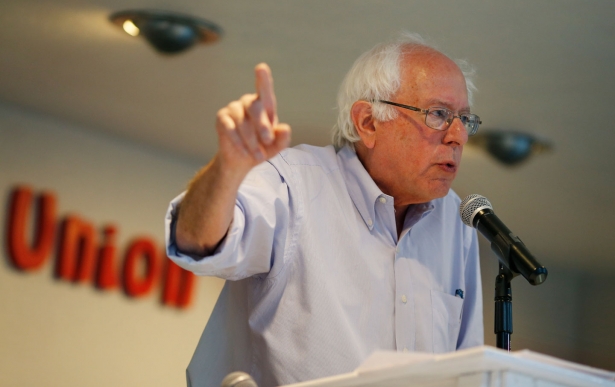
Bernie Sanders Is a Loud, Stubborn Socialist. Republicans Like Him Anyway.

His achievements include the bipartisan VA reform bill: “Frankly, without him, I don’t think we would have gotten it done.”

Sen. Bernie Sanders(Win McNamee/Getty Images)

By Sarah Mimms

In the Senate, Bernie Sanders should be all alone.

Sanders is constantly ribbing Republicans in his trademark condescending Brooklyn-accented tone. He offers up legislation that’s so far to the left that it couldn’t get a vote even under Majority Leader Harry Reid. He’s the curmudgeon in the Senate Democratic conference, rarely satisfied with how far his leadership will go to pursue progressive policies, and not afraid to vote ‘nay’ when his leaders come up short. And none of his Senate colleagues, on either side of the aisle, think he could ever be elected president of the United States; most of them even believe he shouldn’t be.

But rather than earning the frustration and ire of his peers in the vein of other Senate hard-liners such as Sen. Ted Cruz, Sanders has managed to be respected—even liked—by much of the chamber, according to members on both sides of the aisle. The Vermont independent actually has much more in common with Sen. Tom Coburn, the now-retired “Dr. No,” whose hard-line opposition killed many bills in the Senate but also earned him the respect of his colleagues on both sides of the aisle.

Sanders also has been able to work well with his colleagues. He’s passed bipartisan legislation and forged strong relationships with members of both parties in nearly 25 years on Capitol Hill. But most of all, members say, even when Sanders is ideologically an outlier, he lets others know where he stands. He’s not the type to suddenly stab a colleague in the back. And that’s earned him respect both on and off the Hill.

“A lot of people here talk about what they believe in, but they don’t act on it,” Sen. Mark Warner said. “He always acts on what he believes. … We can agree or disagree, but you know where he stands.”

Lawmakers on both sides of the aisle, including Sanders himself, point to last year’s deal to improve the disastrous, scandal-ridden Veterans Affairs Department as a highlight. After weeks of negotiating with a cadre of Republican colleagues, Sanders helped pass the deal on a 91-3 vote in the Senate. “In a pretty dysfunctional Congress I helped pass, in a bipartisan way, the significant veterans bill, which increases health care to veterans and lowers waiting times, and I’m proud of that,” Sanders said. “That was a significant step forward.”

Read more at the National Journal

Why Is Socialist Bernie Sanders So Popular?

Berniemania! Why Is Socialist Bernie Sanders So Popular? – The New York Observer

Brooklyn-born, Vermont-fueled, Bernie Sanders promises a revolution if he’s somehow elected president next year. Does Hillary have to watch her back?

(Illustration: Josh Gosfield/New York Observer)

Mr. Sanders, an independent who caucuses with Democrats, violates most laws of American politics. He proudly calls himself a socialist, a label vilified by Republicans and avoided by most Democrats. He is not outwardly charming; he rarely glad-hands and his speeches are often mirthless. Like a modern day Jonathan Edwards, who found Eugene V. Debs rather than Jesus Christ, he thunders about the dying middle class and oligarchies eroding democracy. Cross him, like one camera-holding man who yapped at him in Keene to take a position on the Edward Snowden affair, and earn a stern rebuke. Why wouldn’t he answer the man’s question? “Because you’re rude, and you’re shouting out things and I don’t really like that,” Mr. Sanders groused.

Despite a thorny approach to retail campaigning, Mr. Sanders’ quest for the White House is on an upswing. Last week, a Wisconsin Democratic Party straw poll showed Mr. Sanders trailing Ms. Clinton only 49 to 41 percent among delegates. On Observer.com, Brent Budowsky wrote, “There is a very real prospect that Mr. Bernie Sanders wins an outright victory in the Iowa caucus.” Donations are flooding in; he raised $1.5 million in the 24-hour period after he announced his candidacy in early May. He has since raised cash from more than 100,000 individual donors.

For a long time, Mr. Sanders’ unbridled liberalism was out of vogue. The Clintons, slashing the welfare rolls and deregulating Wall Street, ruled the booming 1990s. The Soviet Union collapsed; some socialists had lost a lodestar, though Mr. Sanders firmly insisted it was the democratic socialism of the Scandinavian countries, and not the authoritarianism of Russia, that he extolled.

A Sanders supporter in Keene underscored this point, gently chastising a reporter for asking whether an avowed socialist could win over voters nationwide.

“He’s a democratic socialist, like another celebrated Jewish socialist—Jesus,” he said.

Still, after a one-term African-American senator with a funny name rose from nowhere to whip Hillary Clinton, the Sanders faithful are suddenly asking, And why not Bernie? What seems more far-fetched: Barack Hussein Obama, around 2007, becoming leader of the Free World or a socialist Jew (a member of Congress for 24 years and former mayor, to boot) becoming president in 2016? (Never mind Mr. Obama was telegenic and three decades younger.)

Read more at The New York Observer

A crisis for seniors who rely on Social Security

 By Rep. John Larson (D-Conn.) - 06/10/15 05:31 PM EDT Photo credit:  Greg Nash
By Rep. John Larson (D-Conn.) – 06/10/15 05:31 PM EDT Photo credit: Greg Nash

It seems every time we talk about the long-term future of Social Security, many in Washington start clamoring to raise the retirement age or propose other ways to trim Social Security’s modest benefits. Those calling for cuts are missing the dire state of retirement security for the typical American. Traditional pensions have become a thing of the past, and stagnant wages are making it harder and harder to put aside savings. For the two-thirds of retirees who rely on Social Security for a majority of their income, there is not a Social Security crisis, there is a retirement crisis. That is why we must preserve and enhance the one program Americans have always been able to count on.

Just the other week I sat down with seniors in Glastonbury, Conn., to discuss our nation’s retirement crisis. These men and women hail from all walks of life: veterans, small-business owners, homemakers and machinists. They’ve built and rebuilt this country through wars and recessions. I spoke with one man who spent his life as a lineman, his fingers now crooked and gnarled from a lifetime helping to usher America into the Digital Age. Can we really in good conscience ask the millions of men and women, who have already given so much, to keep pushing well past their breaking point? How does it make sense to push the retirement age ever higher or cut benefits at a time when people need them most?

We can shore up Social Security for future generations without needlessly slashing benefits for people like those seniors in Glastonbury or their children and grandchildren. That is why I have been joined by more than 60 of my colleagues in putting forth H.R. 1391, the Social Security 2100 Act.

Rather than cut benefits or hike the retirement age, this proposal would increase benefits across the board. It would provide a better cost-of-living adjustment that would reflect the true cost seniors incur, such as higher medical expenses. It would also ensure that those who have paid into the system won’t retire into poverty by increasing minimum payments. Because more seniors are working into their retirement years, this proposal provides a tax cut to 11 million beneficiaries by raising the level of income individuals and couples can earn before their Social Security benefits are taxed. All of these provisions will strengthen and enhance Social Security for current beneficiaries and generations to come.

The Social Security 2100 Act keeps the system solvent for the next 75 years and beyond, according to the independent analysis of the Social Security Administration’s chief actuary, and does so without cutting benefits or contributing a dime to the deficit.

How do we do this? First, we ask individuals making more than $400,000 a year to contribute into Social Security in the same way as the rest of us. Currently, those with earnings above $118,500 no longer have to pay into the system. To put it another way, LeBron James has made his yearly contribution to Social Security by about lunchtime on New Year’s Day.

Second, we slowly introduce an increase to the contributions both workers and employers make. Over the span of 25 years, it would mean an additional 0.05 percent each year. A worker making $50,000 a year would pay an additional 50 cents per week each year to Social Security.

Read more at The Hill

‘Don’t Underestimate Me’: Bernie Sanders Knows a Thing or Two About Winning

Senator Bernie Sanders (AP/ John Locher)

By John Nichols in The Nation

Burlington, Vermont— For the first century after the founding of the Grand Old Party in 1854, Republicans dominated the politics of the state of Vermont like no other. For more than 100 years, Vermont Republicans won every major race for every statewide office. Republican presidential candidates from John Fremont in 1856 to George H.W. Bush in 1988—with the single exception of Barry Goldwater in 1964—won the Green Mountain State. For one of Vermont’s US Senate seats, an unbroken Republican winning streak continued from before the Civil War to the beginning of the 21st century.

Only in 2006 was the Senate seat streak broken with the election of a candidate who was not a Republican.

His name was Bernie Sanders.

Of all the announced and potential contenders for the 2016 Democratic presidential nomination, none has a longer track record of taking on tough races, beating incumbents, and upsetting the political calculus. Sanders has won 14 elections in Vermont, including ten straight races for the US House and US Senate as the most politically successful and longest serving independent member of Congress in American history.

Read more at The Nation

George W. Bush’s CIA Briefer: Bush and Cheney Falsely Presented WMD Intelligence to Public

By David Corn in Mother Jones

On “Hardball,” Michael Morell concedes the Bush administration misled the nation into the Iraq War.

Former CIA Deputy Director Michael Morell is sworn in as he testifes before the House Intelligence Committee. Manuel Balce Ceneta/AP

For a dozen years, the Bush-Cheney crowd have been trying to escape—or cover up—an essential fact of the W. years: President George Bush, Vice President Dick Cheney, and their lieutenants misled the American public about the WMD threat supposedly posed by Saddam Hussein in order to grease the way to the invasion of Iraq. For Bush, Cheney, and the rest, this endeavor is fundamental; it is necessary to protect the legitimacy of the Bush II presidency. Naturally, Karl Rove and other Bushies have quickly tried to douse the Bush-lied-us-into-war fire whenever such flames have appeared. And in recent days, as Jeb Bush bumbled a question about the Iraq War, he and other GOPers have peddled the fictitious tale that his brother launched the invasion because he was presented lousy intelligence. But now there’s a new witness who will make the Bush apologists’ mission even more impossible: Michael Morell, a longtime CIA official who eventually became the agency’s deputy director and acting director. During the preinvasion period, he served as Bush’s intelligence briefer.

Appearing on MSNBC’s Hardball on Tuesday night, Morell made it clear: The Bush-Cheney administration publicly misrepresented the intelligence related to Iraq’s supposed WMD program and Saddam’s alleged links to Al Qaeda.

Host Chris Matthews asked Morell about a statement Cheney made in 2003: “We know he [Saddam Hussein] has been absolutely devoted to trying to acquire nuclear weapons. And we believe he has, in fact, reconstituted nuclear weapons.” Here’s the conversation that followed:

MATTHEWS: Was that true?

MORELL: We were saying—

MATTHEWS: Can you answer that question? Was that true?

MORELL: That’s not true.

MATTHEWS: Well, why’d you let them get away with it?

Read more at Mother Jones

Bernie Sanders is more serious than you think

Give ‘Em Hell, Bernie

 Bernie Sanders’ entrance into the 2016 presidential race isn't a footnote to the inevitable coronation of Hillary Clinton as the Democratic nominee. Win McNamee/Getty
Bernie Sanders’ entrance into the 2016 presidential race isn’t a footnote to the inevitable coronation of Hillary Clinton as the Democratic nominee. Win McNamee/Getty

By Matt Taibbi April 29, 2015

Many years ago I pitched a magazine editor on a story about Bernie Sanders, then a congressman from Vermont, who’d agreed to something extraordinary – he agreed to let me, a reporter, stick next to him without restrictions over the course of a month in congress.

“People need to know how this place works. It’s absurd,” he’d said. (Bernie often uses the word absurd, his Brooklyn roots coming through in his pronunciation – ob-zert.)

Bernie wasn’t quite so famous at the time and the editor scratched his head. “Bernie Sanders,” he said. “That’s the one who cares, right?”

“Right, that’s the guy,” I said.

I got the go-ahead and the resulting story was a wild journey through the tortuous bureaucratic maze of our national legislature. I didn’t write this at the time, but I was struck every day by what a strange and interesting figure Sanders was.

Many of the battles he brought me along to witness, he lost. And no normal politician would be comfortable with the optics of bringing a Rolling Stone reporter to a Rules Committee hearing.

But Sanders genuinely, sincerely, does not care about optics. He is the rarest of Washington animals, a completely honest person. If he’s motivated by anything other than a desire to use his influence to protect people who can’t protect themselves, I’ve never seen it. Bernie Sanders is the kind of person who goes to bed at night thinking about how to increase the heating-oil aid program for the poor.

This is why his entrance into the 2016 presidential race is a great thing and not a mere footnote to the inevitable coronation of Hillary Clinton as the Democratic nominee. If the press is smart enough to grasp it, his entrance into the race makes for a profound storyline that could force all of us to ask some very uncomfortable questions.

Here’s the thing: Sanders is a politician whose power base is derived almost entirely from the people of the state of Vermont, where he is personally known to a surprisingly enormous percentage of voters.

Read more at Rolling Stone

The unbearable dumbness of American as*holery

Via the Daily Kos
Via the Daily Kos

By One Pissed Off Liberal in the Daily Kos

Fight dumbassery everywhere you see it. We’ve been way too tolerant.

Sure, it’s your right to say whatever you want no matter how stupid or hateful, but is it a good idea? Are you doing yourself or society any favors? It’s your perfect right to be an idiot but your idiocy, once loosed upon the general public, is another matter. You don’t have the moral right to make other people suffer because you’re stupid. Sometimes life is about more than what you have a right to do, but what you should or shouldn’t do within the context of civilized society – which I submit, we should be aiming for. Civilization seems a worthy goal at this point.

America should be ashamed of producing so many stupid people. Virtually every one of whom has or had the potential to shine, and it was just never realized because we as a society are neglectful, especially of the poor and working classes. We do not have universal education any more than we have universal health care. In many cases, the poor just have a pipeline to prison.

There are aspects of our society, such as the failure to provide high quality education and social support to all, that encourage a culture of dumbassery. Think Confederate flag. Think prophet cartoons. Think sheer ignorance and cultural insensitivity.

I think virtually every human has the innate capacity to rise above such cultural backwardness. I think they have Ferrari brains like everyone else, they just never learn to shift gears. No one teaches them. They spend their whole lives driving a Ferrari poorly and never get it out of first gear. In that state, they are susceptible to dumbassery.

Two people are dead and one wounded because a bunch of dumbass macho yahoos down in Texas (who could have been so much more) thought it’d be cute to have a ‘draw the prophet’ contest…to prove they weren’t afraid of Sharia law and shit.

Read it all at the Daily Kos

Nonviolence as Compliance

Officials calling for calm can offer no rational justification for Gray’s death, and so they appeal for order.

lead_960

By Ta-Nehisi Coates in The Atlantic

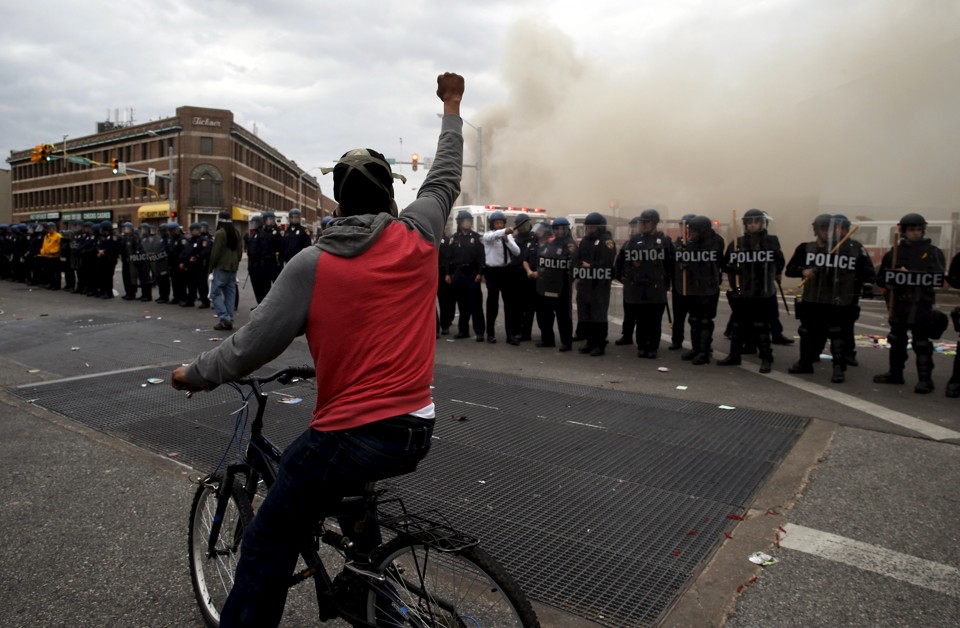
Rioting broke out on Monday in Baltimore—an angry response to the death of Freddie Gray, a death my native city seems powerless to explain. Gray did not die mysteriously in some back alley but in the custody of the city’s publicly appointed guardians of order. And yet the mayor of that city and the commissioner of that city’s police still have no idea what happened. I suspect this is not because the mayor and police commissioner are bad people, but because the state of Maryland prioritizes the protection of police officers charged with abuse over the citizens who fall under its purview.

The citizens who live in West Baltimore, where the rioting began, intuitively understand this. I grew up across the street from Mondawmin Mall, where today’s riots began. My mother was raised in the same housing project, Gilmor Homes, where Freddie Gray was killed. Everyone I knew who lived in that world regarded the police not with admiration and respect but with fear and caution. People write these feelings off as wholly irrational at their own peril, or their own leisure. The case against the Baltimore police, and the society that superintends them, is easily made:

Over the past four years, more than 100 people have won court judgments or settlements related to allegations of brutality and civil rights violations. Victims include a 15-year-old boy riding a dirt bike, a 26-year-old pregnant accountant who had witnessed a beating, a 50-year-old woman selling church raffle tickets, a 65-year-old church deacon rolling a cigarette and an 87-year-old grandmother aiding her wounded grandson ….

And in almost every case, prosecutors or judges dismissed the charges against the victims—if charges were filed at all. In an incident that drew headlines recently, charges against a South Baltimore man were dropped after a video showed an officer repeatedly punching him—a beating that led the police commissioner to say he was “shocked.”

The money paid out by the city to cover for the brutal acts of its police department would be enough to build “a state-of-the-art rec center or renovations at more than 30 playgrounds.” Instead, the money was used to cover for the brutal acts of the city’s police department and ensure they remained well beyond any semblance of justice.

Now, tonight, I turn on the news and I see politicians calling for young people in Baltimore to remain peaceful and “nonviolent.” These well-intended pleas strike me as the right answer to the wrong question. To understand the question, it’s worth remembering what, specifically, happened to Freddie Gray. An officer made eye contact with Gray. Gray, for unknown reasons, ran. The officer and his colleagues then detained Gray. They found him in possession of a switchblade. They arrested him while he yelled in pain. And then, within an hour, his spine was mostly severed. A week later, he was dead. What specifically was the crime here? What particular threat did Freddie Gray pose? Why is mere eye contact and then running worthy of detention at the hands of the state? Why is Freddie Gray dead?

Read more at The Atlantic

Poor People Need a Higher Wage, Not a Lesson in Morality

David Brooks’ rendition of poverty is as “representative” of people with low-incomes as corrupt corporate titans are of small entrepreneurs.

By Greg Kaufmann in The Nation

Baltimore, Maryland (AP Photo/Patrick Semansky)

“The idea that poverty is a problem of persons—that it results from personal moral, cultural, or biological inadequacies—has dominated discussions of poverty for well over two hundred years and given us the enduring idea of the underserving poor.”

—Michael Katz, The Undeserving Poor

In a recent op-ed, New York Times columnist David Brooks called for a “moral revival,” one which requires “holding people responsible” so that we have “social repair.”

To illustrate the need for said revival—which he frames as a reassertion of social norms—Brooks offers what he describes as three “representative figures” of “high school-educated America”: a man whose mother was absent, Dad is in prison, attended seven elementary schools, and “ended up under house arrest”; a girl who was “one of five half-siblings from three relationships,” whose mom lost custody of the kids to an abuser, and whose dad left a woman because another guy had fathered their child; and, finally, a kid who “burned down a lady’s house when he was 13” and says, “I just love beating up somebody and making they nose bleed…and beating them to the ground.”

So goes the latest iteration of the “undeserving poor,” an age-old concept brilliantly excavated by the late historian Michael Katz in his book of the same title. Like the long lineage it stems from, Brooks’ rendition is as “representative” of people with low-incomes as corrupt corporate titans are of small entrepreneurs. Anecdotally, in my years working for Boys and Girls Clubs, reporting as a poverty correspondent for The Nation, and now editing TalkPoverty.org which regularly features posts from people living in poverty—Brooks’ “representative figures” remind me of exactly zero people I have met during this time. I’m not saying that these individuals don’t exist, but they have little to do with the policies or the morality we need to dramatically reduce poverty in America.

Read more at The Nation

Instead of Criminalizing Homelessness, Utah Is Doing the Opposite — And It’s Working

Utah

After Barbara Simons left her abusive husband and the house they lived in together six years ago, she had nowhere to go. She was without a job and her daughter, Jamie, was struggling with mental health issues. She ended up in Salt Lake City, Utah, and feared she’d become homeless.

Then she heard about a program run by the state that would pay for her and Jamie to get an apartment with no strings attached. The Housing First program started in 2005, and Simons says it might have saved her life.

“I don’t know if I’d be alive,” Simons told Mic by phone. “Or I’d be alive and living on the street. It just helped me get back on my feet. It showed that people cared about you.”

Even though Utah is one of the most conservative states in the nation, it has become a leader in progressive policies meant to help the homeless. By proving that a conservative state could solve its chronic homelessness problem for less money than traditional homelessness policies, Utah has become a model for towns, cities and states across the nation.

Read more at Policy.Mic