The Eric Garner case’s sickening outcome

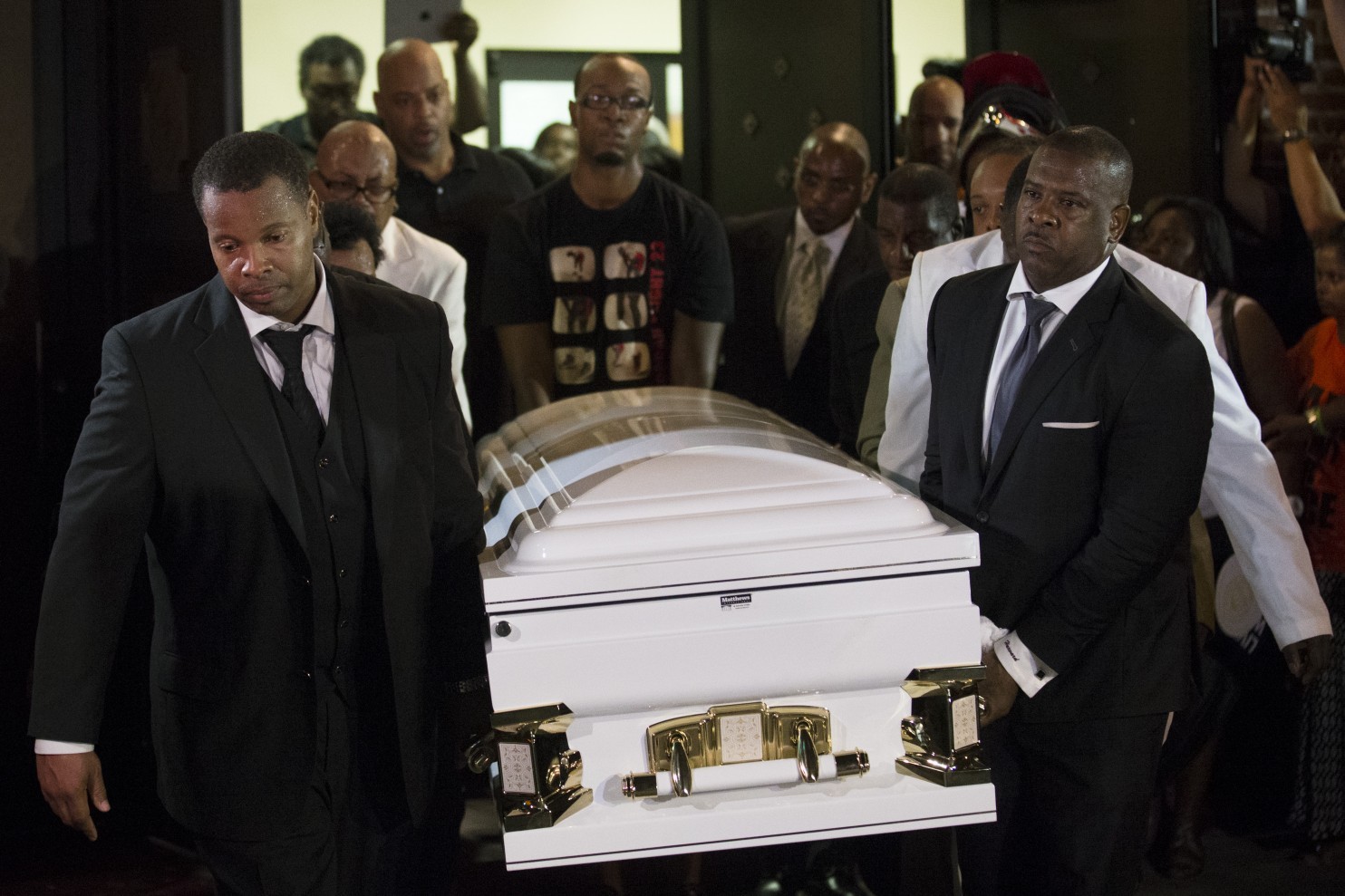
 Pallbearers carry the casket of Eric Garner at Bethel Baptist Church following his funeral service, Wednesday, July 23, 2014, in the Brooklyn borough of New York. (John Minchillo/AP)
Pallbearers carry the casket of Eric Garner at Bethel Baptist Church following his funeral service, Wednesday, July 23, 2014, in the Brooklyn borough of New York. (John Minchillo/AP)

Eugene Robinson in The Washington Post

I can’t breathe.

Those were Eric Garner’s last words, and today they apply to me. The decision by a Staten Island grand jury to not indict the police officer who killed him takes my breath away.

In the depressing reality series that should be called “No Country for Black Men,” this sick plot twist was shocking beyond belief. There should have been an indictment in the Ferguson case, in my view, but at least the events that led to Michael Brown’s killing were in dispute. Garner’s homicide was captured on video. We saw him being choked, heard him plead of his distress, watched as no attempt was made to revive him and his life slipped away.

This time, there were literally millions of eyewitnesses. Somebody tell me, just theoretically, how many does it take? Is there any number that would suffice? Or is this whole “equal justice before the law” thing just a cruel joke?

African American men are being taught a lesson about how this society values, or devalues, our lives. I’ve always said the notion that racism is a thing of the past was absurd — and that those who espoused the “post-racial” myth were either naive or disingenuous. Now, tragically, you see why.

Garner, 43, was an African American man. On July 17, he allegedly committed the heinous crime of selling individual cigarettes on the street. A group of New York City police officers approached and surrounded him. As seen in cellphone video footage recorded by an onlooker, Garner was puzzled that the officers seemed to be taking him into custody for such a piddling offense. He was a big man, but at no point did he strike out at the officers or show them disrespect.

Read more at The Washington Post

Righteous Indignation in Ferguson

By Simon Waxman in the Boston Review

brown-banner

I am not against using violence in self-defense. I don’t even call it violence when it’s self-defense, I call it intelligence. —Malcolm X

The grand jury’s decision to forgo indictment of Ferguson police officer Darren Wilson in the killing of Michael Brown compels us yet again to recognize that there is more to violence than its dictionary definition.

In clinical terms, violence is physical force intended to cause injury. But when officer Wilson shot and killed Michael Brown this past August, he did not engage in violence. He engaged in self-defense. He was justified.

After the jury’s decision was announced, black Americans and their supporters, who see in the non-indictment a form of impunity, took to the streets of Ferguson and St. Louis. Their righteous indignation amounted to a “night of violence,” according to The Guardian and USA Today. KSDK, a St. Louis NBC affiliate, used a common volcanic metaphor: “Violence erupts in Ferguson: Fire, looting, arrests.” Look at any of the major news outlets—shattered store windows and overturned police cruisers. That is violence, and there need be no inquiry into its justification.

Violence is a moral category, not an act. Where aggression is presumptively unjustified, it is violent. Where it is deemed acceptable by the norms of the community in which it occurs, it is not violence.

It is perilous to extrapolate too greatly from a single case, but that peril is not at issue in Ferguson, where Brown’s shooting reflects a widespread and historically endless pattern of white lawmen, and white men acting under cover of law, injuring and killing black men without engaging in what the society calls violence. Here again, the court asked what the victim did to warrant his fate. But the political problem, which courts can’t consider, is who has access to justification.

Read more at the Boston Review

Simon Waxman is the managing editor of the Boston Review.

Also by Simon Waxman: Zimmerman: The Criminal Trial Is a Privilege of Whiteness