7 Bipartisan Reasons to Raise the Minimum Wage

The minimum wage debate is back. Since last year, historically unorganized workers at fast food and big-box retailers across the country have been demanding a higher minimum wage and better working conditions. They are gaining popular support as they become more visible, rallying in big cities and during attention-getting events such as Black Friday.

President Obama, liberals in Congress, and liberals seeking office are making the federal minimum wage a central plank in the effort to combat runaway inequality—now at levels unseen since the 1920s—and push back poverty. Obama has called for increasing the minimum wage from $7.25 per hour to $10.10, with a built-in cost-of-living adjustment tied to inflation. He later announced an executive order requiring federal contractors to observe the $10.10 minimum. And activists at the state and local levels have gone further. California may vote this year on raising its minimum wage to $12.

Increases enjoy wide public support. Recent polls find 76 percent of Americans support a $9 minimum wage. Republicans are split, with 50 percent backing an increase.

There are at least seven reasons voters, if not politicians, in both parties favor a higher minimum wage. They involve concerns about inequality and poverty, about responses to poor wage growth, and about the status of work as well as community. These reasons sometimes conflict, but overall they explain why the minimum wage will continue to play an important role in politics and policy.

Read more at the Boston Review

The “middle class” myth: Here’s why wages are really so low today

(Credit: AP/Darron Cummings)

Let me tell you the story of an “unskilled” worker in America who lived better than most of today’s college graduates. In the winter of 1965, Rob Stanley graduated from Chicago Vocational High School, on the city’s Far South Side. Pay rent, his father told him, or get out of the house. So Stanley walked over to Interlake Steel, where he was immediately hired to shovel taconite into the blast furnace on the midnight shift. It was the crummiest job in the mill, mindless grunt work, but it paid $2.32 an hour — enough for an apartment and a car. That was enough for Stanley, whose main ambition was playing football with the local sandlot all-stars, the Bonivirs.

Stanley’s wages would be the equivalent of $17.17 today — more than the “Fight For 15” movement is demanding for fast-food workers. Stanley’s job was more difficult, more dangerous and more unpleasant than working the fryer at KFC (the blast furnace could heat up to 2,000 degrees). According to the laws of the free market, though, none of that is supposed to matter. All that is supposed to matter is how many people are capable of doing your job. And anyone with two arms could shovel taconite. It required even less skill than preparing dozens of finger lickin’ good menu items, or keeping straight the orders of 10 customers waiting at the counter. Shovelers didn’t need to speak English. In the early days of the steel industry, the job was often assigned to immigrants off the boat from Poland or Bohemia.

“You’d just sort of go on automatic pilot, shoveling ore balls all night,” is how Stanley remembers the work.

So why did Rob Stanley, an unskilled high school graduate, live so much better than someone with similar qualifications could even dream of today? Because the workers at Interlake Steel were represented by the United Steelworkers of America, who demanded a decent salary for all jobs. The workers at KFC are represented by nobody but themselves, so they have to accept a wage a few cents above what Congress has decided is criminal.

The argument given against paying a living wage in fast-food restaurants is that workers are paid according to their skills, and if the teenager cleaning the grease trap wants more money, he should get an education. Like most conservative arguments, it makes sense logically, but has little connection to economic reality. Workers are not simply paid according to their skills, they’re paid according to what they can negotiate with their employers. And in an era when only 6 percent of private-sector workers belong to a union, and when going on strike is almost certain to result in losing your job, low-skill workers have no negotiating power whatsoever.

Read more at Salon

The incredible shrinking deficit

There are still quite a few politicians who claim, just a matter of course, that in the Obama era, the United States runs “a trillion-dollar deficit every year.” It’s clearly time for them to update their talking points.

Closing the books on a fiscal year in which the federal budget deficit fell more sharply than in any year since the end of World War II, the Treasury Department reported on Thursday that the deficit for 2013 dropped to $680 billion, from about $1.1 trillion the previous year.

In nominal terms, that is the smallest deficit since 2008, and signals the end of a five-year stretch beginning with the onset of the recession when the country’s fiscal gap came in at more than $1 trillion each year. As a share of the nation’s economy, the budget deficit fell to about 4.1 percent, from a high of more than 10 percent during the depths of the Great Recession.

The sharp reduction in the deficit last year was boosted in large part by increased government revenue. At the start of the year, the wealthiest taxpayers began paying slightly higher taxes – a policy Republicans said would slow the economy and cause lower federal receipts. We now know GOP policymakers had it backwards: “The Treasury said revenue climbed $324 billion, to $2.8 trillion, from 2012 to 2013. That is growth of around 12.9 percent, reflecting both higher income tax rates and the strengthening economy.”

But congressional Republicans – the folks who had no qualms about rising deficits during the Bush/Cheney era – continue to insist deficit reduction must take priority over pressing national needs. Yesterday, GOP senators went so far as to block a bill on expanded veterans’ benefits, partly out of fears the proposal might increase the deficit a little.

Read more at The MaddowBlog

“Everyone is entitled to his own opinion, but not to his own facts.”
– United States Senator Daniel Patrick Moynihan

The Magical World Where McDonald’s Pays $15 an Hour? It’s Australia

Even in countries with a high minimum wage, the golden arches manage to turn a profit. Here’s how.

Last week, fast-food workers around the United States yet again walked off the job to protest their low pay and demand a wage hike to $15 an hour, about double what many of them earn today. In doing so, they added another symbolic chapter to an eight-month-old campaign of one-day strikes that, so far, has yielded lots of news coverage, but not much in terms of tangible results.

So there’s a certain irony that in Australia, where the minimum wage for full-time adult workers already comes out to about $14.50 an hour, McDonald’s staffers were busy scoring an actual raise. On July 24, the country’s Fair Work Commission approved a new labor agreement between the company and its employees guaranteeing them up to a 15 percent pay increase by 2017.

And here’s the kicker: Many Australian McDonald’s workers were already making more than the minimum to begin with.

The land down under is, of course, not the only high-wage country in the world where McDonald’s does lucrative business. The company actually earns more revenue out of Europe than than it does from the United States. France, with its roughly $12.00 hourly minimum, has more than 1,200 locations. (Australia has about 900).

So how exactly do McDonald’s and other chains manage to turn a profit abroad while paying an hourly wage their American workers can only fantasize about while picketing? Part of the answer, as you might expect, boils down to higher prices. Academic estimates have suggested that, worldwide, worker pay accounts for at least 45 percent of a Big Mac’s cost. In the United States, industry analysts tend to peg the figure a bit lower—labor might make up anywhere from about a quarter of all expenses at your average franchise to about a third.* But generally speaking, in countries where pay is higher, so is the cost of two all-beef patties, as shown in the chart below by Princeton economist Orley Ashenfelter. Note Western Europe way out in the upper-right hand corner, with its high McWages and high Big Mac prices.

Read more at The Atlantic

Too many of America’s working poor have become victims of a bizarre kind of socioeconomic Stockholm Syndrome. I’m talking about poor people who vote the interests of rich people. They’re like dogs begging for scraps from the table of a master who has no intention of sharing anything. But I’m being unfair to dog owners. Most dog owners treat their pets better than some of America’s wealthiest treat their fellow citizens.

Catholic activists want Pope Francis to match words with actions

Sister Teresa Forcades and other left-leaning religious leaders welcome new papal rhetoric but wonder about substance

From her small convent in the mountains near Barcelona, Harvard-educated Sister Teresa Forcades has emerged as a leading advocate of Spain’s “Indignant” protest movement. Lluis Gene/AFP/Getty Images

Spanish revolutionary, Harvard-educated public health specialist, abortion rights advocate and Roman Catholic nun.

These four labels seldom apply to the same person, but Sister Teresa Forcades, a 48-year-old woman from Barcelona, straddles many worlds.

In Europe she is the star of televised debates on feminism and religion, a leader of the Occupy movement in Spain who has taken on big corporate interests and a fierce critic of modern capitalism.

She pulls no punches with her views. “I don’t think it is possible to have democracy and capitalism. They go against each other because the way we live capitalism is that we allow some corporations to have such power that they are able to influence government. And that’s the problem,” she told Al Jazeera in an interview.

Until recently, these controversial opinions might have led to her being reprimanded by the Vatican. But now, with a new leader in power apparently committed to fundamentally changing the church’s approach on social justice issues, she believes she’s merely taking some of Pope Francis’ ideas and running with them.

The new pope has invigorated the previously isolated social justice wing of the church, a change that many leading activists have welcomed. But at the same time, others are warning that his papacy has so far been more about a shift in tone than about substantive change on key issues such as abortion, women’s ordination and gay rights.

In a much-publicized manifesto for his papacy, Francis lamented the misguided priorities of a world obsessed with money. “How can it be that it is not a news item when an elderly homeless person dies of exposure, but it is news when the stock market loses 2 points?” he asked.

Francis drives an old Renault, refuses to live in luxurious papal suites, invites homeless people over for dinner and expelled a German bishop for his exorbitant lifestyle. His focus on social justice represents a stark departure from his predecessors’ focus on doctrine and propelled grassroots activism back into the spotlight.

Forcades said his words hinted at a possible revival of liberation theology, a branch of religious philosophy that “has been where the poor have been” and looks at the imperative “to lose fear to be like Jesus was, entangled in political matters.”

In the 1980s, liberation theologists in Latin America worked with local activists against poverty as part of a political movement for the rights of the oppressed. Accused of professing Marxism under the guise of social justice theories, many priests were driven out of countries such as Nicaragua and Mexico, where they assisted local activists in combating poverty and authoritarian governments.

Read more at Al Jazeera

Sen. Elizabeth Warren Proposes Replacing Payday Lenders With the Post Office

Senator Elizabeth Warren (AP Photo/Jacquelyn Martin)

The Postal Service (USPS) could spare the most economically vulnerable Americans from dealing with predatory financial companies under a proposal endorsed over the weekend by Sen. Elizabeth Warren (D-MA).

“USPS could partner with banks to make a critical difference for millions of Americans who don’t have basic banking services because there are almost no banks or bank branches in their neighborhoods,” Warren wrote in a Huffington Post op-ed on Saturday. The op-ed picked up on a report from the USPS’s Inspector General that proposed using the agency’s extensive physical infrastructure to extend basics like debit cards and small-dollar loans to the same communities that the banking industry has generally ignored. The report found that 68 million Americans don’t have bank accounts and spent $89 billion in 2012 on interest and fees for the kinds of basic financial services that USPS could begin offering. The average un-banked household spent more than $2,400, or about 10 percent of its income, just to access its own money through things like check cashing and payday lending stores. USPS would generate savings for those families and revenue for itself by stepping in to replace those non-bank financial services companies.

Those companies are among the most predatory actors in the money business. Payday loans with annual interest rates well north of 100 percent suck paying $520 to borrow $375. After decades of operating in a regulatory blind spot and ducking state-level reforms, the payday lending business now faces a crackdown from the Consumer Financial Protection Bureau. The threat of new rules for short-term cash loans in general has caused traditional banks to stop offering deposit-advance loans with similar features.

Read more at ThinkProgress Link via Moyers and Company

Republican Congressional Candidate Touts Progressive Minimum Wage Fix

GOP nominee in FL-13 David Jolly CREDIT: AP

An unlikely advocate for one of the most progressive minimum wage proposals emerged last week: Republican congressional candidate David Jolly.

Democratic nominee Alex Sink supports raising the minimum wage to $10.10, as is currently being considered in Congress, while Jolly opposes it. However, in explaining his position to the Tribune, Jolly actually advocated another progressive proposal: indexing the minimum wage so it automatically increases every year.

“Minimum wage should be indexed to inflation or subject to a cost-of-living adjustment like any other federal income program,” Jolly said. “That means some years it may go up, other years it may stay static. Barack Obama is not an economist, neither is the Congress.”

The purchasing power of the minimum wage has significantly lagged the rate of inflation over the past four decades. In 1968, the federal minimum wage was $1.60 per hour. Had it kept up with inflation since then, it would currently be set at $10.50, 45 percent higher than its current rate of $7.25.

In addition, if Jolly preferred tying the minimum wage to increases in worker productivity, it would currently be $18.30 per hour, according to a study from the Economic Policy Institute.

Indexing the minimum wage is a strongly progressive proposal because it would give low-income workers a raise every year without having to rely on Congress, which has only voted for an increase once in the last decade.

Read more at ThinkProgress

Support quality journalism. Subscribe to ThinkProgress

I Wear the Badge of Socialist With Honor

The full text of the new Seattle city council member’s inauguration speech.

kshama_sawant_inauguration_ap_img

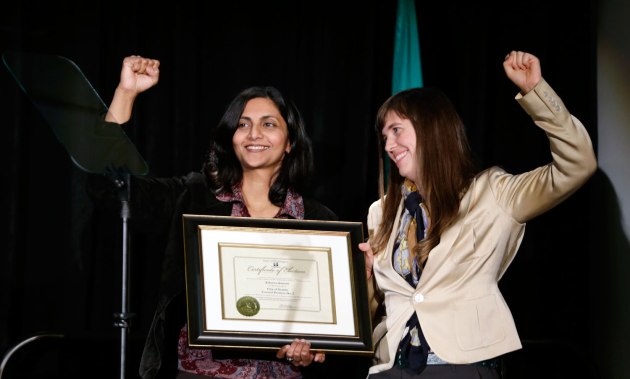
New Seattle Council member Kshama Sawant, left, stands with Nicole Grant, who assisted in a ceremonial swearing-in. (AP Photo/Elaine Thompson)

Editor’s note: At a ceremonial swearing-in on Monday, Kshama Sawant became Seattle’s first socialist city council member in almost a century. The full text of her inauguration speech is below.

My brothers and sisters,

Thank you for your presence here today.

This city has made glittering fortunes for the super wealthy and for the major corporations that dominate Seattle’s landscape. At the same time, the lives of working people, the unemployed and the poor grow more difficult by the day. The cost of housing skyrockets, and education and healthcare become inaccessible.

This is not unique to Seattle. Shamefully, in this, the richest country in human history, fifty million of our people—one in six—live in poverty. Around the world, billions do not have access to clean water and basic sanitation and children die every day from malnutrition.

This is the reality of international capitalism. This is the product of the gigantic casino of speculation created by the highway robbers on Wall Street. In this system the market is God, and everything is sacrificed on the altar of profit. Capitalism has failed the 99%.

Despite recent talk of economic growth, it has only been a recovery for the richest 1%, while the rest of us are falling ever farther behind.

The Nation

Why the American Right Attacks the Poor

19th century engraving Via New York Public Library Digital Collection. Image from Wikipedia Commons.

The defining philosophical argument being made on the American political right today should not be surprising. And that is because the need to make that argument is also not new.

In every society in human history, in which so many have been forced to live in states of perpetual poverty, violence and despair–in the midst of obscene opulence and privilege for a very few–there has been a compelling need to explain the relationship of these facts.

There has also always been a need for a counter narrative to be created and promulgated in order to deflect attention from the most obvious causes of social and economic injustices.

Poverty has often been explained as a consequence of individual moral failures. And the exploitation of the weak and the poor by the powerful and wealthy has also been denied as a possible cause of human suffering in society.

But an autopsy of every historic incidence of social decay and human degradation has revealed the same shockingly obvious and simple truth: that it is the poverty of the many that has always subsidized the wealth of a privileged few.

© 2013 by Paul Kennedy

“Dark Money” Funds Climate Change Denial Effort

A Drexel University study finds that a large slice of donations to organizations that deny global warming are funneled through third-party pass-through organizations that conceal the original funder

A shift to untraceable donations by organizations denying climate change undermines democracy, according to the author of a new study tracking contributions to such groups.

Image: Wikimedia Commons/Carol M. Highsmith

The largest, most-consistent money fueling the climate denial movement are a number of well-funded conservative foundations built with so-called “dark money,” or concealed donations, according to an analysis released Friday afternoon.

The study, by Drexel University environmental sociologist Robert Brulle, is the first academic effort to probe the organizational underpinnings and funding behind the climate denial movement.

It found that the amount of money flowing through third-party, pass-through foundations like Donors Trust and Donors Capital, whose funding cannot be traced, has risen dramatically over the past five years.

In all, 140 foundations funneled $558 million to almost 100 climate denial organizations from 2003 to 2010.

Meanwhile the traceable cash flow from more traditional sources, such as Koch Industries and ExxonMobil, has disappeared.

The study was published Friday in the journal Climatic Change.

“The climate change countermovement has had a real political and ecological impact on the failure of the world to act on global warming,” Brulle said in a statement. “Like a play on Broadway, the countermovement has stars in the spotlight – often prominent contrarian scientists or conservative politicians – but behind the stars is an organizational structure of directors, script writers and producers.”

“If you want to understand what’s driving this movement, you have to look at what’s going on behind the scenes.”

Read more at Scientific American