American Slavery, Reinvented

The Thirteenth Amendment forbade slavery and involuntary servitude, “except as punishment for crime whereof the party shall have been duly convicted.”

lead_960

Crops stretch to the horizon. Black bodies pepper the landscape, hunched over as they work the fields. Officers on horseback, armed, oversee the workers.

To the untrained eye, the scenes in Angola for Life: Rehabilitation and Reform Inside the Louisiana State Penitentiary, an Atlantic documentary filmed on an old Southern slave-plantation-turned-prison, could have been shot 150 years ago. The imagery haunts, and the stench of slavery and racial oppression lingers through the 13 minutes of footage.

The film tells two overlapping stories: One is of accomplishment against incredible odds, of a man who stepped into the most violent maximum-security prison in the nation and gave the men there—discarded and damned—what society didn’t: hope, education, and a moral compass. Burl Cain, the warden of Angola Prison, which is in Louisiana, has created a controversial model for rehabilitation. Through work and religion, they learn to help each other, and try to become better fathers to their children on the outside. Perhaps the lucky few even find redemption.

But there is a second storyline running alongside the first, which raises disquieting questions about how America treats those on the inside as less than fully human. Those troubling opening scenes of the documentary offer visual proof of a truth that America has worked hard to ignore: In a sense, slavery never ended at Angola; it was reinvented.

Some viewers of the video might be surprised to learn that inmates at Angola, once cleared by the prison doctor, can be forced to work under threat of punishment as severe as solitary confinement. Legally, this labor may be totally uncompensated; more typically inmates are paid meagerly—as little as two cents per hour—for their full-time work in the fields, manufacturing warehouses, or kitchens. How is this legal? Didn’t the Thirteenth Amendment abolish all forms of slavery and involuntary servitude in this country?

Read more at The Atlantic

How an obscure drug’s 4,000% price increase might finally spur action on soaring health-care costs

imrs.php

By Carolyn Johnson

Spectacularly high drug prices have become a political punching bag, especially since Turing Pharmaceuticals struck a nerve by increasing the price of a 62-year-old drug by more than 4,000 percent — a mind-boggling increase similar to waking up one day and finding out a gallon of gas costs nearly $100.

Hillary Rodham Clinton announced on Twitter that she’d lay out a plan to help control the “price gouging” in the pharmaceutical industry, which she called “outrageous.” Meanwhile, Sen. Bernie Sanders (I-Vt.) and Rep. Elijah E. Cummings (D-Md.) this summer launched an investigation into exorbitant drug prices and began sending letters to drug companies requesting information about their prices.

The details do indeed turn out to be as insane as they sound. But behind them lurks a real lesson about the way drugs are priced in the United States and what role they actually play in the trillion-dollar fight over controlling health-care costs.

New York-based Turing bought the drug called Daraprim for $55 million this summer. It is used to treat toxoplasmosis, a parasitic infection that can be severe in patients with compromised immune systems, such as HIV, and for pregnant women. Earlier this month, the head of the Infectious Diseases Society of America and the HIV Medicine Association condemned the price increase from $13.50 a pill to $750, noting that the average cost per year for a patient weighing more than 132 pounds would be $634,500

Read more at The Washington Post

Bernie Sanders Declares War On America’s Corrupt For Profit Prison System With New Bill

bernie-sanders-announces-2016

Bernie Sanders is striking back at corporate America’s prison industrial complex with a new bill that abolishes for profit prisons.

In a statement, Sanders discussed his new legislation:

It is clear to most Americans that we need major reforms in our broken criminal justice system. We need to end the tragic reality that the United States has more people in jail than any other country on earth, and that the people being incarcerated are disproportionately black and Hispanic. We need to take a hard look at why the rate of recidivism in this country is so high and why we are not developing successful paths back to civil society for those who serve prison time. Further we need to end, once and for all, the disgraceful practice of corporations profiting from the incarceration of Americans.

As a nation, our goal must be to do everything we can to create the conditions that prevent mass incarceration. At a time when we are spending $50 billion a year on our correctional system, it makes a lot more sense to me to be investing in jobs and education for our young people than in more and more jails. Not only can we prevent thousands of lives from being destroyed, we can save billions of taxpayer dollars. Locking people up is a lot more expensive than schools.

My legislation will eliminate federal, state and local contracts for privately run prisons within 2 years. It will reinstate the federal parole system. It will increase oversight and eliminate the overcharging of prisoners by private companies for banking and other services. It will end the mandatory quota of immigrants detained. It will require ICE to improve the monitoring of detention facilities and eliminate private detention centers within 2 years.

The private prison industry makes money by keeping individuals incarcerated. The motivation in a for-profit prison system has nothing to do with the common good or the benefit of society. Private prisons make money for their corporate owners by keeping as many people locked up as cheaply as possible.

Read more at PoliticusUSA

 This Is What Greece’s Refugee Crisis Really Looks Like

“Thanks to God I have made it here. I am free, I am alive!”

 Refugees arriving on the isle of Lesbos in a dinghy from Turkey. (Lazar Simeonov)
Refugees arriving on the isle of Lesbos in a dinghy from Turkey. (Lazar Simeonov)

By Jesse Rosenfeld

Lesbos, Athens, and northern Greece—In the baking midday August heat on the Greek island of Lesbos, Ziad Mouatash bounces out of an overcrowded inflatable raft and touches EU soil for the first time. The 22-year-old from Yarmouk—the Palestinian refugee camp on the edge of Damascus that has been besieged and bombed since 2012 by Bashar al-Assad’s forces and recently invaded by ISIS and the Al Qaeda–affiliated Nusra Front—hugs everyone around him, ecstatic to be alive.

From the Greek shore, activists and locals had looked on helplessly as the boat’s motor broke down two miles away, water pouring into the barely floating rubber dinghy. Children and adults alike cried desperately for help, until they were towed to Greece by another boat of refugees coming from Turkey.

Mouatash paid human traffickers in Turkey over 1,000 euros for this near-death experience, but as far as he’s concerned, it was a far less risky choice than continuing to hide out in deteriorating Damascus, which he’d abandoned for Turkey two weeks before. As a Palestinian who grew up in Syria’s refugee camps, he is stateless, but he has a brother in Paris and hopes to start a new life in France.

He paces up and down the shoreline, unsure of which direction to go, while local activists try to bring the new arrivals together to tell them that they need to start a 40-mile walk to a registration center on the other side of the island.

 Although he has escaped the horrors of Syria’s grinding civil war, Mouatash is just beginning the difficult journey through Europe. He will have to cross more borders illegally; rest in filthy, makeshift camps; pay traffickers to help him cross those borders; dodge border police; and sleep in parks and fields, before he can reunite with his brother. Still, Mouatash is one of the lucky ones. Four days after his arrival, a raft off the Greek island of Kos capsized and six Syrians—including a baby—drowned.

Read more at The Nation

Supreme Court Ruling Makes Same-Sex Marriage a Right Nationwide

By Adam Liptak in The New York Times

 The White House was illuminated in honor of same-sex marriage.
The White House was illuminated in honor of same-sex marriage.

WASHINGTON — In a long-sought victory for the gay rights movement, the Supreme Court ruled by a 5-to-4 vote on Friday that the Constitution guarantees a right to same-sex marriage.

“No longer may this liberty be denied,” Justice Anthony M. Kennedy wrote for the majority in the historic decision. “No union is more profound than marriage, for it embodies the highest ideals of love, fidelity, devotion, sacrifice and family. In forming a marital union, two people become something greater than once they were.”

Marriage is a “keystone of our social order,” Justice Kennedy said, adding that the plaintiffs in the case were seeking “equal dignity in the eyes of the law.”

The decision, which was the culmination of decades of litigation and activism, set off jubilation and tearful embraces across the country, the first same-sex marriages in several states, and resistance — or at least stalling — in others. It came against the backdrop of fast-moving changes in public opinion, with polls indicating that most Americans now approve of the unions.

The court’s four more liberal justices joined Justice Kennedy’s majority opinion. Each member of the court’s conservative wing filed a separate dissent, in tones ranging from resigned dismay to bitter scorn.

Read more at The New York Times

Have Turkish Voters Renounced Islamist Dictatorship?

Turkey sees end of single party gov’t as AK Party vote drops significantly – Today’s Zaman

800px-Turkish-flag.svg
By Nevit Dilmen (Image:Turkishflag.jpg) [CC BY-SA 2.0], via Wikimedia Commons
After 13 years of domination as a single-party government, the Justice and Development Party (AK Party), which has been receiving growing criticism for pursuing highly divisive, authoritarian and repressive policies, saw a significant erosion of support in Sunday’s election and it failed to secure the 276 seats in the Parliament necessary to continue its single-party rule for another term.

The pro-Kurdish Peoples’ Democratic Party’s (HDP), which opted to run as a party in this election for the first time, rather than fielding independent candidates to circumvent the country’s 10 percent election threshold, managed to pass the barrier, which reduced the number of seats in Parliament that would have otherwise gone to the AK Party. Hence, the establishment of a coalition government is back on Turkey’s agenda after more than a decade.

The unofficial results of the election, which many said was more like a referendum in that would determine the fate and political future of the country – becoming either more authoritarian or denying President Erdoğan the changes he aspires to and curbing his power – indicated that the AK Party received 40.6 percent, the main opposition Republican People’s Party (CHP) received 25.3 percent, the Nationalist Movement Party (MHP) received 16 percent while the HDP, which widened its appeal beyond its core Kurdish vote to center-left and secularist segments disillusioned with Erdoğan, received 12.7 percent of the nationwide vote. These percentages translate into 257 seats for the AK Party, 131 for the CHP, 83 for the MHP and 79 for the HDP.

Sunday’s vote was held amid concerns of vote rigging, prompting more than 50,000 people to sign up to serve as election monitors. The fears were not without reason, as last year’s local elections, held on March 30, were overshadowed by allegations of election fraud due to the discrepancies between the numbers recorded at polling stations and those actually entered into the country’s election authority, the Higher Election Board (YSK), in addition to suspicious power outages taking place across 22 provinces during the vote count.

On Sunday, the mood was tense at some polling stations, particularly in the country’s predominantly Kurdish Southeast, after a bombing on Friday killed two people and wounded at least 200 at an election rally for the HDP, which has been a frequent target of violence in the run-up to the polls.

Read more at Today’s Zaman

Bernie Sanders Announces His Candidacy for President of the United States

George W. Bush’s CIA Briefer: Bush and Cheney Falsely Presented WMD Intelligence to Public

By David Corn in Mother Jones

On “Hardball,” Michael Morell concedes the Bush administration misled the nation into the Iraq War.

Former CIA Deputy Director Michael Morell is sworn in as he testifes before the House Intelligence Committee. Manuel Balce Ceneta/AP

For a dozen years, the Bush-Cheney crowd have been trying to escape—or cover up—an essential fact of the W. years: President George Bush, Vice President Dick Cheney, and their lieutenants misled the American public about the WMD threat supposedly posed by Saddam Hussein in order to grease the way to the invasion of Iraq. For Bush, Cheney, and the rest, this endeavor is fundamental; it is necessary to protect the legitimacy of the Bush II presidency. Naturally, Karl Rove and other Bushies have quickly tried to douse the Bush-lied-us-into-war fire whenever such flames have appeared. And in recent days, as Jeb Bush bumbled a question about the Iraq War, he and other GOPers have peddled the fictitious tale that his brother launched the invasion because he was presented lousy intelligence. But now there’s a new witness who will make the Bush apologists’ mission even more impossible: Michael Morell, a longtime CIA official who eventually became the agency’s deputy director and acting director. During the preinvasion period, he served as Bush’s intelligence briefer.

Appearing on MSNBC’s Hardball on Tuesday night, Morell made it clear: The Bush-Cheney administration publicly misrepresented the intelligence related to Iraq’s supposed WMD program and Saddam’s alleged links to Al Qaeda.

Host Chris Matthews asked Morell about a statement Cheney made in 2003: “We know he [Saddam Hussein] has been absolutely devoted to trying to acquire nuclear weapons. And we believe he has, in fact, reconstituted nuclear weapons.” Here’s the conversation that followed:

MATTHEWS: Was that true?

MORELL: We were saying—

MATTHEWS: Can you answer that question? Was that true?

MORELL: That’s not true.

MATTHEWS: Well, why’d you let them get away with it?

Read more at Mother Jones

Bernie Sanders is more serious than you think

Give ‘Em Hell, Bernie

 Bernie Sanders’ entrance into the 2016 presidential race isn't a footnote to the inevitable coronation of Hillary Clinton as the Democratic nominee. Win McNamee/Getty
Bernie Sanders’ entrance into the 2016 presidential race isn’t a footnote to the inevitable coronation of Hillary Clinton as the Democratic nominee. Win McNamee/Getty

By Matt Taibbi April 29, 2015

Many years ago I pitched a magazine editor on a story about Bernie Sanders, then a congressman from Vermont, who’d agreed to something extraordinary – he agreed to let me, a reporter, stick next to him without restrictions over the course of a month in congress.

“People need to know how this place works. It’s absurd,” he’d said. (Bernie often uses the word absurd, his Brooklyn roots coming through in his pronunciation – ob-zert.)

Bernie wasn’t quite so famous at the time and the editor scratched his head. “Bernie Sanders,” he said. “That’s the one who cares, right?”

“Right, that’s the guy,” I said.

I got the go-ahead and the resulting story was a wild journey through the tortuous bureaucratic maze of our national legislature. I didn’t write this at the time, but I was struck every day by what a strange and interesting figure Sanders was.

Many of the battles he brought me along to witness, he lost. And no normal politician would be comfortable with the optics of bringing a Rolling Stone reporter to a Rules Committee hearing.

But Sanders genuinely, sincerely, does not care about optics. He is the rarest of Washington animals, a completely honest person. If he’s motivated by anything other than a desire to use his influence to protect people who can’t protect themselves, I’ve never seen it. Bernie Sanders is the kind of person who goes to bed at night thinking about how to increase the heating-oil aid program for the poor.

This is why his entrance into the 2016 presidential race is a great thing and not a mere footnote to the inevitable coronation of Hillary Clinton as the Democratic nominee. If the press is smart enough to grasp it, his entrance into the race makes for a profound storyline that could force all of us to ask some very uncomfortable questions.

Here’s the thing: Sanders is a politician whose power base is derived almost entirely from the people of the state of Vermont, where he is personally known to a surprisingly enormous percentage of voters.

Read more at Rolling Stone

Nonviolence as Compliance

Officials calling for calm can offer no rational justification for Gray’s death, and so they appeal for order.

lead_960

By Ta-Nehisi Coates in The Atlantic

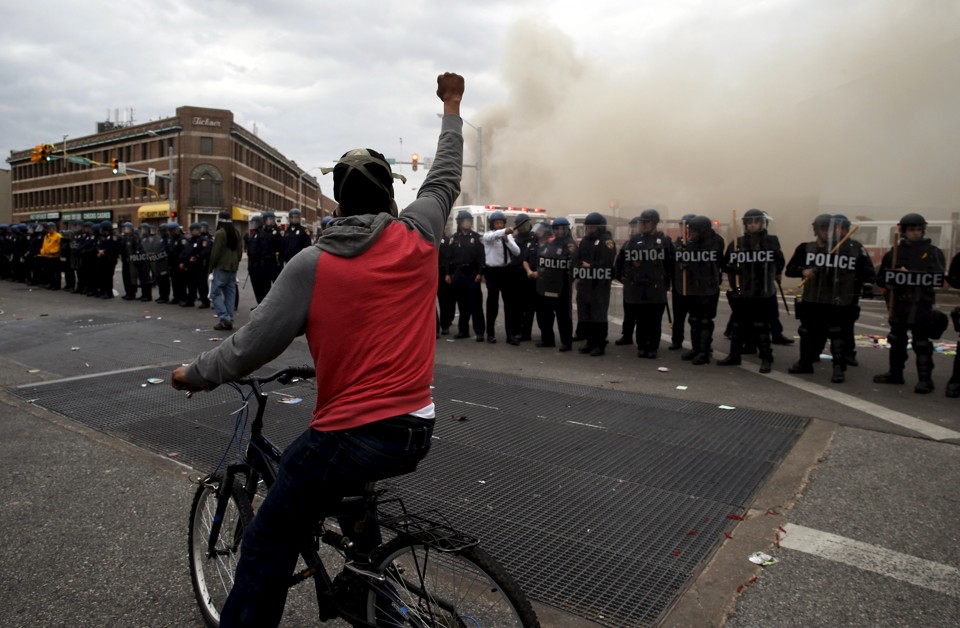
Rioting broke out on Monday in Baltimore—an angry response to the death of Freddie Gray, a death my native city seems powerless to explain. Gray did not die mysteriously in some back alley but in the custody of the city’s publicly appointed guardians of order. And yet the mayor of that city and the commissioner of that city’s police still have no idea what happened. I suspect this is not because the mayor and police commissioner are bad people, but because the state of Maryland prioritizes the protection of police officers charged with abuse over the citizens who fall under its purview.

The citizens who live in West Baltimore, where the rioting began, intuitively understand this. I grew up across the street from Mondawmin Mall, where today’s riots began. My mother was raised in the same housing project, Gilmor Homes, where Freddie Gray was killed. Everyone I knew who lived in that world regarded the police not with admiration and respect but with fear and caution. People write these feelings off as wholly irrational at their own peril, or their own leisure. The case against the Baltimore police, and the society that superintends them, is easily made:

Over the past four years, more than 100 people have won court judgments or settlements related to allegations of brutality and civil rights violations. Victims include a 15-year-old boy riding a dirt bike, a 26-year-old pregnant accountant who had witnessed a beating, a 50-year-old woman selling church raffle tickets, a 65-year-old church deacon rolling a cigarette and an 87-year-old grandmother aiding her wounded grandson ….

And in almost every case, prosecutors or judges dismissed the charges against the victims—if charges were filed at all. In an incident that drew headlines recently, charges against a South Baltimore man were dropped after a video showed an officer repeatedly punching him—a beating that led the police commissioner to say he was “shocked.”

The money paid out by the city to cover for the brutal acts of its police department would be enough to build “a state-of-the-art rec center or renovations at more than 30 playgrounds.” Instead, the money was used to cover for the brutal acts of the city’s police department and ensure they remained well beyond any semblance of justice.

Now, tonight, I turn on the news and I see politicians calling for young people in Baltimore to remain peaceful and “nonviolent.” These well-intended pleas strike me as the right answer to the wrong question. To understand the question, it’s worth remembering what, specifically, happened to Freddie Gray. An officer made eye contact with Gray. Gray, for unknown reasons, ran. The officer and his colleagues then detained Gray. They found him in possession of a switchblade. They arrested him while he yelled in pain. And then, within an hour, his spine was mostly severed. A week later, he was dead. What specifically was the crime here? What particular threat did Freddie Gray pose? Why is mere eye contact and then running worthy of detention at the hands of the state? Why is Freddie Gray dead?

Read more at The Atlantic