RNC Turns Deaf Ear To Questions About Trip Funded by Hate Group

Gage Skidmore [CC BY-SA 3.0], via Wikimedia Commons
Republican National Committee Chairman Reince Priebus photo attribution: Gage Skidmore [CC BY-SA 3.0], via Wikimedia Commons

Last week, the Southern Poverty Law Center (SPLC) faxed and sent letters to every member of the Republican National Committee (RNC) regarding an upcoming trip to Jerusalem being organized by RNC Chair Reince Priebus.

The letters expressed concern about the organization paying for the trip, the American Family Association (AFA), which the SPLC has listed as an anti-LGBT hate group since 2010.

In particular, the letters asked RNC members not to lend their good offices to an organization with a long track record of making anti-LGBT, anti-Muslim and other hateful statements. An email to Priebus’ director of communications about this matter was not responded to.

In early December, Time reported that 60 members, or about a third, of the RNC had decided to travel to Israel. But you wouldn’t know that from the calls we made. We left dozens of voicemails and sent many, many emails, none of which were replied to.

In Illinois, Indiana, Iowa, Oklahoma and Tennessee, communications directors were unaware of the trip and promised to speak with RNC members and get back to us. They did not. Other state communications directors, like those in Maryland and Louisiana, said they knew nothing of the trip and could not answer questions. In Idaho, a communications staffer told us she had no idea what we were talking about, but that she would have known about a trip if there was one.

Read more at the Southern Poverty Law Center

Well, well. It seems that the fascists have been planning a nice little putsch. Speak of strange bedfellows.

As Syria’s Revolution Sputters, a Chaotic Stalemate

 TORN BY WAR The view from a mosque in Homs, Syria, that has served as a rallying point for insurgents.  Credit Sergey Ponomarev for The New York Times
TORN BY WAR The view from a mosque in Homs, Syria, that has served as a rallying point for insurgents. Credit Sergey Ponomarev for The New York Times

By Anne Barnard in The New York Times

ANTAKYA, Turkey — It was a victory that President Bashar al-Assad’s opponents had dreamed of: Insurgents seized a key army base in northern Syria after more than a year of trying. But the mood in this Turkish border town, flooded with Syrians who have fled both government bombings and extremist insurgents, was more bitter than celebratory.

The assault this month was led by the Nusra Front, Al Qaeda’s arm in Syria, which claimed the spoils. By contrast, many of the first Syrians to rise up against Mr. Assad in 2011 — civilian demonstrators and army defectors alike — followed the battle from the sidelines here, unable to enter Syria under threat of death from the extremists of Nusra and its rival group, the Islamic State.

As Syria’s war heads toward its fourth year, the complex battleground is increasingly divided between the government and the extremists, leaving many Syrians feeling that the revolution on which they gambled their lives and livelihoods has failed.

Different insurgent groups battle one another, even as they fight against Mr. Assad’s forces and his allies, foreign Shiite militias. A chaotic stalemate reigns in a war that has killed more than 200,000 people and wounded one million.

In northern and eastern Syria, where Mr. Assad’s opponents won early victories and once dreamed of building self-government, the nationalist rebel groups calling themselves the Free Syrian Army are forced to operate under the extremists’ umbrellas, to go underground or to flee, according to Syrian insurgents, activists and two top commanders of the American-financed F.S.A. groups.

Read more at The New York Times

Why Merav Michaeli Is Upbeat About the Israeli Left

 Photograph via flickr
Photograph via flickr

Merav Michaeli, the Israeli journalist and women’s rights activist-turned-Knesset member for the Labor Party, is a sign of hope for a progressive future in Israel. Last Tuesday, she tried to convince an exclusive crowd of worried Jewish leftists gathered in an apartment on Manhattan’s Upper West Side that there was hope for the upcoming elections and for the future of a democratic Israel. The talk was sponsored by the progressive Zionist organization Ameinu, and also included journalists, professors, high-ranking members of the New Israel Fund and Encounter, along with representatives from Hillel, Habonim Dror, and others. What followed was a passionate, sometimes heated, and surprisingly optimistic discussion of the future of the Jewish State and the role American Jews can play.

*The first question asked was about the nationality bill, the controversial proposed law to officially declare Israel the “Nation-State of the Jewish People.” This question proved an easy one—since there is no Knesset, there will be no nationality bill. When there is a new Knesset, its makeup will likely be so different that it won’t even be proposed again.

*On the coming elections slated for March 17: Though the mood in the room suggested I was not alone in hearing virtually nothing but terrifying predictions of a rout by the right and another term for Netanyahu, if not a first term for the ultra-nationalist Jewish Home Party’s Naftali Bennett, she was hopeful. For the first time in a long time, she said, there was actually a good chance a center-left coalition headed by her Labor Party will take power, meaning Labor leader Isaac Herzog and not Bibi Netanyahu would be Prime Minister. “The feeling towards Netanyahu right now, there is so much grudge and hatred, people are sick of him. His approval ratings are very, very low,” she said.

To capitalize on this, Labor is busy forming a center-left bloc of parties that will include the recently-fired former justice minister Tzipi Livni and former defense secretary and chief of staff Shaul Mofaz to give Herzog an additional vote of confidence among the public. Though the political climate in Israel is notoriously quick to change, polls show that if the election were held today, this coalition would win the majority of votes. The goal, she said, is to create, “One address for people who want to restore a more democratic Israel, one that works towards narrowing gaps in society.”

Read more at The Jewish Daily Forward

Brave New Turkey

Gobierno de Chile [CC BY 3.0 cl (http://creativecommons.org/licenses/by/3.0/cl/deed.en)], via Wikimedia Commons
President Recep Tayyip Erdogan of Turkey Gobierno de Chile [CC BY 3.0 cl], via Wikimedia Commons

By Andrew Finkel in The New York Times

ISTANBUL — Freedom House, the democracy watchdog, earlier this year downgraded the Turkish press from being “partly free” to “not free.” Now it may have to create a new category: “not free at all.”

On Sunday, Dec. 14, Turkish police raided the headquarters of Zaman, the country’s most widely circulated daily, and a major television station, taking into custody at least 24 people, including the paper’s editor-in-chief and the station’s director. (The editor has since been released.) They were detained on suspicions of “establishing a terrorist group.” But the New York-based Committee to Protect Journalists said the raids smacked “of political vengeance.”

A decade ago Recep Tayyip Erdogan, then Turkey’s prime minister, was the most likely candidate to lead the Islamic world. He had managed to keep Turkey out of the 2003 Iraq War, was grooming it for membership in the European Union, and was getting on with economic reform. Ordinary Turks were feeling prosperous, proud and hopeful. So why is the Turkish government now going off the rails when it has been perfectly popular doing the right things?

Today Mr. Erdogan is the president, and his style is in-your-face confrontational. He is revered by enough people to get his party re-elected, but many others loathe him (remember the protests in Gezi Park?), and some of his eccentricities have made him a favorite of headline writers. Like a potentate of some Sacha Baron Cohen parody, he has had a presidential palace with over a thousand rooms built for himself. No one knows how much it cost: The government agency responsible for the construction says the sum is a state secret because its disclosure would damage the economy.

Read more at The New York Times

How the Statue of Liberty Almost Ended Up in Egypt

By Dora Hasan Mekouar in Voice of America

The Statue of Liberty looks out on the lower Manhattan skyline, January 2014. (AP)

Instead of imploring the world to “give me your tired, your poor”, the Statue of Liberty’s welcoming message might well have been “as-salamu alaykum”, the Arabic greeting used by Muslims around the world.

That’s right, the world’s most recognized symbol of freedom and the American dream, was originally intended for Egypt, which ultimately rejected it for being too old fashioned.

The decision came as a disappointment to Lady Liberty’s creator, Frédéric Auguste Bartholdi, who’d envisioned the Suez Canal as the ideal venue for his mammoth harbor structure.

The decision came as a disappointment to Lady Liberty’s creator, Frédéric Auguste Bartholdi, who’d envisioned the Suez Canal as the ideal venue for his mammoth harbor structure.
Statue of Liberty creator Frédéric Auguste Bartholdi’s original design for the mouth of the Suez Canal in Egypt.

“He was inspired by the Sphinx and the pyramids and the idea you could create something massive that could almost be eternal,” said Elizabeth Mitchell, who brings Bartholdi’s quest to life in her book Liberty’s Torch: The Great Adventure to Build the Statue of Liberty.

Mitchell was motivated to write the book after coming across Bartholdi’s diaries at the New York City Public Library. That’s when she first realized the iconic symbol wasn’t a gift from France as many Americans believe.

“In fact, the true story is more moving because what you have is this individual artist who had a vision and he really wanted to make this happen,” Mitchell said, “and he really had to go through every machination to get this thing built.”

After his failure in Egypt, the artist shifted his attention to America, which was prospering after the end of the Civil War.

“Maybe no other country at the time would understand the excitement and importance of having this bigger-than-life, colossal symbol,” Mitchell said.

Read more at Voice of America

Out of control: How the world’s health organizations failed to stop the Ebola disaster

 Two people lay dead on the floor Sept. 20 inside a ward at the Redemption Hospital, which has become a transfer and holding center for Ebola patients in the New Kru Town slum of Monrovia, Liberia.

Two people lay dead on the floor Sept. 20 inside a ward at the Redemption Hospital, which has become a transfer and holding center for Ebola patients in the New Kru Town slum of Monrovia, Liberia.

Tom Frieden remembers the young woman with the beautiful hair, dyed a rusty gold and braided meticulously, elaborately, perhaps by someone who loved her very much. She was lying facedown, half off the mattress. She had been dead for hours, and flies had found the bare flesh of her legs.

Two other bodies lay nearby. Bedridden patients who had not yet succumbed said of the dead, “Please, get them out of here.”

Frieden, the director of the U.S. Centers for Disease Control and Prevention (CDC), knew it was no simple matter to properly carry away a body loaded with Ebola virus. It takes four people wearing protective suits, one at each corner of the body bag. On that grim day near the end of August, in a makeshift Ebola ward in Monrovia, Liberia, burial teams already had lugged 60 victims to a truck for the trip to the crematorium.

Frieden had seen plenty of death over the years, but this was far worse than he expected, a plague on a medieval scale. “A scene out of Dante,” he called it.

Shaken, he flew back to the United States on Aug. 31 and immediately briefed President Obama by phone. The window to act was closing, he told the president in the 15-minute call.

That conversation, nearly six months after the World Health Organization (WHO) learned of an Ebola outbreak in West Africa, was part of a mounting realization among world leaders that the battle against the virus was being lost. As of early September, with more than 1,800 confirmed Ebola deaths in Guinea, Liberia and Sierra Leone, there was still no coordinated global response. Alarmed U.S. officials realized they would need to call in the military.

Obama eventually ordered 3,000 military personnel to West Africa; about 200 had arrived by the beginning of this month. They will be joined by health workers from countries such as Britain, China and Cuba. Canada and Japan are sending protective gear and mobile laboratories. Nonprofit organizations such as the Gates Foundation also are contributing. But it’s not at all clear that this belated muscular response will be enough to quell the epidemic before it takes tens of thousands of lives.

This is an open-ended crisis involving a microscopic threat on the move. This week came the unsettling news that the Ebola epidemic has now reached across the Atlantic Ocean to a hospital in Texas, where a Liberian man has tested positive for the virus.

So how did the situation get so horribly out of control?

Read more at The Washington Post

The Moral Siege

The militarization of Jewish supremacism in Israel

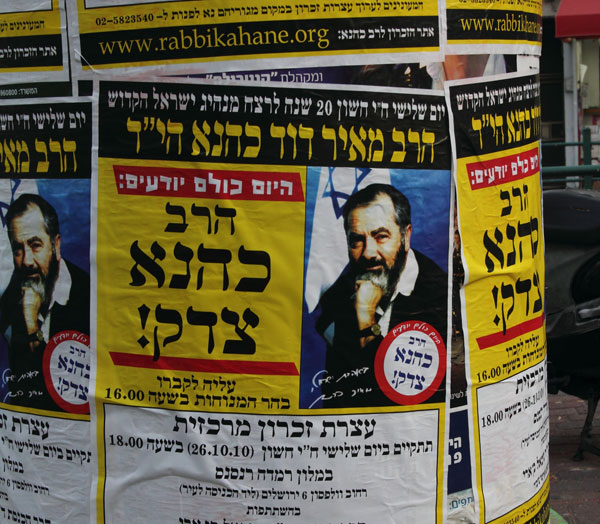
Bills posted for a Rabbi Meir Kahane memorial rally. Photograph: Yossi Gurvitz

By Assaf Sharon in the Boston Review

Addressing Israel’s offensive in Gaza, John Kerry said: “Israel is under siege by a terrorist organization.” Living in Israel, I found the secretary’s comment baffling. In my city, Jerusalem, the sirens have sounded only three times. Tel Aviv and its vicinity has had it worse, with three dozen sirens or so over the last month. Yet daily routine has not been greatly affected. In the south, near the Gaza strip, things are different. With numerous rockets daily, life in some Israeli towns and villages has become what happens between one rush to the shelter to the next. This is certainly not acceptable, but it is not a siege either. In Jewish history, the archetypical siege is the Roman siege of Jerusalem, described by the first-century historian, Josephus, thus: “Throughout the city people were dying of hunger in large numbers, and enduring unspeakable sufferings. In every house the merest hint of food sparked violence, and close relatives fell to blows, snatching from one another the pitiful supports of life.” In Zionist history, the paradigm comes from 1948, when Jerusalem was once again stricken with hunger and want of basic supplies. Here is how one mother described it in a letter to her son who was fighting in the north: “Whoever doesn’t have food simply goes hungry. There’s no gas for cooking, people gather wood and cook in the street. Other than bread, (and this too only 200 grams per person daily) there’s almost nothing to buy…. Water is delivered in a carriage with an allowance of 1.5 cans per person for a week (can=eighteen liters), which is precious little. And as there is no fuel for cars, the water must be brought (from great distance) from wells.” Today, this description is more suitable to Gaza than to Israel.

But there is another siege haunting Israel today. This siege is internal rather than external, moral rather than physical. The murder of sixteen-year-old Muhhamad Abu-H’deir, burned alive by Jewish extremists on July 2, made headlines worldwide. But the context in which this crime was hatched receives less attention. The day before, as the three Israeli youths kidnapped and murdered three weeks earlier were being buried, hundreds of extremists gathered in Jerusalem under the banner “We want Revenge!” And their slogans clarified: “Death to Arabs” and “Death to Leftists.” As the mob marched to the city center, they pounded on store fronts, demanding Arab blood. A large group gathered outside McDonald’s shouting for its Arab employees to be brought out. Smaller groups roamed the streets looking for Arabs to abuse. A wave of racist violence has been washing the streets since then. Organized mobs of extremists have been marching through the streets of Jerusalem shouting racist slogans, calling, “Death to Arabs!” Like scenes taken from revolutionary films, they block cars and busses mid-street, checking whether there are Arabs inside. If found, they are assaulted verbally as well as physically. Many Palestinians refrain from traveling on the city’s light rail because it has become a regular venue for racist attacks.

Sadly, Jerusalem is not unique. An anti-war demonstration in Tel Aviv was attacked by hundreds of right-wing hooligans led by a rapper going by the nickname “the shadow.” Some of them were wearing the “Good Night Left Side” T-shirts popular among white-supremacist and neo-Nazi groups in Europe. A week later this violent scene recurred in Haifa, where right-wing hooligans assaulted an Arab deputy mayor and his son as they were approaching an anti-war demonstration. In Jerusalem’s old city, a mother and her two young children survived an attempted stabbing by Jewish extremists. Amir Shawiki and Ahmed Kasuani, twenty-year-old Jerusalemites, were less fortunate. Both were severely beaten by a Jewish mob simply because they were Arabs. Omar Diwani, a city bus driver in Jerusalem, was hospitalized after four young men assaulted him upon detecting his Arab accent. Dozens of similar attacks against Arabs and “lefties” have taken place recently in the streets, in cafes, in shopping centers, on busses and trains. Israel’s radical right is on the rise.

Jewish radicalism is not a new phenomenon. Its current incarnation traces back to Rabbi Meir Kahane, who, after forming the militant Jewish Defense League in the United States, emmigrated to Israel and founded the ultra-nationalist Kach party. Kahane advocated the forced eviction of all Palestinians residing west of the Jordan river, subordinating state law to Jewish religious law (Halakha), and revenge as punitive policy. Although strongly liberal on economic issues, his ethics were utterly collectivist: the moral agents were not individuals but nations. Any harm to a Jew was an affront to the nation, and revenge should be taken not necessarily on the perpetrator but on “the Arabs.” I vividly remember classmates of mine who, under his influence, would retaliate against random Palestinians following attacks on Israelis. Retaliation quickly morphed into preemption and then into naked aggression. In his short tenure in the Knesset, Kahane proposed outrageous legislation, such as revoking the citizenship of all non-Jews, or criminalizing sexual relations between Jews and Arabs. The core of his ideology was a militant form of Jewish supremacism, best expressed in the slogan frequently heard these days “a Jew is a soul, an Arab the son of a whore.” But with Kahane the medium was more significant than the message. Fusing populist rhetoric with strong-man authoritarianism, he appealed both to religious zealots and to underpriviledged Israelis. Playing on their resentment, he riled them against the “elites,” whom he portrayed simultaneously as all-powerful—controlling the media, the education system, and the courts—and as weak and degenerate. Weak in their treatment of the Arab enemy, and degenerate in their morality, which for him meant the loss of their Jewish fiber. His hostility toward Arabs, however, sometimes seemed second to his loathing of the left. These “fifth column” “destroyers of Israel,” as he biblically labeled them, were subject not only to derision but also to very thinly disguised threats.

Read more at the Boston Review

The Syrian Front: Waiting to Die in Aleppo

konigludwig's avatarWorld News Forum

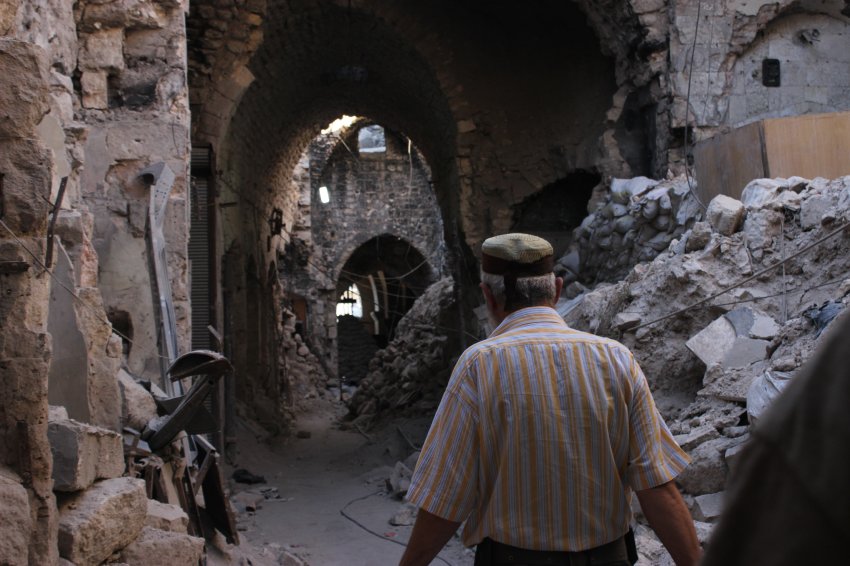
By Christoph Reuter in Der Spiegel A typical street scene in Aleppo. The front lines in the city are no longer the scene of intense fighting, as the focus of the battle has moved elsewhere. But the city remains divided and death commonplace.

Driving through the outer districts of the city, a ghostly wasteland begins. The streets and the half-destroyed residential buildings are empty and the only sounds come from shredded metal signs moving in the wind — and the occasional thunder of distant artillery.

Eastern Aleppo has been virtually abandoned, as have most residential districts located away from the front. Those left in the city prefer to crowd into housing right up against the battle lines, which have remained virtually static in the last two years. Paradoxically, people feel safest living within range of enemy tank and sniper fire. Such are the rules of Aleppo.

The reasons are pragmatic…

View original post 248 more words

Either With Us or Against Us

As Turkey’s ruling party consolidates its power, the space for free expression narrows.

Turkish President Recep Tayyip Erdogan
(By Randam (Own work) [GFDL or CC-BY-SA-3.0-2.5-2.0-1.0], via Wikimedia Commons

“A militant in the guise of a journalist — a shameless woman. Know your place!” This is how three-term Turkish prime minister Recep Tayyip Erdogan chose to describe Amberin Zaman, the Economist’s longtime Turkey correspondent, during a campaign rally on Aug. 7, just three days before he won the country’s first-ever direct presidential election. Erdogan lashed out at Zaman for having allegedly “insulted” Muslims in an interview with opposition leader Kemal Kilicdaroglu on the 24-hour TV news channel CNN Turk — and she was likewise vilified in the conservative press and aggressively harassed online by Erdogan supporters.

The next day, Enis Berberoglu, editor in chief of Hurriyet, one of the country’s highest-circulating dailies, abruptly resigned. Because Hurriyet is owned by Dogan, the same media group that owns CNN Turk, many doubted that Berberoglu’s move was coincidental. Erdogan went on to win the election with 52 percent of the vote. By the time of his inauguration at the end of August, several journalists at other newspapers had also lost their jobs — for reasons widely regarded as political.

These events followed a pattern that has become disturbingly familiar in recent years. As Erdogan’s Justice and Development Party (AKP) has grown increasingly entrenched since it first came to power in 2002, the space for free expression has narrowed perceptibly. This trend has been particularly evident over the past 15 months, starting with the protests that began in Istanbul’s Gezi Park and which then swept the country in the summer of 2013, when dozens of journalists were fired or forced to resign after expressing critical viewpoints. Most recently, Turkey’s trouble with press freedom made headlines this weekend when Erdogan denounced the New York Times for, he said, implying that the Turkish state was connected with Islamic State (IS) militants.

In 2013, Turkey remained the world’s top jailer of journalists (followed by Iran and China) for the second year in a row. As of the end of the year there were 40 reporters behind bars — one of several factors that led Freedom House to downgrade the country from “partly free” to “not free” in its 2014 press freedom rankings. Turkey came in 134th out of 197 countries.

Social media has not been spared. In the lead-up to local elections on March 30, the Turkish government shut down Twitter for two weeks and YouTube for 67 days in an effort to suppress the leak of damning wiretapped recordings that surfaced in a police and judicial investigation into government corruption at the highest levels.

“The main problem is that pro-AKP media is not only the dominant media, it’s the obligatory media,” said one Turkish journalist who asked not to be named. “If you’re not with them, you’re against them.”

Read more at Foreign Policy

Archaeologists Discover Nazi Extermination Camp Gas Chambers in Poland

A rusty road sign outside the perimeter of a Nazi death camp in Sobibor, Poland, on Sept. 18, 2014. (Reuters/Kacper Pempel)

From “Archaeologists unearth hidden death chambers used to kill a quarter-million Jews at notorious camp”

By Terrence McCoy in The Washington Post

Few sites across war-torn Poland harbor more secrets of atrocity and horror than the Nazi concentration camp of Sobibor. Different from Auschwitz, which almost immediately yielded the full scope of the crimes committed there, the history of Sobibor in eastern Poland was initially hidden and opaque.

Unlike Auschwitz, the fate of Sobibor wasn’t liberation. It was obliteration. The Nazis who had run the camp tried to extinguish every remnant of it in 1943, painting over its grounds with a farm, trees and asphalt. Besides a railroad track and the commander’s house, Haaretz noted, nothing remained of the camp. Save for the testimonies of the few survivors, who could only provide scant recollections of small areas of the camp, Sobibor had been lost to history.

But now, more than 70 years later, relics of genocide have surfaced, bringing more clarity to the murder of an estimated 250,000 Jews there than ever before. Buried beneath an asphalt road were a series of well-preserved gas chamber walls that archaeologists say will help elucidate the secrets of Sobibor. Beneath the road were brick rows, stacked four deep — the exoskeleton of four gas chambers.

“The discovery of the gas chambers at Sobibor is a very important finding in Holocaust research,” historian David Silberklang, editor of Yad Vashem Studies, said in a statement. “It is important to understand that there were no survivors from among the Jews who worked in the area of the gas chambers. Therefore, these findings are all that is left of those murdered there, and they open a window onto the day-to-day suffering of these people.”

Read more at The Washington Post