Why Is No One Talking About the GOP’s Plan to Send Millions of Disabled Americans Into Poverty?

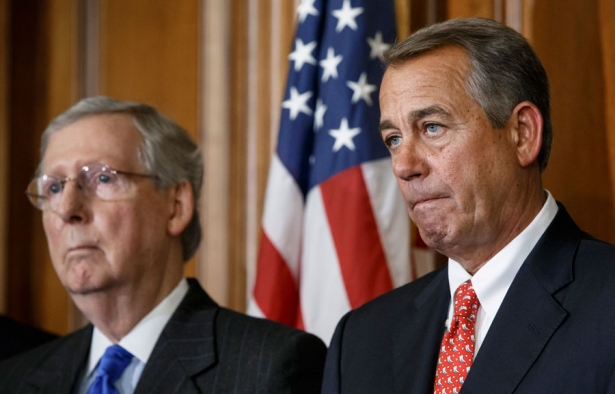
House Speaker John Boehner and Senate Majority Leader Mitch McConnell on Capitol Hill, February 10, 2015 (AP Photo/J. Scott Applewhite)

By William Greider

Despite their virtues, many conservative Republicans have an unfortunate habit of picking on the weak and disadvantaged, slandering the people least able to fight back. We saw a glimpse of this callousness in Mitt Romney’s disparagement of the “47 percent” who are “takers” living off the hard-working “makers.” The newly empowered GOP majority in Congress is going down the same road—targeting the millions of sick or injured Americans who receive Social Security disability payments.

This is a favorite old canard of self-righteous right-wingers. They label these unfortunate people as shiftless and suggest none too subtly that many are faking their injuries and illnesses. The GOP has been pushing this cold-hearted slander for at least thirty-five years, ever since the glorious reign of Ronald Reagan in the 1980s (who remembers Reagan’s imaginary “Welfare Queen” who drove to pick up her welfare check in a Cadillac?).

McConnell-Boehner Republicans are now reviving the Gipper’s big lie, claiming the Social Security system is in crisis because of swollen disability benefits. Allegedly to save the system, these so-called fiscal conservatives intend to cut benefits and throw out those supposedly able-bodied slackers. Once again, their facts are bogus. Never mind, their story line is concocted to arouse anti-government resentment among people who are themselves strapped for income.

Read more at The Nation

ALEC Pushes to Force the US to Amend The Constitution

genvana's avatarWorld News Forum

ALEC is pushing state legislators to call for an amendment to the Constitution, which would require the federal budget to be balanced each year. (Image via Shutterstock) ALEC is pushing state legislators to call for an amendment to the Constitution, which would require the federal budget to be balanced each year. (Image via Shutterstock)

By Jessica Mason in Truthout

The United States could be on the verge of calling its first constitutional convention since 1787, and the American Legislative Exchange Council, or “ALEC,” has been working behind the scenes to make it happen, including through its new lobbying arm, the Jeffersonian Project.

ALEC is urging state legislators to pass state resolutions calling for a constitutional convention in order to pass a federal balanced budget amendment.

The campaign has attracted little media attention, but the pieces of legislation that could trigger a convention are moving forward much more quickly than many have anticipated. Although there are many unanswered legal questions about the constitutional convention strategy — and fears on both the right and left of an out-of-control “runaway…

View original post 360 more words

A Capitalist Argument for Clean Energy: The Rise of Green Banks

(Andy Potts)

By Nancy Cook in the National Journal

About three years ago, Connecticut changed its approach to promoting renewable energy: It decided to act more like a bank than like a state government. Gone were many of the subsidies that had propped up the regional clean-energy market for years. In their place, Connecticut officials started to lend money to fund commercially viable green projects. The goal was to combine public financing with private loans from community banks and other financial institutions to help create a renewable-energy marketplace.

This marks a shift in the argument for clean energy from a moral to a capitalist one. “Connecticut is trying to demonstrate that clean energy is an arena where money can be made,” says Daniel Esty, the former commissioner of the Connecticut Department of Energy and Environmental Protection and a professor at Yale Law School. “It’s not just a story about clean energy. It’s a story about cheaper, cleaner energy, and that has much broader appeal.”

Read more at the National Journal

Jobless Claims in U.S. Unexpectedly Drop to Eight-Year Low

Michigan, New Jersey and Ohio were among states that reported the biggest decrease in claims in the week ended July 12 amid fewer firings in manufacturing and transportation industries. That may indicate more auto plants than usual remained open this year to meet improving demand. photographer: Jeff Kowalsky/Bloomberg

By Nina Glinski and Victoria Stilwell in Bloomberg News

The number of Americans filing applications for unemployment benefits dropped last week to the lowest level in more than eight years, reflecting what could be a pickup in auto making during a typically slow time of year.

Jobless claims fell by 19,000 to 284,000 in the week ended July 19, the fewest since February 2006 and lower than any economist surveyed by Bloomberg forecast, a Labor Department report showed today in Washington. Applications can be volatile in July because of auto plant shutdowns, even as state data showed nothing inconsistent with prior years, a Labor Department spokesman said as the data was released to the press.

Fewer claims signal employers are reluctant to let go of staff as the talent pool shrinks and sales improve. A tightening labor market could lift wages and spur consumer spending, which accounts for about 70 percent of the economy.

The four-week average of jobless claims, considered a less volatile measure than the weekly figure, decreased to 302,000, the lowest since May 2007, from 309,250 in the prior week.

The number of people continuing to receive jobless benefits declined by 8,000 to 2.5 million in the week ended July 12, the fewest since June 2007. The unemployment rate among people eligible for benefits held at 1.9 percent, today’s report showed. These data are reported with a one-week lag.

Employers added 288,000 jobs in June, lifting the average monthly advance so far in 2014 to almost 231,000. If that pace is sustained, it would be the best year since 1999.

Read more at Bloomberg News

World News Forum Commentary

101B1190_0064
© 2010 by Paul Kennedy

Hello, Jewel. I vaguely remember this last CPAC convention. Basically, a bunch of rich donors to the Republican Party gathered to go over their talking points and write big checks.

This is sad stuff. This is the best they can do. Red state-blue state? Really, Rick? Texas ranks 21st among states in per capita income in the United States–New York ranks fourth, and most of the rest of the top twenty are blue states, according to the U.S. Census Bureau. And Texas has more citizens without health insurance than any other state, according to a Gallup poll taken in 2011:

Texas continues to be the state with the highest percentage of residents without health insurance. At 27.6%, its rate is more than four percentage points higher than the next highest state, Mississippi. This is the largest gap Gallup has measured between the first and second state since it began tracking health insurance in 2008.

During the last presidential election campaign, as I’m sure you’ll remember, Rick Perry’s Texas was lauded by Republicans as a model of sensible Republican fiscal management. Never mind that he used billions in Federal bailout funds to balance his state budgets, even while bashing Obama over federal stimulus spending:

But the reality of Perry’s relationship with fed-stim is complicated. Through the second quarter of this year, Texas has used $17.4 billion in federal stimulus money — including $8 billion of the one-time dollars to fund state expenses that recur over and over. In fact, Texas used the federal stimulus to balance its last two budgets.

Source: The Texas Tribune.

Because Republicans have no earthly idea how to grow an economy, they are desperate to slash spending whenever and wherever they can, except for rich people, because the very, very wealthy are, after all, the minority interest they represent.

America incarcerates a larger percentage of its population than Putin’s Russia or Communist China, and those countries put people in prison just for making the government mad by saying unpopular things. And Texas, by the way, executes more people than Saudi Arabia.

Republican governors have discovered that, in the long run, it might actually be cheaper to spend money on things like education than on incarcerating people. Republicans have had a sudden revelation: after decades of pushing for harder and stiffer sentencing laws, that maybe it doesn’t really make all that much sense to put every kid convicted of a minor drug offense into prison for decades.

Republicans are the party of bold new thinking. Trouble is that it’s progressive thinking from the 1930s.

Quixotic ’80 Campaign Gave Birth to Kochs’ Powerful Network

The Libertarian Party’s 1980 presidential candidate, Ed Clark, center, with his running mate, David H. Koch. Credit Randy Rasmussen/Associated Press

He backed the full legalization of abortion and the repeal of laws that criminalized drug use, prostitution and homosexuality. He attacked campaign donation limits and assailed the Republican star Ronald Reagan as a hypocrite who represented “no change whatsoever from Jimmy Carter and the Democrats.”

It was 1980, and the candidate was David H. Koch, a 40-year-old bachelor living in a rent-stabilized apartment in New York City. Mr. Koch, the vice-presidential nominee for the Libertarian Party, and his older brother Charles, one of the party’s leading funders, were mounting a long-shot assault on the fracturing American political establishment.

The Kochs had invested hundreds of thousands of dollars in the burgeoning libertarian movement. In the waning days of the 1970s, in the wake of Watergate, Vietnam and a counterculture challenging traditional social mores, they set out to test just how many Americans would embrace what was then a radical brand of politics.

It was the first and only bid for high office by a Koch family member. But much of what occurred in that quixotic campaign shaped what the Kochs have become today — a formidable political and ideological force determined to remake American politics, driven by opposition to government power and hostility to restrictions on money in campaigns.

Read more at The New York Times

Paul Ryan Has a Plan for the Poor. It’s Terrible.

How his 2015 budget could sink America’s neediest deeper into poverty.

Tony Alter/ Flickr

House budget committee chairman Paul Ryan (R-Wis.) has lately rebranded himself as an advocate for the poor, albeit with his own makers-versus-takers, Ayn Randian twist. He recently issued a lengthy study of federal anti-poverty programs and over the past year and a half he has embarked on a “listening tour” to hear from low-income Americans. On Tuesday, Ryan issued the House GOP’s 2015 budget proposal, which would make major changes to two of the federal government’s primary anti-poverty programs, food stamps and Medicaid. Using as his model the supposedly successful welfare reform effort of the 1990s, Ryan envisions turning these programs into block grants that are handed over to the states to administer. But his plan to “help families in need lead lives of dignity” is likely to make matters worse for America’s neediest. Here’s why.

In 1996, Congress reengineered the federal program that provided cash assistance to the poorest families. Along with imposing stiff work requirements, Congress turned the old entitlement program, whose budget rose and fell automatically with need, into a block grant with a fixed budget. The grant was then distributed to the states, with few strings attached, under the premise that they were “laboratories of innovation” that would revolutionize the way the government helped the poor.

But as welfare reform has shown, giving states this sort of flexibility in how they spend federal money can lead to a lot of abuse that Republicans are so keen on rooting out.

According to data crunched by the Center on Budget and Policy Priorities, states have diverted billions of dollars of welfare block grants for uses these funds were not intended to support. In the first year of welfare reform, about 70 percent of the Temporary Assistance for Needy Families (TANF) block grant went to pay for basic cash assistance for poor families. By 2012, that number had fallen to 29 percent and states were spending just 8 percent on providing transportation, job training, and other services intended to help people transition from welfare into the workforce.

The numbers are even more dismal in some individual states. In 2012, Louisiana spent 7 percent of its $261 million in TANF funds on basic assistance, down from 36 percent in 2001. Just 4 percent of the funds went to programs to help welfare recipients get back into the workforce. A mere 2 percent of the funds paid for child care, another critical component of a reform effort that was geared toward nudging women with small children into low-wage jobs.

What happened to the rest of the money? According to CBBP, 71 percent of it went to other services, including “other nonassistance,” a nebulous category used to mask payments for a hodgepodge of programs that the state didn’t want to spend its own tax revenues on.

Read more at Mother Jones

Support quality journalism. Subscribe to Mother Jones.

And if you feel like you need still more Paul Ryan, you can check out Michael Thomasky’s article in the The Daily Beast: Paul Ryan: Still a Total Jerk

NAFTA at 20: “A Vehicle To Increase Profits at the Expense of Democracy”

Thursday the AFL-CIO released a new report, NAFTA at 20. The report makes the point that, “On the whole, NAFTA-style agreements have proved to be primarily a vehicle to increase corporate profits at the expense of workers, consumers, farmers, communities, the environment and even democracy itself.”

In a press release accompanying the report AFL-CIO President Richard Trumka says that working people and democratic governance on all sides of NAFTA’s borders are now worse off, and Congress should recognize this before approving any more “NAFTA-style” trade agreements.

“There is no success story for workers to be found in North America 20 years after NAFTA,” said Trumka. “The NAFTA model focuses on lifting corporations out of reach of democratic governance, rather than solely reducing tariffs. This report should serve as a cautionary tale to the Obama Administration and Congress as they consider negotiating and implementing new trade deals.”

Trade Agreements Should Stop Following The NAFTA Model

Preceding the report, Trumka gave a major speech on trade at the Center for American Progress. He talked about the history of “a disastrous, outdated, failed model of global economic policies.” He said that trade agreements should abandon the NAFTA model and instead offer a “global new deal … to bring the basic infrastructure of modern society—electricity, water, schools, roads, internet access—to everyone on Earth.”

The Report

A summary of the report contains these points about NAFTA:

– It’s a flawed model that promotes the economic interests of a very few and at the expense of workers, consumers, farmers, communities, the environment and even democracy itself.
– While the overall volume of trade within North America due to NAFTA has increased and corporate profits have skyrocketed, wages have remained stagnant in all three countries.
– Productivity has increased, but workers’ share of these gains has decreased steadily, along with unionization rates.
– NAFTA pushed small Mexican farmers off their lands, increasing the flow of desperate undocumented migrants.
– It exacerbated inequality in all three countries.
– And the NAFTA labor side agreement has failed to accomplish its most basic mandate: to ensure compliance with fundamental labor rights and enforcement of national labor laws.

The NAFTA architecture of deregulation coupled with investor protections allowed companies to move labor intensive components of their operations to locations with weak laws and lax enforcement. This incentivized local, state and federal authorities to artificially maintain low labor costs by ignoring–or in some cases actively interfering with–such fundamental rights as the rights to organize, strike and be free from discrimination. This dynamic undermined organizing and bargaining efforts even in areas with relatively robust labor laws. Today, it is commonplace for employers to threaten to move south—whether to South Carolina or Tijuana—if workers do not agree to cuts in wages and benefits.

See the report at NAFTA at 20.

The Speech

In his speech Trumka began by outlining how NAFTA failed regular people by killing jobs and keeping wages down, which enriching an already-wealthy few – setting the stage for the 2008 financial collapse.

Read more at Truthout

Truthout is an independent news organization funded by individual donations. Support independent journalism. Please donate to Truthout.

Related stories: Mexico’s tomato-farm workers toil in ‘circle of poverty’ and America’s War on Immigrants

America’s war on immigrants

Al Jazeera America

In the name of safeguarding the nation, acute violations of human rights go unchallenged

Activists hold family photos outside the White House on March 12 to protest the nearly 2 million deportations that have taken place during Barack Obama’s presidency while Congress debates immigration reform.Brendan Smialowski//AFP/Getty Images

As the interminable debate in Washington over immigration reform wears on, undocumented migrants in the U.S. continue to exist at the mercy of law enforcement efforts that defy all pretenses of justice and legality.

Earlier this year, Al Jazeera America reported on the stop-and-frisk-style raids being conducted in New Orleans by Immigration and Customs Enforcement (ICE) officers to boost migrant deportation quotas. In that article, a Honduran immigrant recounts his experience of being handcuffed and shackled in the back of an ICE vehicle, which had been deployed to round up undocumented people using racial profiling techniques, saying, “I heard one of the agents say to another, ‘This is like going hunting.’ … And the other responded, ‘Yeah, I like this s—.’”

Also mentioned in the article is the fact that ICE agents in New Orleans “use mobile fingerprinting devices similar to those used by the U.S. military during its counterinsurgency campaigns in Iraq and Afghanistan.”

If we add to this mix the prevalence of abuse that deportees face from federal officials, fatal shootings of migrants by Border Patrol personnel and the rampant construction of nativist border walls, it begins to appear that the U.S. is indeed waging a war on immigration. It starts at the very top: Commander-in-Chief Barack Obama has overseen more deportations than any other president in history — nearly 2 million people in the six years he has been in office.

The severity of such statistics is partially camouflaged by Republican accusations that Obama isn’t tough enough on immigration. Meanwhile, he is able to invoke Republican intransigence to excuse his inaction on reform. That much is clear. What is less clear and much more insidious is that political inertia ultimately benefits those in power, regardless of party.

This is where the story gets interesting:

Read more at Al Jazeera America

7 Bipartisan Reasons to Raise the Minimum Wage

The minimum wage debate is back. Since last year, historically unorganized workers at fast food and big-box retailers across the country have been demanding a higher minimum wage and better working conditions. They are gaining popular support as they become more visible, rallying in big cities and during attention-getting events such as Black Friday.

President Obama, liberals in Congress, and liberals seeking office are making the federal minimum wage a central plank in the effort to combat runaway inequality—now at levels unseen since the 1920s—and push back poverty. Obama has called for increasing the minimum wage from $7.25 per hour to $10.10, with a built-in cost-of-living adjustment tied to inflation. He later announced an executive order requiring federal contractors to observe the $10.10 minimum. And activists at the state and local levels have gone further. California may vote this year on raising its minimum wage to $12.

Increases enjoy wide public support. Recent polls find 76 percent of Americans support a $9 minimum wage. Republicans are split, with 50 percent backing an increase.

There are at least seven reasons voters, if not politicians, in both parties favor a higher minimum wage. They involve concerns about inequality and poverty, about responses to poor wage growth, and about the status of work as well as community. These reasons sometimes conflict, but overall they explain why the minimum wage will continue to play an important role in politics and policy.

Read more at the Boston Review