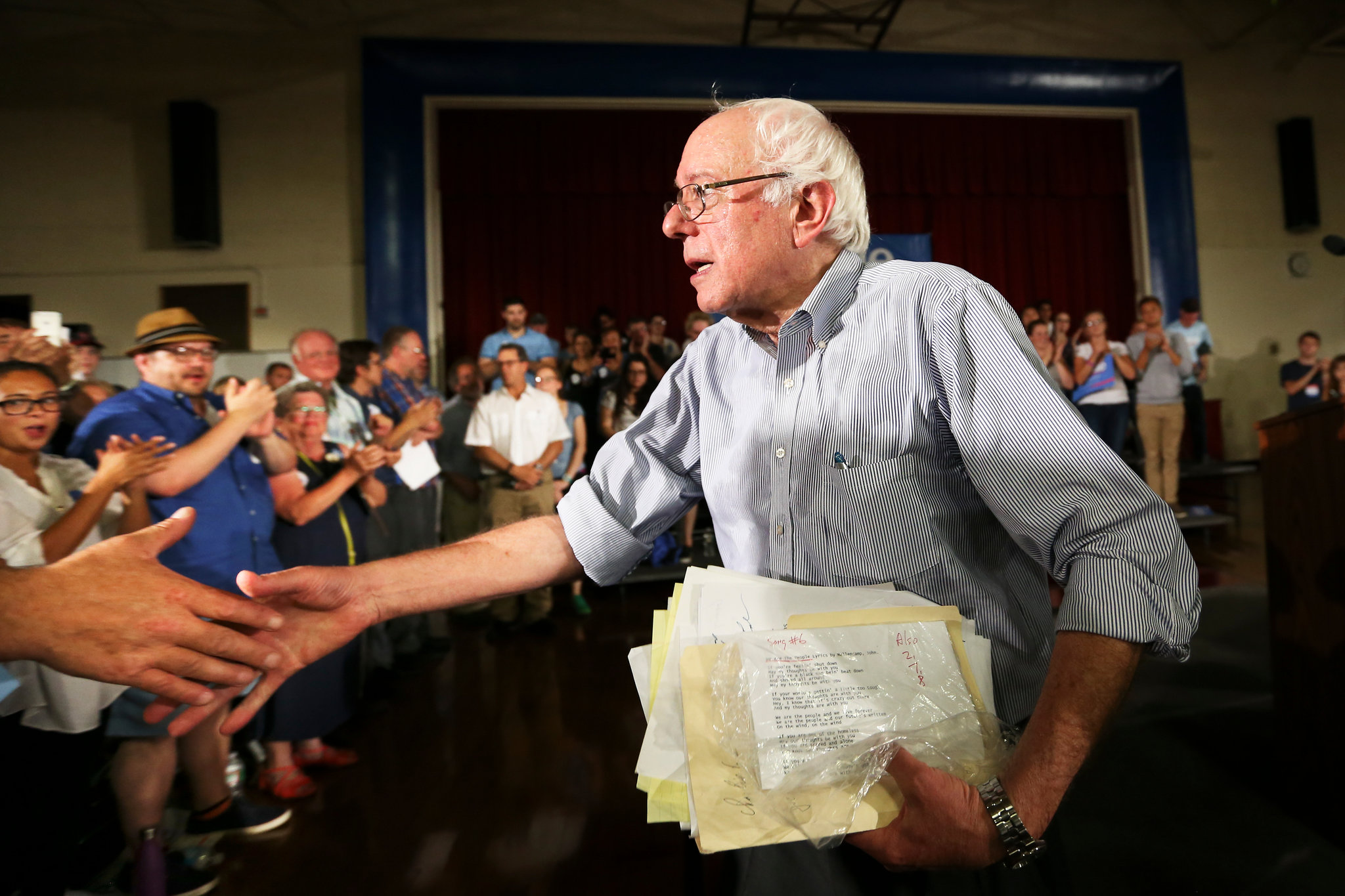
To fund his presidential campaign, Senator Bernie Sanders has relied on tens of thousands of donors whose average gift is $31.30. Credit Cheryl Senter/Associated Press
By Eric Lichtblau
WASHINGTON — Donna Mae Litowitz, a Miami Beach retiree, likes Senator Bernie Sanders of Vermont so much that three months ago she sent his presidential campaign $10,000. His campaign sent back all but $2,700 because it was more than he was allowed to take under federal election law, but she wishes he had kept it all.
“I like what Sanders stands for, and he says what needs to be said,” said Ms. Litowitz, who gave money in 2008 to Senator Barack Obama’s presidential campaign. “And I don’t like Hillary Clinton.”
In an election dominated by million-dollar donations to “super PACs,” Ms. Litowitz qualifies in Mr. Sanders’s insurgent campaign as a big donor. Unlike almost all of the other major Democratic and Republican candidates this year, Mr. Sanders has refused to accept support from super PACs, relying instead on supporters like Ms. Litowitz as well as tens of thousands of small donors giving as little as $5 or $10.
The average donation, according to campaign officials, is $31.30.
The White House was illuminated in honor of same-sex marriage.
WASHINGTON — In a long-sought victory for the gay rights movement, the Supreme Court ruled by a 5-to-4 vote on Friday that the Constitution guarantees a right to same-sex marriage.
“No longer may this liberty be denied,” Justice Anthony M. Kennedy wrote for the majority in the historic decision. “No union is more profound than marriage, for it embodies the highest ideals of love, fidelity, devotion, sacrifice and family. In forming a marital union, two people become something greater than once they were.”
Marriage is a “keystone of our social order,” Justice Kennedy said, adding that the plaintiffs in the case were seeking “equal dignity in the eyes of the law.”
The decision, which was the culmination of decades of litigation and activism, set off jubilation and tearful embraces across the country, the first same-sex marriages in several states, and resistance — or at least stalling — in others. It came against the backdrop of fast-moving changes in public opinion, with polls indicating that most Americans now approve of the unions.
The court’s four more liberal justices joined Justice Kennedy’s majority opinion. Each member of the court’s conservative wing filed a separate dissent, in tones ranging from resigned dismay to bitter scorn.
The eminent evolutionary biologist E.O. Wilson has an audacious vision for saving Earth from a cataclysmic extinction event
A bold conservation vision calls for a return to the South’s once-vast longleaf pine forests. (Carlton Ward Jr. )
By Tony Hiss in Smithsonian Magazine
“Battles are where the fun is,” said E.O. Wilson, the great evolutionary biologist, “and where the most rapid advances are made.” We were sitting in oversized rocking chairs in a northwest Florida guest cottage with two deep porches and half-gallons of butter-pecan ice cream in the freezer, a Wilson favorite. He’d invited me here to look at what he considers a new approach to conservation, a new ecological Grail that, naturally, won’t happen without a fight.
Wilson, 85, is the author of more than 25 books, many of which have changed scientific understanding of human nature and of how the living part of the planet is put together.
Known as the father of sociobiology, he is also hailed as the pre-eminent champion of biodiversity: Wilson coined the word “biophilia” to suggest that people have an innate affinity for other species, and his now widely accepted “theory of island biogeography” explains why national parks and all confined landscapes inevitably lose species. He grew up in and around Mobile, Alabama, and has been at Harvard for over 60 years but still calls himself “a Southern boy who came north to earn a living.” He is courtly, twinkly, soft-spoken, has a shock of unruly white hair, and is slightly stooped from bending over to look at small things all his life—he’s the world’s leading authority on ants. Wilson has earned more than a hundred scientific awards and other honors, including two Pulitzer Prizes. And perhaps his most urgent project is a quest to refute conservation skeptics who think there isn’t enough left of the natural world to be worth saving.
Throughout the 544 million or so years since hard-shelled animals first appeared, there has been a slow increase in the number of plants and animals on the planet, despite five mass extinction events. The high point of biodiversity likely coincided with the moment modern humans left Africa and spread out across the globe 60,000 years ago. As people arrived, other species faltered and vanished, slowly at first and now with such acceleration that Wilson talks of a coming “biological holocaust,” the sixth mass extinction event, the only one caused not by some cataclysm but by a single species—us.
Wilson recently calculated that the only way humanity could stave off a mass extinction crisis, as devastating as the one that killed the dinosaurs 65 million years ago, would be to set aside half the planet as permanently protected areas for the ten million other species. “Half Earth,” in other words, as I began calling it—half for us, half for them. A version of this idea has been in circulation among conservationists for some time.
“It’s been in my mind for years,” Wilson told me, “that people haven’t been thinking big enough—even conservationists. Half Earth is the goal, but it’s how we get there, and whether we can come up with a system of wild landscapes we can hang onto. I see a chain of uninterrupted corridors forming, with twists and turns, some of them opening up to become wide enough to accommodate national biodiversity parks, a new kind of park that won’t let species vanish.”
Ranches owned by Ted Turner Enterprises are home to 51,000 bison–the world’s largest private herd.
Like Wilson, M.C. Davis is a tireless, elaborately courteous Southern charmer. But Wilson himself is quick to point out a difference: “I only write about saving biodiversity. He’s actually doing it.”
Davis’ idea has been to revive the “Piney Woods,” the signature ecosystem of the American Southeast. The longleaf pine forest once covered 90 million acres, or about 60 percent of the land, in a virtually continuous 1,200-mile stretch across nine states from Virginia to East Texas. That forest has been reduced by 97 percent, and there are about three million acres of it left. That’s more catastrophic than what has happened to coral reefs (10 percent to 20 percent destroyed) or the Amazon rainforest (more than 20 percent). The longleaf pine forest’s “Big Cut,” as it’s still known, began after the Civil War and left behind what commentators referred to as “a sea of stumps.” Much of the land has since been reforested, but de-longleafed, and is now planted with row after row of faster-growing pines raised for pulpwood.
Davis, a commodities trader in timber and oil and gas rights, who grew up 65 miles west of his forest, is jovial, folksy, forceful, slightly rumpled-looking, unassuming (“I’m a dirt-road, Panhandle guy”). But for the past decade he has been spending half a million dollars a year planting longleaf pine trees and another half million on other parts of a longleaf forest.
Davis remembers his awakening. He got stuck in a big pileup on I-4 near Tampa, saw a high-school marquee with the sign “Black Bear Seminar” and walked in the door: “There was an old drunk, and a politician who’d thought there’d be a crowd, and a couple of Canadians looking for day-old doughnuts and coffee—and, up on the stage, two women talking about saving black bears. They were riveting. The next day I gave those ladies enough money to keep going for another two years, which I think scared them, it was so out of the blue. Then I asked them for a 100-book environmental reading list for me, for my education. I spent a year reading Thoreau, John Muir, Ed Wilson. Then I started buying up land to see what I could do.”
To honor Wilson, Davis built the dazzling, $12 million E.O. Wilson Biophilia Center at one edge of Nokuse, where thousands of fourth through seventh graders from six counties get free classes that let them hold real baby gopher tortoises and clamber and pose for pictures on a giant ant sculpture.
Wilson regards Nokuse as part of “the final stage of conservation.” Back in 1871, the United States electrified the world by inventing the national park, setting aside 2.2 million acres, an area larger than Delaware, to create Yellowstone National Park as a public “pleasuring ground.” (The world now has 5,000 national parks among its 200,000 protected areas.) Half a century ago, the vision expanded. Fifty years ago this month, President Johnson signed the Wilderness Act, which for the first time permanently protected land for its own sake, establishing a National Wilderness Preservation System of areas where “the earth and community of life are untrammeled by man, where man is only a visitor who does not remain.” This was hailed as securing the “freedom of the wilderness”; Wilson would call it “the conservation of eternity.” The 9.1 million acres of American wilderness protected in 1964 have since grown to 109.5 million acres (4 percent of the country), thanks to citizen groups working on behalf of the rest of life.
Brooklyn-born, Vermont-fueled, Bernie Sanders promises a revolution if he’s somehow elected president next year. Does Hillary have to watch her back?
(Illustration: Josh Gosfield/New York Observer)
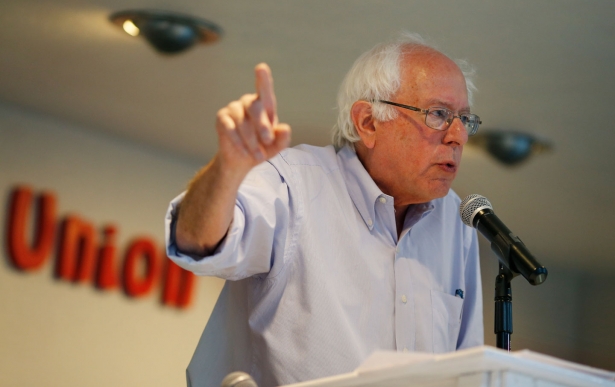
Mr. Sanders, an independent who caucuses with Democrats, violates most laws of American politics. He proudly calls himself a socialist, a label vilified by Republicans and avoided by most Democrats. He is not outwardly charming; he rarely glad-hands and his speeches are often mirthless. Like a modern day Jonathan Edwards, who found Eugene V. Debs rather than Jesus Christ, he thunders about the dying middle class and oligarchies eroding democracy. Cross him, like one camera-holding man who yapped at him in Keene to take a position on the Edward Snowden affair, and earn a stern rebuke. Why wouldn’t he answer the man’s question? “Because you’re rude, and you’re shouting out things and I don’t really like that,” Mr. Sanders groused.
Despite a thorny approach to retail campaigning, Mr. Sanders’ quest for the White House is on an upswing. Last week, a Wisconsin Democratic Party straw poll showed Mr. Sanders trailing Ms. Clinton only 49 to 41 percent among delegates. On Observer.com, Brent Budowsky wrote, “There is a very real prospect that Mr. Bernie Sanders wins an outright victory in the Iowa caucus.” Donations are flooding in; he raised $1.5 million in the 24-hour period after he announced his candidacy in early May. He has since raised cash from more than 100,000 individual donors.
For a long time, Mr. Sanders’ unbridled liberalism was out of vogue. The Clintons, slashing the welfare rolls and deregulating Wall Street, ruled the booming 1990s. The Soviet Union collapsed; some socialists had lost a lodestar, though Mr. Sanders firmly insisted it was the democratic socialism of the Scandinavian countries, and not the authoritarianism of Russia, that he extolled.
A Sanders supporter in Keene underscored this point, gently chastising a reporter for asking whether an avowed socialist could win over voters nationwide.
“He’s a democratic socialist, like another celebrated Jewish socialist—Jesus,” he said.
Still, after a one-term African-American senator with a funny name rose from nowhere to whip Hillary Clinton, the Sanders faithful are suddenly asking, And why not Bernie? What seems more far-fetched: Barack Hussein Obama, around 2007, becoming leader of the Free World or a socialist Jew (a member of Congress for 24 years and former mayor, to boot) becoming president in 2016? (Never mind Mr. Obama was telegenic and three decades younger.)
By Nevit Dilmen (Image:Turkishflag.jpg) [CC BY-SA 2.0], via Wikimedia CommonsAfter 13 years of domination as a single-party government, the Justice and Development Party (AK Party), which has been receiving growing criticism for pursuing highly divisive, authoritarian and repressive policies, saw a significant erosion of support in Sunday’s election and it failed to secure the 276 seats in the Parliament necessary to continue its single-party rule for another term.
The pro-Kurdish Peoples’ Democratic Party’s (HDP), which opted to run as a party in this election for the first time, rather than fielding independent candidates to circumvent the country’s 10 percent election threshold, managed to pass the barrier, which reduced the number of seats in Parliament that would have otherwise gone to the AK Party. Hence, the establishment of a coalition government is back on Turkey’s agenda after more than a decade.
The unofficial results of the election, which many said was more like a referendum in that would determine the fate and political future of the country – becoming either more authoritarian or denying President Erdoğan the changes he aspires to and curbing his power – indicated that the AK Party received 40.6 percent, the main opposition Republican People’s Party (CHP) received 25.3 percent, the Nationalist Movement Party (MHP) received 16 percent while the HDP, which widened its appeal beyond its core Kurdish vote to center-left and secularist segments disillusioned with Erdoğan, received 12.7 percent of the nationwide vote. These percentages translate into 257 seats for the AK Party, 131 for the CHP, 83 for the MHP and 79 for the HDP.
Sunday’s vote was held amid concerns of vote rigging, prompting more than 50,000 people to sign up to serve as election monitors. The fears were not without reason, as last year’s local elections, held on March 30, were overshadowed by allegations of election fraud due to the discrepancies between the numbers recorded at polling stations and those actually entered into the country’s election authority, the Higher Election Board (YSK), in addition to suspicious power outages taking place across 22 provinces during the vote count.
On Sunday, the mood was tense at some polling stations, particularly in the country’s predominantly Kurdish Southeast, after a bombing on Friday killed two people and wounded at least 200 at an election rally for the HDP, which has been a frequent target of violence in the run-up to the polls.
Burlington, Vermont— For the first century after the founding of the Grand Old Party in 1854, Republicans dominated the politics of the state of Vermont like no other. For more than 100 years, Vermont Republicans won every major race for every statewide office. Republican presidential candidates from John Fremont in 1856 to George H.W. Bush in 1988—with the single exception of Barry Goldwater in 1964—won the Green Mountain State. For one of Vermont’s US Senate seats, an unbroken Republican winning streak continued from before the Civil War to the beginning of the 21st century.
Only in 2006 was the Senate seat streak broken with the election of a candidate who was not a Republican.
Of all the announced and potential contenders for the 2016 Democratic presidential nomination, none has a longer track record of taking on tough races, beating incumbents, and upsetting the political calculus. Sanders has won 14 elections in Vermont, including ten straight races for the US House and US Senate as the most politically successful and longest serving independent member of Congress in American history.
On “Hardball,” Michael Morell concedes the Bush administration misled the nation into the Iraq War.
Former CIA Deputy Director Michael Morell is sworn in as he testifes before the House Intelligence Committee. Manuel Balce Ceneta/AP
For a dozen years, the Bush-Cheney crowd have been trying to escape—or cover up—an essential fact of the W. years: President George Bush, Vice President Dick Cheney, and their lieutenants misled the American public about the WMD threat supposedly posed by Saddam Hussein in order to grease the way to the invasion of Iraq. For Bush, Cheney, and the rest, this endeavor is fundamental; it is necessary to protect the legitimacy of the Bush II presidency. Naturally, Karl Rove and other Bushies have quickly tried to douse the Bush-lied-us-into-war fire whenever such flames have appeared. And in recent days, as Jeb Bush bumbled a question about the Iraq War, he and other GOPers have peddled the fictitious tale that his brother launched the invasion because he was presented lousy intelligence. But now there’s a new witness who will make the Bush apologists’ mission even more impossible: Michael Morell, a longtime CIA official who eventually became the agency’s deputy director and acting director. During the preinvasion period, he served as Bush’s intelligence briefer.
Appearing on MSNBC’s Hardball on Tuesday night, Morell made it clear: The Bush-Cheney administration publicly misrepresented the intelligence related to Iraq’s supposed WMD program and Saddam’s alleged links to Al Qaeda.
Host Chris Matthews asked Morell about a statement Cheney made in 2003: “We know he [Saddam Hussein] has been absolutely devoted to trying to acquire nuclear weapons. And we believe he has, in fact, reconstituted nuclear weapons.” Here’s the conversation that followed:
MATTHEWS: Was that true?
MORELL: We were saying—
MATTHEWS: Can you answer that question? Was that true?
MORELL: That’s not true.
MATTHEWS: Well, why’d you let them get away with it?
How immigration will save America and Social Security too.
Immigrant children, Ellis Island, New York.
The Christian Science Monitor recently published a very interesting and informative article about the current debate in the United States Senate over the future of Social Security disability benefits.
Reallocating one year’s funding for Social Security retirement to disability would ensure that both programs remain fully funded until 2033. Although this has been done many times before, the current congressional Republican majority is opposed, preferring instead to begin cutting benefits for disabled Americans by as much as 20% next year. Republicans complain that Democrats are refusing to address the serious, looming fiscal crisis of the program.
But while Social Security certainly has future funding problems, they are not as daunting as Republicans wish to portray them. The Republican leadership’s motivation is purely ideological. They desire to destroy the Social Security program. And they want to begin by reducing payments to disabled Americans next year. The average disability recipient receives about $1250 a month in benefits. I’d like to see even one Republican Senator live on that budget, or cut their own pay by 20% next year.
Over one million veterans returned home injured from the wars in Iraq and Afghanistan. Many of them so severely injured that they may never work again. And many of these gravely injured soldiers returned home to waiting spouses and children. Republicans are now threatening to cut the disability benefits for those veterans and their families.
Interestingly, the prospectus for the future funding of Social Security programs is not as bleak as Republicans would like the American public to believe. And there is a very simple explanation for this that is directly related to the reason that Social Security is facing future deficits in the first place: population demographics.
More people are withdrawing benefits from the system than are paying into it. But American society is preparing to undergo a surprising demographic shift as an unexpected consequence of immigration. As increasing numbers of young immigrants join the American labor force in the coming decades–and as inevitable immigration reforms provide the necessary pathways to citizenship for young, undocumented immigrants–Social Security revenues will likely see a significant increase relative to program expenditures.
America has always been a nation of immigrants. It’s who we are. And immigration has always been a major source of strength for America and a boon to our economy. So why, in God’s name, are so many Americans opposed to it now? Perhaps it’s because they have forgotten, or maybe never understood at all, who we are as a people, and the vital role that immigration has always played in our nation’s history.
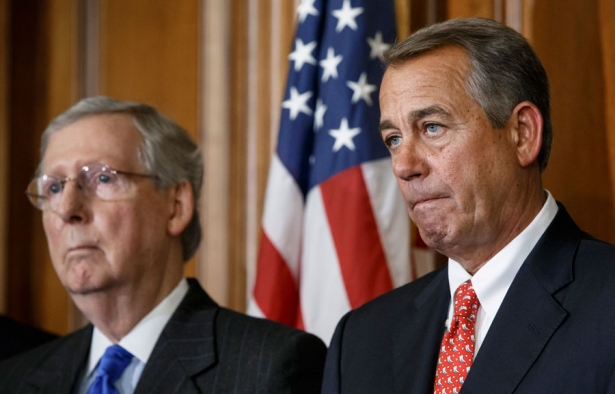
House Speaker John Boehner and Senate Majority Leader Mitch McConnell on Capitol Hill, February 10, 2015 (AP Photo/J. Scott Applewhite)
By William Greider
Despite their virtues, many conservative Republicans have an unfortunate habit of picking on the weak and disadvantaged, slandering the people least able to fight back. We saw a glimpse of this callousness in Mitt Romney’s disparagement of the “47 percent” who are “takers” living off the hard-working “makers.” The newly empowered GOP majority in Congress is going down the same road—targeting the millions of sick or injured Americans who receive Social Security disability payments.
This is a favorite old canard of self-righteous right-wingers. They label these unfortunate people as shiftless and suggest none too subtly that many are faking their injuries and illnesses. The GOP has been pushing this cold-hearted slander for at least thirty-five years, ever since the glorious reign of Ronald Reagan in the 1980s (who remembers Reagan’s imaginary “Welfare Queen” who drove to pick up her welfare check in a Cadillac?).
McConnell-Boehner Republicans are now reviving the Gipper’s big lie, claiming the Social Security system is in crisis because of swollen disability benefits. Allegedly to save the system, these so-called fiscal conservatives intend to cut benefits and throw out those supposedly able-bodied slackers. Once again, their facts are bogus. Never mind, their story line is concocted to arouse anti-government resentment among people who are themselves strapped for income.






 The Progressive Democrat

You must be logged in to post a comment.