Marx Is Back

The global working class is starting to unite — and that’s a good thing.


The inscription on Karl Marx’s tombstone in London’s Highgate Cemetery reads, “Workers of all lands, unite.” Of course, it hasn’t quite ended up that way. As much buzz as the global Occupy movement managed to produce in a few short months, the silence is deafening now. And it’s not often that you hear of shop workers in Detroit making common cause with their Chinese brethren in Dalian to stick it to the boss man. Indeed, as global multinational companies have eaten away at labor’s bargaining power, the factory workers of the rich world have become some of the least keen on helping out their fellow wage laborers in poor countries. But there’s a school of thought — and no, it’s not just from the few remaining Trotskyite professors at the New School — that envisions a type of global class politics making a comeback. If so, it might be time for global elites to start trembling. Sure, it doesn’t sound quite as threatening as the original call to arms, but a new specter may soon be haunting the world’s 1 percent: middle-class activism.

Karl Marx saw an apocalyptic logic to the class struggle. The battle of the vast mass against a small plutocracy had an inevitable conclusion: Workers 1, Rich Guys 0. Marx argued that the revolutionary proletarian impulse was also a fundamentally global one — that working classes would be united across countries and oceans by their shared experience of crushing poverty and the soullessness of factory life. At the time Marx was writing, the idea that poor people were pretty similar across countries — or at least would be soon — was eminently reasonable. According to World Bank economist Branko Milanovic, when The Communist Manifesto was written in 1848, most income inequality at the global level was driven by class differences within countries. Although some countries were clearly richer than others, what counted as an income to make a man rich or condemn him to poverty in England would have translated pretty neatly to France, the United States, even Argentina.

But as the Industrial Revolution gained steam, that parity changed dramatically over the next century — one reason Marx’s prediction of a global proletarian revolution turned out to be so wrong. Just a few years after The Communist Manifesto was published, wages for workers in Britain began to climb. The trend followed across the rest of Europe and North America. The world entered a period of what Harvard University economist Lant Pritchett elegantly calls “divergence, big time.” The Maddison Project database of historical statistics suggests that per capita GDP in 1870 (in 1990 dollars, adjusting for purchasing power) was around $3,190 in Britain — compared with an African average of $648. Compare that with Britain in 2010, which had a per capita GDP of $23,777; the African average was $2,034. One hundred and forty years ago, the average African person was about one-fifth as rich as his British comrade. Today, he’s worth less than one-tenth.

Although many Americans get worked up about absurdly inflated CEO salaries and hedge fund bonuses, a hard economic fact has been overlooked: As the West took off into sustained growth, the gap in incomes among countries began to dwarf the income gaps within countries. That means a temp in East London may still struggle to make ends meet, but plop her down in Lagos and she’ll live like a queen. If you’re feeling bad about your nonexistent year-end bonus, consider this: Milanovic estimates that the average income of the richest 5 percent in India is about the same as that of the poorest 5 percent in the United States.

Like banks and multinationals, wealth and poverty are now globalized. The lowest municipal workers in Europe and the United States are far richer than their counterparts in poor developing countries (even when purchasing power parity is taken into account), and they’re almost infinitesimally better off than the majority of people in those countries who still survive off the earnings of small farms or microenterprises.

Read more at Foreign Policy

Support quality journalism. Subscribe to Foreign Policy

Why Republicans Keep Calling Women Sluts

They just can’t help themselves, and here’s why.

As you’ve heard, yesterday Mike Huckabee stepped up to the plate and smacked a stand-up double in the GOP’s ongoing effort to alienate every woman in America, when he said, “If the Democrats want to insult the women of America by making them believe that they are helpless without Uncle Sugar coming in and providing for them a prescription each month for birth control because they cannot control their libido or their reproductive system without the help of government then so be it! Let us take that discussion all across America because women are far more than the Democrats have played them to be.”

As expected, Huckabee quickly explained to his supporters who the real victim is here (“I am apparently the worst conservative ever or at least the most annoying one according to the left wingers in Washington today”), but the question is, why do they keep doing this? After all, every Republican knows by now that their party has a problem with women; Mitt Romney lost their votes by 11 points. The simple answer is that they can’t help themselves, but more specifically, it’s a combination of ignorance, contempt, and Puritan morality that inevitably leads to these eruptions. And it’s going to keep happening. Let’s look at the particulars:

Read more at The American Prospect

The hidden history of the CIA’s prison in Poland

A car drives past barbed-wire fence surrounding a military area in Stare Kiejkuty village in Poland. (Kacper Pempel/REUTERS )

By Adam Goldman, Updated: Thursday, January 23, 11:33 AM

On a cold day in early 2003, two senior CIA officers arrived at the U.S. Embassy in Warsaw to pick up a pair of large cardboard boxes. Inside were bundles of cash totaling $15 million that had been flown from Germany via diplomatic pouch.

The men put the boxes in a van and weaved through the Polish capital until coming to the headquarters of Polish intelligence. They were met by Col. ­Andrzej Derlatka, deputy chief of the intelligence service, and two of his associates.

The Americans and Poles then sealed an agreement that over the previous weeks had allowed the CIA the use of a secret prison — a remote villa in the Polish lake district — to interrogate al-Qaeda suspects. The Polish intelligence service received the money, and the CIA had a solid location for its newest covert operation, according to former agency officials who spoke on the condition of anonymity to discuss the interrogation program, including previously unreported details about the creation of the CIA’s “black sites,” or secret prisons.

The CIA prison in Poland was arguably the most important of all the black sites created by the agency after the Sept. 11, 2001, attacks. It was the first of a trio in Europe that housed the initial wave of accused Sept. 11 conspirators, and it was where Khalid Sheik Mohammed, the self-declared mastermind of the attacks, was waterboarded 183 times after his capture.

Much about the creation and operation of the CIA’s prison at a base in one of the young democracies of Central Europe remains cloaked in mystery, matters that the U.S. government has classified as state secrets. But what happened in Poland more than a decade ago continues to reverberate, and the bitter debate about the CIA’s interrogation program is about to be revisited.

The Senate Intelligence Committee intends to release portions of an exhaustive 6,000-page report on the interrogation program, its value in eliciting critical intelligence and whether Congress was misled about aspects of the program.

The treatment of detainees also continues to be a legal issue in the military trials of Mohammed and others at Guantanamo Bay in Cuba.

And in December, the European Court of Human Rights heard arguments that Poland violated international law and participated in torture by accommodating its American ally; a decision is expected this year.

“In the face of Polish and United States efforts to draw a veil over these abuses, the European Court of Human Rights now has an opportunity to break this conspiracy of silence and uphold the rule of law,” said Amrit Singh, a lawyer with the Open Society Justice Initiative, which petitioned the court on behalf of a detainee who was held at the Polish site.

Read more at The Washington Post

Support quality journalism. Subscribe to The Washington Post

The Cruelest Pregnancy

Frank Bruni

WHAT would Marlise Munoz have made of all of this?

We’ll never know. She can no longer form words. Can no longer form thoughts. It’s arguable that we shouldn’t even be referring to a “she,” to a “her,” because if she’s brain-dead, as her family has consistently said, then she meets the legal criteria for death in all 50 states, and what’s been tethered to machines in a hospital in Fort Worth for the last seven weeks isn’t exactly a mother. It’s an artificially maintained ecosystem, an incubator for a fetus that has somehow been given precedence over all other concerns: the pain of Marlise’s husband and parents; their wishes to put an end to this; their best guess about what her desires would have been; her transformation, without any possibility of her consent, into a mere vessel.

“A host,” her father, Ernest Machado, called her in an interview with Manny Fernandez of The Times. He used equally chilling language to describe her stillness and the rubbery feel of her skin, saying that she reminded him of “a mannequin.”

Ben Wiseman

Is her fate really what we mean when we speak of “valuing life” or “the sanctity of life,” to summon two phrases tossed around too quickly and simplistically? It seems to me that several lives are being devalued in the process, and that while there are no happy outcomes here, there’s also no sense or dignity on the chilling road that this Texas hospital is taking us down.

In late November, Marlise, 33, was found unconscious on the kitchen floor by her husband, Erick. She had apparently suffered a pulmonary embolism. At the hospital, according to Erick’s subsequent statements, it was determined that she was brain-dead, and he requested that she be disconnected from the machines that keep her vital organs functioning. He and she had both worked as paramedics and had discussed such end-of-life decisions, he said, and so he knew that she wouldn’t have wanted any extraordinary measures taken. The woman he loved was gone. It was time to come to bitter terms with that, and to say goodbye.

Hospital officials, supposedly acting on behalf of the state, won’t let him. They went ahead with extraordinary measures, because Marlise was 14 weeks pregnant, and while that fell well within the window when abortion is legal, a Texas law compels hospitals to provide life support for terminally ill patients with fetuses developing inside them.

Read more at The New York Times

Support quality journalism. Subscribe to The New York Times

Sometimes ‘Nazi’ Is the Right Word

By ETGAR KERETJAN. 17, 2014

TEL AVIV — “NAZI” is a short word. It has only two syllables, like “rac-ist” or “kill-er.” “Democracy,” on the other hand, is a long word with lots of syllables that is very tiring to say. It may not be as tiring as saying “freedom of expression” or “social justice,” but still, there is something really exhausting about it.

People in Israel use “Nazi” when they want the most vicious curse possible, and it’s usually directed at someone they perceive as belligerent. It could be a cop, a soldier or an elected official who, in their opinion, is acting like a bully.

Such usage is offensive and infuriating. As the son of Holocaust survivors, I find it particularly rankling. This week the Knesset gave preliminary approval to a bill that would criminalize saying “Nazi” under inappropriate circumstances. The government views the word as a weapon of mass destruction no less lethal than an Iranian nuclear bomb, and so it insists on Israel’s basic right to protect itself from the threat.

Many Israelis think that passing a law against a word is stupid and juvenile; others see it as fascist and anti-democratic. Incidentally, saying “fascist” or “anti-democratic” is also seen as insulting and offensive. And I wouldn’t be surprised if someone tried to outlaw those words in the future, too.

Imagine a different state of Israel, one very much like our own: This other Israel would also be sunny, with golden beaches, roadblocks in the territories, targeted killings, and rockets hitting the southern towns. The only difference between this new Israel and the current one would be that in the new Hebrew language that would be spoken there, you could say anything except “Nazi,” “fascist” and “anti-democratic.” Wouldn’t that be a better place to live than our current Israel?

And now that we’re exercising our imaginations, let’s picture yet another new Israel — one where the word “Nazi” is permitted but the government genuinely wants a peace accord and its members do not treat the Palestinians like “shrapnel in your butt” — as our economy minister, Naftali Bennett, recently put it — but rather as neighbors seeking freedom and self-determination.

Read more at The New York Times

Support quality journalism. Subscribe to the The New York Times.

Democracy needs dogged local journalism

By Rachel Maddow, Wednesday, January 15, 7:55 PM

If you type “Shawn Boburg” into your Web browser address bar, a strange thing happens. Boburg is a reporter for The Record newspaper, in Bergen County, N.J. But ShawnBoburg.com sends visitors to The Record’s rival, Newark’s Star-Ledger.

The man who bought the rights to Boburg’s online name — and who presumably engineered the nasty little redirect — is David Wildstein, who last week became the country’s most high-profile political appointee. After his high school classmate Chris Christie was elected governor of New Jersey in 2009, Wildstein was appointed to the Port Authority of New York and New Jersey for a highly paid position that, conveniently, had no job description.

Wildstein, who has since resigned, was held in contempt last week by a state legislature committee for refusing to answer questions about his role in the four-day traffic disaster that gridlocked the town of Fort Lee, N.J., last September.

According to reporting in The Record, Wildstein has made a habit of buying the Web addresses of people who cross his path in New Jersey politics — including the Democratic candidate for lieutenant governor in 2012 and a mid-level official at the Federal Aviation Administration who helped forge a firefighting agreement with the Port Authority that Wildstein disliked. While he was at the Port Authority, Wildstein bought the online names of New York Gov. Andrew Cuomo’s top appointees to the agency, including Executive Director Pat Foye, who sounded the alarm about the Fort Lee scheme. Wildstein’s redirect on PatFoye.com sends visitors to the Web site of the New York Yankees.

It’s one thing for public officials to subject one another to that kind of low-level, neener-neener harassment, but in New Jersey, reporters have been targeted too. Wildstein snatched up and redirected ShawnBoburg.com after Boburg wrote a (not terribly unflattering) profile of the intensely private Wildstein last year and an article on Christie’s patronage hiring.

The long knives that New Jersey politicians have out for each other was the stuff of legend (and excellent TV drama) well before the bridge scandal. But the documents released thus far show how much the governor’s staff and appointees hated not only rival public officials but also the press.

Read more at The Washington Post

Support quality journalism. Subscribe to the The Washington Post

The War on Poverty

http://www.youtube.com/watch?v=oWvHr-0BXhc&feature=plcp
Syrian refugees in Lebanon (image via Wikipedia Commons)

Poor people are being murdered, beheaded, raped and terrorized by well armed gangs of mostly young men in Syria and in Mexico. What do these places and people have in common? Almost nothing. Is it about religion? Obviously not. I will bet you that most Mexican drug cartel members consider themselves Christians and have Christian symbols tattooed on their bodies. Muslims and Buddhists are no different, and depending upon where you are in the world, a Buddhist is as likely as a Muslim or a Christian to be involved in the murder or persecution of another person simply because they are of another ethnic or religious identification. The common denominator here is poverty. That’s what it is really all about. These people have no hope, no chance at a good education, a good job, or a decent life. They are hopelessly ignorant. Violence and criminality are their only alternatives. Recognizing and understanding this simple fact, we can see that the real war is of the wealthy against the poor, and that this war is an international war that knows no borders and no boundaries. By understanding and joining forces with ordinary people around the world who are also struggling for existence, we take the just fight to a higher level. When we help a poor person in Egypt, we help ourselves. When we help the poorest among us, we help ourselves. Sounds like something Jesus would have said, doesn’t it? That’s because he did. “What you do unto the least of my brothers…”

© 2014 by Paul Kennedy

I Wear the Badge of Socialist With Honor

The full text of the new Seattle city council member’s inauguration speech.

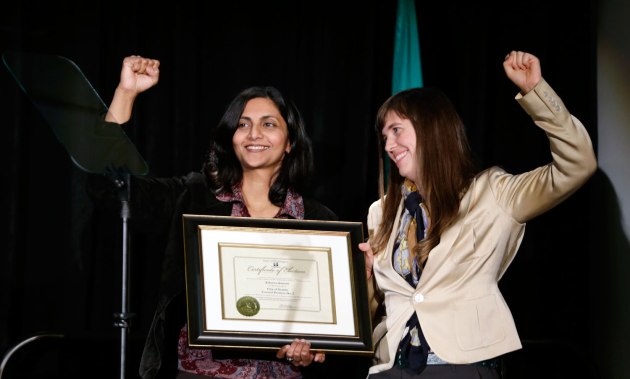
kshama_sawant_inauguration_ap_img

New Seattle Council member Kshama Sawant, left, stands with Nicole Grant, who assisted in a ceremonial swearing-in. (AP Photo/Elaine Thompson)

Editor’s note: At a ceremonial swearing-in on Monday, Kshama Sawant became Seattle’s first socialist city council member in almost a century. The full text of her inauguration speech is below.

My brothers and sisters,

Thank you for your presence here today.

This city has made glittering fortunes for the super wealthy and for the major corporations that dominate Seattle’s landscape. At the same time, the lives of working people, the unemployed and the poor grow more difficult by the day. The cost of housing skyrockets, and education and healthcare become inaccessible.

This is not unique to Seattle. Shamefully, in this, the richest country in human history, fifty million of our people—one in six—live in poverty. Around the world, billions do not have access to clean water and basic sanitation and children die every day from malnutrition.

This is the reality of international capitalism. This is the product of the gigantic casino of speculation created by the highway robbers on Wall Street. In this system the market is God, and everything is sacrificed on the altar of profit. Capitalism has failed the 99%.

Despite recent talk of economic growth, it has only been a recovery for the richest 1%, while the rest of us are falling ever farther behind.

The Nation

Pope Francis Hurts The Tender Feelings Of A Billionaire Republican

Pope Francis has hurt the delicate feelings of Home Depot billionaire and Republican Ken Langone just by preaching the message of Jesus. Awww… Image: jfxgillis

If Pope Francis ever finds himself in need of a hammer and some nails, he may want to consider avoiding Home Depot. Ken Langone, founder of the company, has been whining kvetching pissing and moaning grumpy about Pope Francis having the gall to promote the message of Jesus. In recent months, the Pope has been on a verbal rampage against the horrors that the unrestrained greed of “savage capitalism” has wrought across the globe. He’s been preaching that the message of Jesus was not to get rich by screwing the poor but to serve them. This has deeply offended poor Langone’s tender sensibilities.

Just who the hell does Pope Francis think he is? The Pope or something?
Via CNBC.com:

Langone said he’s raised the issue more than once with Cardinal Timothy Dolan, archbishop of New York, most recently at a breakfast in early December at which he updated him on fundraising progress.

“I’ve told the cardinal, ‘Your Eminence, this is one more hurdle I hope we don’t have to deal with. You want to be careful about generalities. Rich people in one country don’t act the same as rich people in another country,’ ” he said.

Well, he’s right about that. The United States has some of the greediest rich people on the planet. And Pope Francis knows it. Not only did Wall Street executives destroy the economy and throw millions out of work, they gave themselves HUGE bonuses using tax payer dollars. And then spent the next several years screwing those very same tax payers in every conceivable way.

Read more at Addicting Info

Why the American Right Attacks the Poor

19th century engraving Via New York Public Library Digital Collection. Image from Wikipedia Commons.

The defining philosophical argument being made on the American political right today should not be surprising. And that is because the need to make that argument is also not new.

In every society in human history, in which so many have been forced to live in states of perpetual poverty, violence and despair–in the midst of obscene opulence and privilege for a very few–there has been a compelling need to explain the relationship of these facts.

There has also always been a need for a counter narrative to be created and promulgated in order to deflect attention from the most obvious causes of social and economic injustices.

Poverty has often been explained as a consequence of individual moral failures. And the exploitation of the weak and the poor by the powerful and wealthy has also been denied as a possible cause of human suffering in society.

But an autopsy of every historic incidence of social decay and human degradation has revealed the same shockingly obvious and simple truth: that it is the poverty of the many that has always subsidized the wealth of a privileged few.

© 2013 by Paul Kennedy