Nonviolence as Compliance

Officials calling for calm can offer no rational justification for Gray’s death, and so they appeal for order.
lead_960

By Ta-Nehisi Coates in The Atlantic

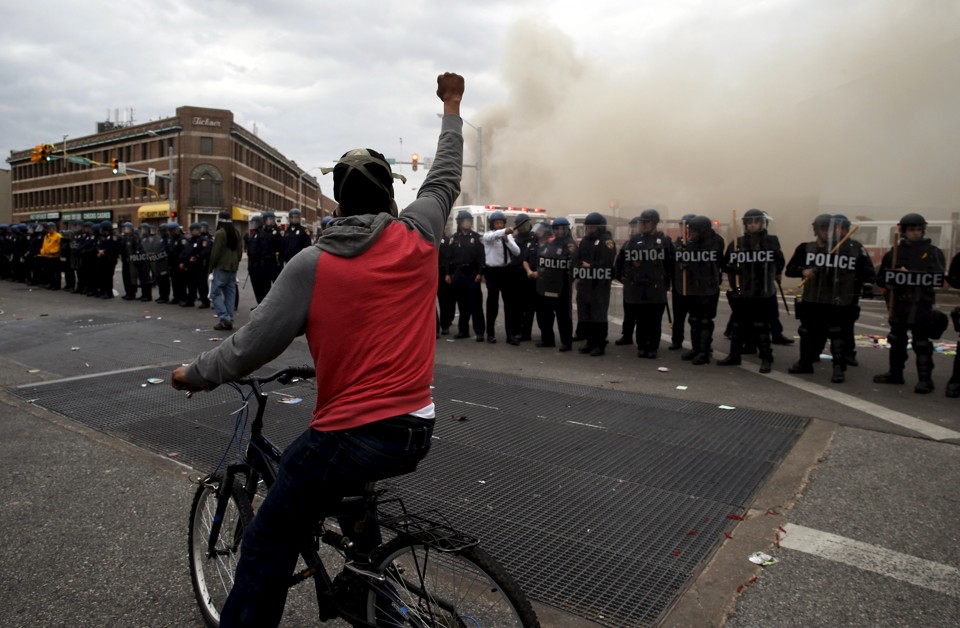
Rioting broke out on Monday in Baltimore—an angry response to the death of Freddie Gray, a death my native city seems powerless to explain. Gray did not die mysteriously in some back alley but in the custody of the city’s publicly appointed guardians of order. And yet the mayor of that city and the commissioner of that city’s police still have no idea what happened. I suspect this is not because the mayor and police commissioner are bad people, but because the state of Maryland prioritizes the protection of police officers charged with abuse over the citizens who fall under its purview.

The citizens who live in West Baltimore, where the rioting began, intuitively understand this. I grew up across the street from Mondawmin Mall, where today’s riots began. My mother was raised in the same housing project, Gilmor Homes, where Freddie Gray was killed. Everyone I knew who lived in that world regarded the police not with admiration and respect but with fear and caution. People write these feelings off as wholly irrational at their own peril, or their own leisure. The case against the Baltimore police, and the society that superintends them, is easily made:

Over the past four years, more than 100 people have won court judgments or settlements related to allegations of brutality and civil rights violations. Victims include a 15-year-old boy riding a dirt bike, a 26-year-old pregnant accountant who had witnessed a beating, a 50-year-old woman selling church raffle tickets, a 65-year-old church deacon rolling a cigarette and an 87-year-old grandmother aiding her wounded grandson ….

And in almost every case, prosecutors or judges dismissed the charges against the victims—if charges were filed at all. In an incident that drew headlines recently, charges against a South Baltimore man were dropped after a video showed an officer repeatedly punching him—a beating that led the police commissioner to say he was “shocked.”

The money paid out by the city to cover for the brutal acts of its police department would be enough to build “a state-of-the-art rec center or renovations at more than 30 playgrounds.” Instead, the money was used to cover for the brutal acts of the city’s police department and ensure they remained well beyond any semblance of justice.

Now, tonight, I turn on the news and I see politicians calling for young people in Baltimore to remain peaceful and “nonviolent.” These well-intended pleas strike me as the right answer to the wrong question. To understand the question, it’s worth remembering what, specifically, happened to Freddie Gray. An officer made eye contact with Gray. Gray, for unknown reasons, ran. The officer and his colleagues then detained Gray. They found him in possession of a switchblade. They arrested him while he yelled in pain. And then, within an hour, his spine was mostly severed. A week later, he was dead. What specifically was the crime here? What particular threat did Freddie Gray pose? Why is mere eye contact and then running worthy of detention at the hands of the state? Why is Freddie Gray dead?

Read more at The Atlantic
Poor People Need a Higher Wage, Not a Lesson in Morality

David Brooks’ rendition of poverty is as “representative” of people with low-incomes as corrupt corporate titans are of small entrepreneurs.

By Greg Kaufmann in The Nation

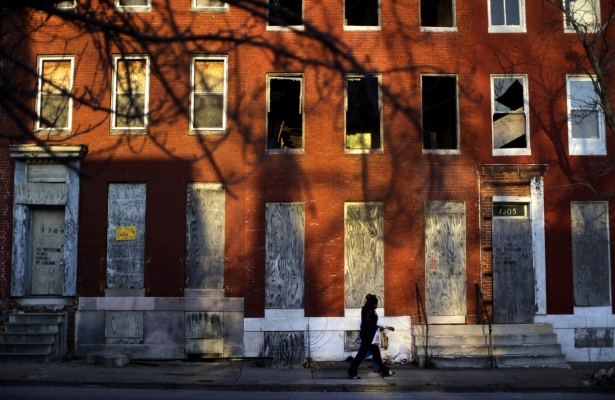
Baltimore, Maryland (AP Photo/Patrick Semansky)

“The idea that poverty is a problem of persons—that it results from personal moral, cultural, or biological inadequacies—has dominated discussions of poverty for well over two hundred years and given us the enduring idea of the underserving poor.”

—Michael Katz, The Undeserving Poor

In a recent op-ed, New York Times columnist David Brooks called for a “moral revival,” one which requires “holding people responsible” so that we have “social repair.”

To illustrate the need for said revival—which he frames as a reassertion of social norms—Brooks offers what he describes as three “representative figures” of “high school-educated America”: a man whose mother was absent, Dad is in prison, attended seven elementary schools, and “ended up under house arrest”; a girl who was “one of five half-siblings from three relationships,” whose mom lost custody of the kids to an abuser, and whose dad left a woman because another guy had fathered their child; and, finally, a kid who “burned down a lady’s house when he was 13” and says, “I just love beating up somebody and making they nose bleed…and beating them to the ground.”

So goes the latest iteration of the “undeserving poor,” an age-old concept brilliantly excavated by the late historian Michael Katz in his book of the same title. Like the long lineage it stems from, Brooks’ rendition is as “representative” of people with low-incomes as corrupt corporate titans are of small entrepreneurs. Anecdotally, in my years working for Boys and Girls Clubs, reporting as a poverty correspondent for The Nation, and now editing TalkPoverty.org which regularly features posts from people living in poverty—Brooks’ “representative figures” remind me of exactly zero people I have met during this time. I’m not saying that these individuals don’t exist, but they have little to do with the policies or the morality we need to dramatically reduce poverty in America.

Read more at The Nation

Majority of public assistance goes to working families, report finds

"20111110-OC-AMW-0050 - Flickr - USDAgov" by U.S. Department of Agriculture - 20111110-OC-AMW-0050. Licensed under CC BY 2.0 via Wikimedia Commons.
U.S. Government Food Stamps, 1941. Image via the United States Department of Agriculture (public domain).

State and federal public assistance programs pay $153 billion to low-wage workers who can’t make ends meet

The majority of American families on public assistance or Medicaid are headed by at least one full-time worker, according to a report released Monday by the University of California at Berkeley’s Center for Labor Research and Education.

Researchers who analyzed annual state and federal spending on public assistance programs — including food stamps, Medicaid, Temporary Aid to Needy Families and the earned income tax credit — found that more than 56 percent of that spending goes to working families.

In other words, employers, such fast-food restaurants, are paying their employees so little that they must rely on government assistance to make ends meet. In total, these employees seek an estimated $153 billion in public assistance each year, according to the report.

“When companies pay too little for workers to provide for their families, workers rely on public assistance programs to meet their basic needs,” Ken Jacobs, chair of the Center for Labor Research and Education and co-author of the report, said in a release. “This creates significant cost to the states.”

Read more at Al Jazeera America

Have Republicans Forgotten Who We Are?

How immigration will save America and Social Security too.

Immigrant children, Ellis Island, New York.

The Christian Science Monitor​ recently published a very interesting and informative article about the current debate in the United States Senate over the future of Social Security disability benefits.

Reallocating one year’s funding for Social Security retirement to disability would ensure that both programs remain fully funded until 2033. Although this has been done many times before, the current congressional Republican majority is opposed, preferring instead to begin cutting benefits for disabled Americans by as much as 20% next year. Republicans complain that Democrats are refusing to address the serious, looming fiscal crisis of the program.

But while Social Security certainly has future funding problems, they are not as daunting as Republicans wish to portray them. The Republican leadership’s motivation is purely ideological. They desire to destroy the Social Security program. And they want to begin by reducing payments to disabled Americans next year. The average disability recipient receives about $1250 a month in benefits. I’d like to see even one Republican Senator live on that budget, or cut their own pay by 20% next year.

Over one million veterans returned home injured from the wars in Iraq and Afghanistan. Many of them so severely injured that they may never work again. And many of these gravely injured soldiers returned home to waiting spouses and children. Republicans are now threatening to cut the disability benefits for those veterans and their families.

Interestingly, the prospectus for the future funding of Social Security programs is not as bleak as Republicans would like the American public to believe. And there is a very simple explanation for this that is directly related to the reason that Social Security is facing future deficits in the first place: population demographics.

More people are withdrawing benefits from the system than are paying into it. But American society is preparing to undergo a surprising demographic shift as an unexpected consequence of immigration. As increasing numbers of young immigrants join the American labor force in the coming decades–and as inevitable immigration reforms provide the necessary pathways to citizenship for young, undocumented immigrants–Social Security revenues will likely see a significant increase relative to program expenditures.

America has always been a nation of immigrants. It’s who we are. And immigration has always been a major source of strength for America and a boon to our economy. So why, in God’s name, are so many Americans opposed to it now? Perhaps it’s because they have forgotten, or maybe never understood at all, who we are as a people, and the vital role that immigration has always played in our nation’s history.

© 2015 by konigludwig

Fethullah Gulen: Turkey’s Eroding Democracy

 Hizmet supporters in Istanbul protesting the government’s harassment of journalists.   Credit Sedat Suna/European Pressphoto Agency
Hizmet supporters in Istanbul protesting the government’s harassment of journalists.
Credit Sedat Suna/European Pressphoto Agency

By Fethullah Gulen

SAYLORSBURG, Pa. — It is deeply disappointing to see what has become of Turkey in the last few years. Not long ago, it was the envy of Muslim-majority countries: a viable candidate for the European Union on its path to becoming a functioning democracy that upholds universal human rights, gender equality, the rule of law and the rights of Kurdish and non-Muslim citizens. This historic opportunity now appears to have been squandered as Turkey’s ruling party, known as the A.K.P., reverses that progress and clamps down on civil society, media, the judiciary and free enterprise.

Turkey’s current leaders seem to claim an absolute mandate by virtue of winning elections. But victory doesn’t grant them permission to ignore the Constitution or suppress dissent, especially when election victories are built on crony capitalism and media subservience. The A.K.P.’s leaders now depict every democratic criticism of them as an attack on the state. By viewing every critical voice as an enemy — or worse, a traitor — they are leading the country toward totalitarianism.

The latest victims of the clampdown are the staff, executives and editors of independent media organizations who were detained and are now facing charges made possible by recent changes to the laws and the court system. The director of one of the most popular TV channels, arrested in December, is still behind bars. Public officials investigating corruption charges have also been purged and jailed for simply doing their jobs. An independent judiciary, a functioning civil society and media are checks and balances against government transgressions. Such harassment sends the message that whoever stands in the way of the ruling party’s agenda will be targeted by slander, sanctions and even trumped-up charges.

Turkey’s rulers have not only alienated the West, they are also now losing credibility in the Middle East. Turkey’s ability to assert positive influence in the region depends not only on its economy but also on the health of its own democracy.

The core tenets of a functioning democracy — the rule of law, respect for individual freedoms — are also the most basic of Islamic values bestowed upon us by God. No political or religious leader has the authority to take them away. It is disheartening to see religious scholars provide theological justification for the ruling party’s oppression and corruption or simply stay silent. Those who use the language and symbols of religious observance but violate the core principles of their religion do not deserve such loyalty from religious scholars.

Speaking against oppression is a democratic right, a civic duty and for believers, a religious obligation. The Quran makes clear that people should not remain silent in the face of injustice: “O you who believe! Be upholders and standard-bearers of justice, bearing witness to the truth for God’s sake, even though it be against your own selves, or parents or kindred.”

For the past 50 years, I have been fortunate to take part in a civil society movement, sometimes referred to as Hizmet, whose participants and supporters include millions of Turkish citizens. These citizens have committed themselves to interfaith dialogue, community service, relief efforts and making life-changing education accessible. They have established more than 1,000 modern secular schools, tutoring centers, colleges, hospitals and relief organizations in over 150 countries. They are teachers, journalists, businessmen and ordinary citizens.

Read more in The New York Times/The Opinion Pages

Tyranny’s False Comfort: Why Rights Aren’t Wrong in Tough Times

 Displaced people from the Yezidi sect, fleeing violence from forces linked to the extremist group Islamic State (also known as ISIS) in the northern Iraqi town of Sinjar, walk towards the Syrian border in August 2014. © 2014 Reuters

Displaced people from the Yezidi sect, fleeing violence from forces linked to the extremist group Islamic State (also known as ISIS) in the northern Iraqi town of Sinjar, walk towards the Syrian border in August 2014. © 2014 Reuters

By Kenneth Roth, Executive Director, Human Rights Watch

The world has not seen this much tumult for a generation. The once-heralded Arab Spring has given way almost everywhere to conflict and repression. Islamist extremists commit mass atrocities and threaten civilians throughout the Middle East and parts of Asia and Africa. Cold War-type tensions have revived over Ukraine, with even a civilian jetliner shot out of the sky. Sometimes it can seem as if the world is unraveling.

Many governments have responded to the turmoil by downplaying or abandoning human rights. Governments directly affected by the ferment are often eager for an excuse to suppress popular pressure for democratic change. Other influential governments are frequently more comfortable falling back on familiar relationships with autocrats than contending with the uncertainty of popular rule. Some of these governments continue to raise human rights concerns, but many appear to have concluded that today’s serious security threats must take precedence over human rights. In this difficult moment, they seem to argue, human rights must be put on the back burner, a luxury for less trying times.

That subordination of human rights is not only wrong, but also shortsighted and counterproductive. Human rights violations played a major role in spawning or aggravating most of today’s crises. Protecting human rights and enabling people to have a say in how their governments address the crises will be key to their resolution. Particularly in periods of challenges and difficult choices, human rights are an essential compass for political action.

Read the entire Keynote Address of the Human Rights Watch World Report 2015

RNC Turns Deaf Ear To Questions About Trip Funded by Hate Group

Gage Skidmore [CC BY-SA 3.0], via Wikimedia Commons
Republican National Committee Chairman Reince Priebus photo attribution: Gage Skidmore [CC BY-SA 3.0], via Wikimedia Commons

Last week, the Southern Poverty Law Center (SPLC) faxed and sent letters to every member of the Republican National Committee (RNC) regarding an upcoming trip to Jerusalem being organized by RNC Chair Reince Priebus.

The letters expressed concern about the organization paying for the trip, the American Family Association (AFA), which the SPLC has listed as an anti-LGBT hate group since 2010.

In particular, the letters asked RNC members not to lend their good offices to an organization with a long track record of making anti-LGBT, anti-Muslim and other hateful statements. An email to Priebus’ director of communications about this matter was not responded to.

In early December, Time reported that 60 members, or about a third, of the RNC had decided to travel to Israel. But you wouldn’t know that from the calls we made. We left dozens of voicemails and sent many, many emails, none of which were replied to.

In Illinois, Indiana, Iowa, Oklahoma and Tennessee, communications directors were unaware of the trip and promised to speak with RNC members and get back to us. They did not. Other state communications directors, like those in Maryland and Louisiana, said they knew nothing of the trip and could not answer questions. In Idaho, a communications staffer told us she had no idea what we were talking about, but that she would have known about a trip if there was one.

Read more at the Southern Poverty Law Center

Well, well. It seems that the fascists have been planning a nice little putsch. Speak of strange bedfellows.

Brave New Turkey

Gobierno de Chile [CC BY 3.0 cl (http://creativecommons.org/licenses/by/3.0/cl/deed.en)], via Wikimedia Commons
President Recep Tayyip Erdogan of Turkey Gobierno de Chile [CC BY 3.0 cl], via Wikimedia Commons

By Andrew Finkel in The New York Times

ISTANBUL — Freedom House, the democracy watchdog, earlier this year downgraded the Turkish press from being “partly free” to “not free.” Now it may have to create a new category: “not free at all.”

On Sunday, Dec. 14, Turkish police raided the headquarters of Zaman, the country’s most widely circulated daily, and a major television station, taking into custody at least 24 people, including the paper’s editor-in-chief and the station’s director. (The editor has since been released.) They were detained on suspicions of “establishing a terrorist group.” But the New York-based Committee to Protect Journalists said the raids smacked “of political vengeance.”

A decade ago Recep Tayyip Erdogan, then Turkey’s prime minister, was the most likely candidate to lead the Islamic world. He had managed to keep Turkey out of the 2003 Iraq War, was grooming it for membership in the European Union, and was getting on with economic reform. Ordinary Turks were feeling prosperous, proud and hopeful. So why is the Turkish government now going off the rails when it has been perfectly popular doing the right things?

Today Mr. Erdogan is the president, and his style is in-your-face confrontational. He is revered by enough people to get his party re-elected, but many others loathe him (remember the protests in Gezi Park?), and some of his eccentricities have made him a favorite of headline writers. Like a potentate of some Sacha Baron Cohen parody, he has had a presidential palace with over a thousand rooms built for himself. No one knows how much it cost: The government agency responsible for the construction says the sum is a state secret because its disclosure would damage the economy.

Read more at The New York Times

George Stinney’s Conviction Tossed Out … 70 Years After Execution

 George Stinney in 1944. Credit SC Department of Archives and History, via Associated Press
George Stinney in 1944. Credit SC Department of Archives and History, via Associated Press

By Jesse Wegman in The New York Times

Seventy years after he was executed in South Carolina, George Stinney’s conviction was vacated by a state judge Wednesday on the grounds that he had not received a fair trial.

Stinney, a 14-year-old black boy, was arrested in March 1944 for the murder of two white girls in Clarendon County, S.C. In less than three months, he was tried, convicted and put to death.

He was the youngest person to be executed in the U.S. in the 20th century. Reports from the execution chamber said he was so small that the jolt of electricity knocked the mask from his face.

In a 28-page order, Judge Carmen T. Mullen — who heard testimony on the case in January — did not rule on the merits of the murder charges against Stinney, but found that there were “fundamental, constitutional violations of due process” across the board.

Indeed, nothing about Stinney’s case came close to meeting basic constitutional requirements.

He was arrested without a warrant and questioned without a lawyer.

The lawyer eventually appointed to defend him was a tax commissioner who had never before represented a criminal defendant.

The only evidence against him was the word of the local police chief who said he had confessed.

Stinney’s entire capital trial lasted three hours. His lawyer neither cross-examined the prosecution’s witnesses nor called any witnesses for the defense.

The jury — all white in a county that was almost three-quarters black — convicted and condemned him in 10 minutes. There were no appeals.

Read more at The New York Times

The Eric Garner case’s sickening outcome

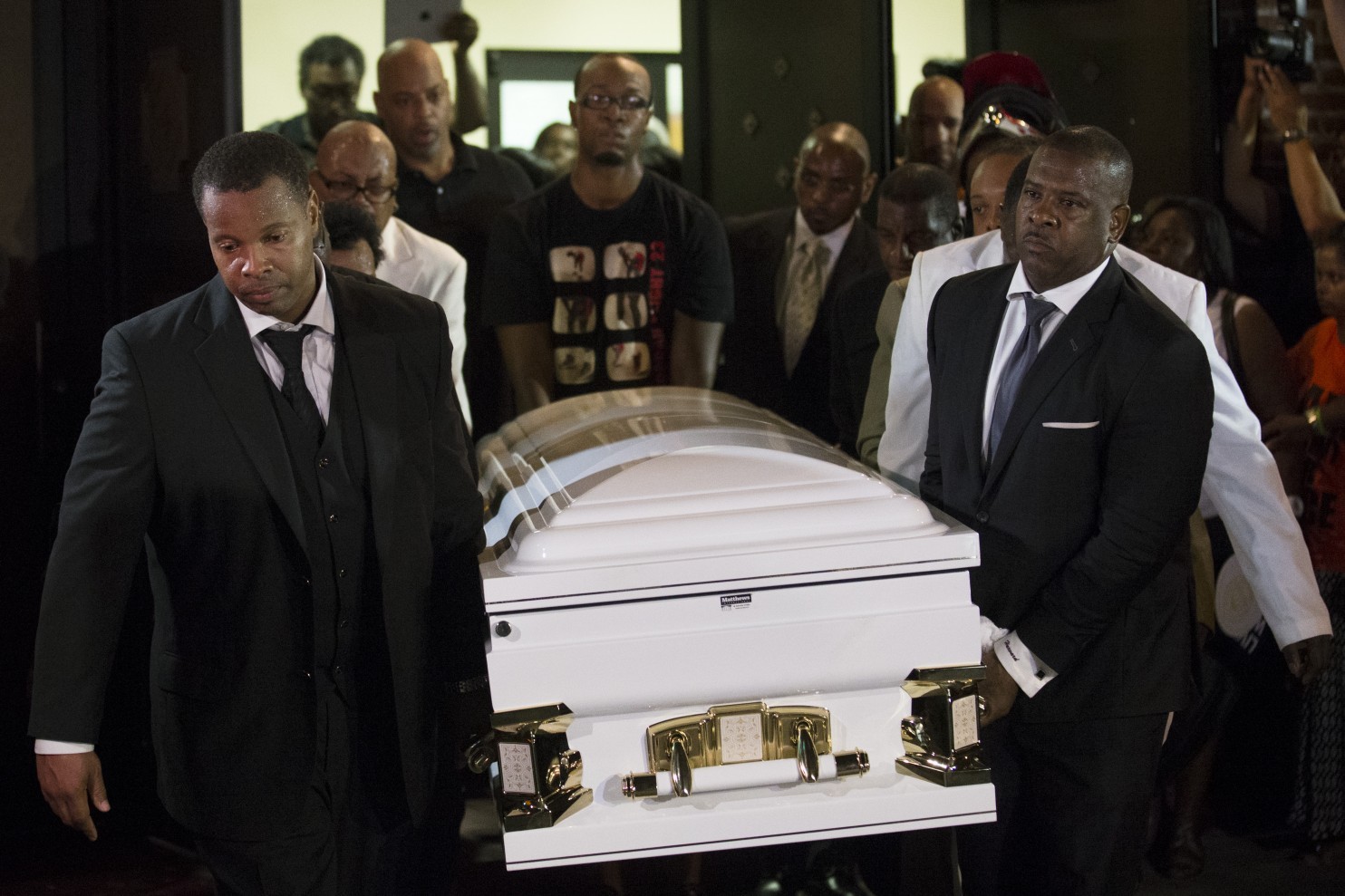
 Pallbearers carry the casket of Eric Garner at Bethel Baptist Church following his funeral service, Wednesday, July 23, 2014, in the Brooklyn borough of New York. (John Minchillo/AP)
Pallbearers carry the casket of Eric Garner at Bethel Baptist Church following his funeral service, Wednesday, July 23, 2014, in the Brooklyn borough of New York. (John Minchillo/AP)

Eugene Robinson in The Washington Post

I can’t breathe.

Those were Eric Garner’s last words, and today they apply to me. The decision by a Staten Island grand jury to not indict the police officer who killed him takes my breath away.

In the depressing reality series that should be called “No Country for Black Men,” this sick plot twist was shocking beyond belief. There should have been an indictment in the Ferguson case, in my view, but at least the events that led to Michael Brown’s killing were in dispute. Garner’s homicide was captured on video. We saw him being choked, heard him plead of his distress, watched as no attempt was made to revive him and his life slipped away.

This time, there were literally millions of eyewitnesses. Somebody tell me, just theoretically, how many does it take? Is there any number that would suffice? Or is this whole “equal justice before the law” thing just a cruel joke?

African American men are being taught a lesson about how this society values, or devalues, our lives. I’ve always said the notion that racism is a thing of the past was absurd — and that those who espoused the “post-racial” myth were either naive or disingenuous. Now, tragically, you see why.

Garner, 43, was an African American man. On July 17, he allegedly committed the heinous crime of selling individual cigarettes on the street. A group of New York City police officers approached and surrounded him. As seen in cellphone video footage recorded by an onlooker, Garner was puzzled that the officers seemed to be taking him into custody for such a piddling offense. He was a big man, but at no point did he strike out at the officers or show them disrespect.

Read more at The Washington Post