Tea Party rebels are exposing the deep rifts between country-club elites and social-issue hard-liners.
Speaker of the House Rep. John Boehner, R-Ohio, walks away from the microphone during a news conference after a House GOP meeting on Capitol Hill on Tuesday, Oct. 15, 2013 in Washington. The federal government remains partially shut down and faces a first-ever default between Oct. 17 and the end of the month. (AP Photo/ Evan Vucci)
By William Greider
Fresh chatter among Washington insiders is not about whether the Republican Party will win in 2016 but whether it will survive. Donald Trump—the fear that he might actually become the GOP nominee—is the ultimate nightmare. Some gleeful Democrats are rooting (sotto voce) for the Donald, though many expect he will self-destruct.
Nevertheless, Republicans face a larger problem. The GOP finds itself trapped in a marriage that has not only gone bad but is coming apart in full public view. After five decades of shrewd strategy, the Republican coalition Richard Nixon put together in 1968—welcoming the segregationist white South into the Party of Lincoln—is now devouring itself in ugly, spiteful recriminations.
The abrupt resignation of House Speaker John Boehner was his capitulation to this new reality. His downfall was loudly cheered by many of his own troops—the angry right-wingers in the House who have turned upon the party establishment. Chaos followed. The discontented accuse party leaders of weakness and betraying their promises to the loyal rank and file.
At the heart of this intramural conflict is the fact that society has changed dramatically in recent decades, but the GOP has refused to change with it. Americans are rapidly shifting toward more tolerant understandings of personal behavior and social values, but the Republican Party sticks with retrograde social taboos and hard-edged prejudices about race, gender, sexual freedom, immigration, and religion. Plus, it wants to do away with big government (or so it claims).
The party establishment, including business and financial leaders, seems to realize that Republicans need to moderate their outdated posture on social issues. But they can’t persuade their own base—especially Republicans in the white South—to change. The longer the GOP holds out, the more likely it is to be damaged by the nation’s changing demographics—the swelling impact of Latinos and foreign-born citizens, and the flowering influence of millennials, the 18-to-30-year-olds who are more liberal and tolerant than their elders.
Bernie Sanders at a town hall in Manchester, N.H. on Saturday. (Dominick Reuter/Reuters)
By Harold Meyerson
Bernie Sanders has been getting a bum rap from people who purport to be his fellow progressives. He’s been chastised for not supporting open borders: Totally open immigration, the Vermont senator told Vox’s Ezra Klein, was “a Koch brothers proposal” that would erode the “concept of the nation state.” He’s been accused of downplaying the effects of racism by emphasizing the effects of classism — a more valid criticism to which Sanders, after his initial, grumpy response to protesters last month, has responded more recently by highlighting the racism of many police practices. Some critics have added that Sanders’s allegedly blinkered vision stems from his decades in nearly all-white Vermont, or from his admiration for the social democracies of nearly all-white Scandinavia, or from the purported racial blindness of social democracy itself.
To fault Sanders for failing to support open borders, however, is to hold him to a standard that no present-day elected official in any nation I know of has met. Like his fellow liberals and, polling shows, most Americans, Sanders supports offering citizenship to those immigrants, documented and not (excepting those who’ve committed serious crimes), who are already here, and stopping the efforts to deport them. Like most Americans, Sanders clearly supports the continuation of legal immigration.
When Vermont Senator Bernie Sanders told The Nation last year that he was “prepared to run for president,” he said he would do so only if it was clear that progressives were enthusiastic about a movement campaign seeking nothing less than “a political revolution.” It was an audacious proposal—but after traveling the country for a year, Sanders decided that the enthusiasm was there and announced in late April as a candidate for the Democratic nomination. There were plenty of doubters then. Two months into the campaign, however, everything about this candidacy—the crowds, the poll numbers, the buzz—is bigger than expected. That says something about Sanders. But it also says something about the prospects for progressive politics. In late June, The Nation sat down with Sanders for several conversations that asked the longtime Nation reader (“started when I was a University of Chicago student in the early 1960s”) to put not just his campaign but the moment in historical perspective for our 150th-anniversary issue:
The Nation: Your campaign for the presidency has surprised people. The crowds are big; the poll numbers are stronger than the pundits predicted. You’re a student of political history. Put what’s happening now in perspective. Are we at one of those pivot points—as we saw in the 1930s—where our politics could open up and take the country in a much more progressive direction?
Sanders: Obviously, we’re not in the midst of a massive depression, as we were in the 1930s. But I think the discontent of the American people is far, far greater than the pundits understand. Do you know what real African-American youth unemployment is? It’s over 50 percent. Families with a member 55 or older have literally nothing saved for retirement. Workers are worried about their jobs ending up in China. They’re worried about being fired when they’re age 50 and being replaced at half-wages by somebody who is 25. They’re disgusted with the degree that billionaires are able to buy elections. They are frightened by the fact that we have a Republican Party that refuses to even recognize the reality of climate change, let alone address this huge issue.
In 1936, when Roosevelt ran for reelection, he welcomed the hatred of what he called “the economic royalists”—today, they’re the billionaire class—and I’m prepared to do that as well. That’s the kind of language the American people are ready to hear.
The Nation: As long as we’re talking about the evolution of public policy, let’s talk about the evolution of a word: socialism. You appeared on ABC’s This Week and, when you were asked whether a socialist can be elected president, you did not blink; you talked about socialism in positive, detailed terms. I don’t believe a presidential candidate has ever done that on a Sunday-morning show.
Sanders: Mitch McConnell, the Republican leader in the Senate, often criticizes President Obama, incorrectly, for trying to push “European-style socialism,” and McConnell says the American people don’t want it. First of all, of course, Obama is not trying to push European-style socialism. Second of all, I happen to believe that, if the American people understood the significant accomplishments that have taken place under social-democratic governments, democratic-socialist governments, labor governments throughout Europe, they would be shocked to know about those accomplishments. One of the goals of this campaign is to advance that understanding…. How many Americans know that in virtually every European country, when you have a baby, you get guaranteed time off and, depending on the country, significant financial benefits as well. Do the American people know that? I doubt it. Do the American people even know that we’re the only major Western industrialized country that doesn’t guarantee healthcare for all? Most people don’t know that. Do the American people know that in many countries throughout Europe, public colleges and universities are either tuition-free or very inexpensive?
I have always believed that the countries in Scandinavia have not gotten the kind of honest recognition they deserve for the extraordinary achievements they have made…. The Danish ambassador, whom I talked to a couple of years ago, said to me that in Denmark it is very, very hard to be poor; you really have to literally want to be outside of the system. Well, that’s pretty good. In Denmark, all of their kids can go to college; not only do they go for free, they actually get stipends. Healthcare is, of course, a right for all people. They have a very strong childcare system, which to me is very important. Their retirement system is very strong. They are very active in trying to protect their environment…. And, by the way, the voter turnout in those countries is much higher; in Denmark, in the last election, it was over 80 percent. Political consciousness is much higher than it is in the United States. It’s a more vibrant democracy in many respects. So why would I not defend that? Do they think I’m afraid of the word? I’m not afraid of the word.
Officials calling for calm can offer no rational justification for Gray’s death, and so they appeal for order.
By Ta-Nehisi Coates in The Atlantic
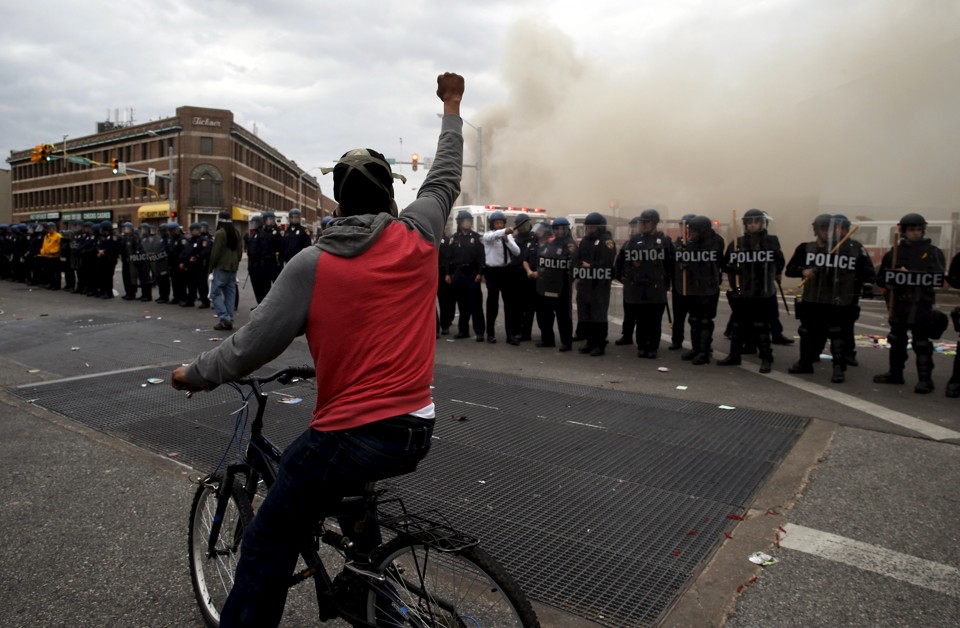
Rioting broke out on Monday in Baltimore—an angry response to the death of Freddie Gray, a death my native city seems powerless to explain. Gray did not die mysteriously in some back alley but in the custody of the city’s publicly appointed guardians of order. And yet the mayor of that city and the commissioner of that city’s police still have no idea what happened. I suspect this is not because the mayor and police commissioner are bad people, but because the state of Maryland prioritizes the protection of police officers charged with abuse over the citizens who fall under its purview.
The citizens who live in West Baltimore, where the rioting began, intuitively understand this. I grew up across the street from Mondawmin Mall, where today’s riots began. My mother was raised in the same housing project, Gilmor Homes, where Freddie Gray was killed. Everyone I knew who lived in that world regarded the police not with admiration and respect but with fear and caution. People write these feelings off as wholly irrational at their own peril, or their own leisure. The case against the Baltimore police, and the society that superintends them, is easily made:
Over the past four years, more than 100 people have won court judgments or settlements related to allegations of brutality and civil rights violations. Victims include a 15-year-old boy riding a dirt bike, a 26-year-old pregnant accountant who had witnessed a beating, a 50-year-old woman selling church raffle tickets, a 65-year-old church deacon rolling a cigarette and an 87-year-old grandmother aiding her wounded grandson ….
And in almost every case, prosecutors or judges dismissed the charges against the victims—if charges were filed at all. In an incident that drew headlines recently, charges against a South Baltimore man were dropped after a video showed an officer repeatedly punching him—a beating that led the police commissioner to say he was “shocked.”
The money paid out by the city to cover for the brutal acts of its police department would be enough to build “a state-of-the-art rec center or renovations at more than 30 playgrounds.” Instead, the money was used to cover for the brutal acts of the city’s police department and ensure they remained well beyond any semblance of justice.
Now, tonight, I turn on the news and I see politicians calling for young people in Baltimore to remain peaceful and “nonviolent.” These well-intended pleas strike me as the right answer to the wrong question. To understand the question, it’s worth remembering what, specifically, happened to Freddie Gray. An officer made eye contact with Gray. Gray, for unknown reasons, ran. The officer and his colleagues then detained Gray. They found him in possession of a switchblade. They arrested him while he yelled in pain. And then, within an hour, his spine was mostly severed. A week later, he was dead. What specifically was the crime here? What particular threat did Freddie Gray pose? Why is mere eye contact and then running worthy of detention at the hands of the state? Why is Freddie Gray dead?
David Brooks’ rendition of poverty is as “representative” of people with low-incomes as corrupt corporate titans are of small entrepreneurs.
By Greg Kaufmann in The Nation
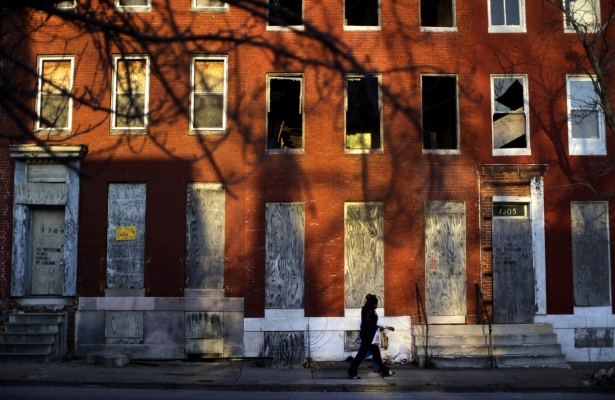
Baltimore, Maryland (AP Photo/Patrick Semansky)
“The idea that poverty is a problem of persons—that it results from personal moral, cultural, or biological inadequacies—has dominated discussions of poverty for well over two hundred years and given us the enduring idea of the underserving poor.”
—Michael Katz, The Undeserving Poor
In a recent op-ed, New York Times columnist David Brooks called for a “moral revival,” one which requires “holding people responsible” so that we have “social repair.”
To illustrate the need for said revival—which he frames as a reassertion of social norms—Brooks offers what he describes as three “representative figures” of “high school-educated America”: a man whose mother was absent, Dad is in prison, attended seven elementary schools, and “ended up under house arrest”; a girl who was “one of five half-siblings from three relationships,” whose mom lost custody of the kids to an abuser, and whose dad left a woman because another guy had fathered their child; and, finally, a kid who “burned down a lady’s house when he was 13” and says, “I just love beating up somebody and making they nose bleed…and beating them to the ground.”
So goes the latest iteration of the “undeserving poor,” an age-old concept brilliantly excavated by the late historian Michael Katz in his book of the same title. Like the long lineage it stems from, Brooks’ rendition is as “representative” of people with low-incomes as corrupt corporate titans are of small entrepreneurs. Anecdotally, in my years working for Boys and Girls Clubs, reporting as a poverty correspondent for The Nation, and now editing TalkPoverty.org which regularly features posts from people living in poverty—Brooks’ “representative figures” remind me of exactly zero people I have met during this time. I’m not saying that these individuals don’t exist, but they have little to do with the policies or the morality we need to dramatically reduce poverty in America.
George Stinney in 1944. Credit SC Department of Archives and History, via Associated Press
By Jesse Wegman in The New York Times
Seventy years after he was executed in South Carolina, George Stinney’s conviction was vacated by a state judge Wednesday on the grounds that he had not received a fair trial.
Stinney, a 14-year-old black boy, was arrested in March 1944 for the murder of two white girls in Clarendon County, S.C. In less than three months, he was tried, convicted and put to death.
He was the youngest person to be executed in the U.S. in the 20th century. Reports from the execution chamber said he was so small that the jolt of electricity knocked the mask from his face.
In a 28-page order, Judge Carmen T. Mullen — who heard testimony on the case in January — did not rule on the merits of the murder charges against Stinney, but found that there were “fundamental, constitutional violations of due process” across the board.
Indeed, nothing about Stinney’s case came close to meeting basic constitutional requirements.
He was arrested without a warrant and questioned without a lawyer.
The lawyer eventually appointed to defend him was a tax commissioner who had never before represented a criminal defendant.
The only evidence against him was the word of the local police chief who said he had confessed.
Stinney’s entire capital trial lasted three hours. His lawyer neither cross-examined the prosecution’s witnesses nor called any witnesses for the defense.
The jury — all white in a county that was almost three-quarters black — convicted and condemned him in 10 minutes. There were no appeals.
I am not against using violence in self-defense. I don’t even call it violence when it’s self-defense, I call it intelligence. —Malcolm X
The grand jury’s decision to forgo indictment of Ferguson police officer Darren Wilson in the killing of Michael Brown compels us yet again to recognize that there is more to violence than its dictionary definition.
In clinical terms, violence is physical force intended to cause injury. But when officer Wilson shot and killed Michael Brown this past August, he did not engage in violence. He engaged in self-defense. He was justified.
After the jury’s decision was announced, black Americans and their supporters, who see in the non-indictment a form of impunity, took to the streets of Ferguson and St. Louis. Their righteous indignation amounted to a “night of violence,” according to The Guardian and USA Today. KSDK, a St. Louis NBC affiliate, used a common volcanic metaphor: “Violence erupts in Ferguson: Fire, looting, arrests.” Look at any of the major news outlets—shattered store windows and overturned police cruisers. That is violence, and there need be no inquiry into its justification.
Violence is a moral category, not an act. Where aggression is presumptively unjustified, it is violent. Where it is deemed acceptable by the norms of the community in which it occurs, it is not violence.
It is perilous to extrapolate too greatly from a single case, but that peril is not at issue in Ferguson, where Brown’s shooting reflects a widespread and historically endless pattern of white lawmen, and white men acting under cover of law, injuring and killing black men without engaging in what the society calls violence. Here again, the court asked what the victim did to warrant his fate. But the political problem, which courts can’t consider, is who has access to justification.
Elderly voters board a van that will take them to a polling station in Atlanta on the first day of early voting, Oct. 13, 2014. via Al Jazeera America
Election officials in 27 states, most of them Republicans, have launched a program that threatens a massive purge of voters from the rolls. Millions, especially black, Hispanic and Asian-American voters, are at risk. Already, tens of thousands have been removed in at least one battleground state, and the numbers are expected to climb, according to a six-month-long, nationwide investigation by Al Jazeera America.
At the heart of this voter-roll scrub is the Interstate Crosscheck program, which has generated a master list of nearly 7 million names. Officials say that these names represent legions of fraudsters who are not only registered but have actually voted in two or more states in the same election — a felony punishable by 2 to 10 years in prison.
Until now, state elections officials have refused to turn over their Crosscheck lists, some on grounds that these voters are subject to criminal investigation. Now, for the first time, three states — Georgia, Virginia and Washington — have released their lists to Al Jazeera America, providing a total of just over 2 million names.
The Crosscheck list of suspected double voters has been compiled by matching names from roughly 110 million voter records from participating states. Interstate Crosscheck is the pet project of Kansas’ controversial Republican secretary of state, Kris Kobach, known for his crusade against voter fraud.
Based on the Crosscheck lists, officials have begun the process of removing names from the rolls — beginning with 41,637 in Virginia alone. Yet the criteria used for matching these double voters are disturbingly inadequate.
There are 6,951,484 names on the target list of the 28 states in the Crosscheck group; each of them represents a suspected double voter whose registration has now become subject to challenge and removal. According to a 2013 presentation by Kobach to the National Association of State Election Directors, the program is a highly sophisticated voter-fraud-detection system. The sample matches he showed his audience included the following criteria: first, last and middle name or initial; date of birth; suffixes; and Social Security number, or at least its last four digits.
In North Carolina, Republican officials are loudly proclaiming their hunt for alleged double voters using Crosscheck. But in nearby Georgia, Democratic leaders say they are shocked that they have been kept in the dark about the state’s use of Crosscheck lists — and the racial profile of the targeted voters.
“It’s biased, I think, both in form and intent,” says Rep. Stacey Abrams, leader of the Democrats in the Georgia state legislature. “But more concerning to me is the fact this is being done stealthfully. … We have never had this information presented to us.”
Abrams, in her second role as founder of New Georgia Project, a nonpartisan voter registration group, has, in coordination with the NAACP, already sued Georgia’s Republican secretary of state, Brian Kemp, on behalf of 56,001 voters who filled out registration forms but have yet to see their names appear on voter rolls.
Al Jazeera America showed the Crosscheck lists to Martin Luther King III, who succeeded his father and Lowery to lead the SCLC. He notes that using shoddily put-together lists of supposed matches is not a new tactic. The capture of common names is certain to ensnare black voters, he says, and reminds him of the presidential race of 2000, when Florida Secretary of State Katherine Harris wrongly purged voters from a list of nearly 58,000, many of them African-American. They were purged on the grounds that they were felons and thus banned from voting, which helped to hand the presidency to George W. Bush. Yet not one was found guilty of voting illegally. Once again, King notes, this minority-heavy list falsely flags fraudulent voters. Compared to the prior purge, this new one is more sophisticated, he says. “I hate to characterize it as a trick [but] it really is. It really is about trying to control who can and cannot vote.”
With millions of suspects, one question keeps arising: Why have there been no mass convictions? Kobach proudly proclaims that Kansas has “referred” 14 voters for prosecution for double voting. And none of them has been convicted.
Yet demands to purge lists of double voters have reached a histrionic volume. In April of this year, former presidential counselor Dick Morris told Fox TV audiences that “probably over a million people that voted twice in [the 2012] election. This is the first concrete evidence we’ve ever had of massive voter fraud.”
In North Carolina, state officials have hired former FBI agent Charles W. “Chuck” Stuber, who played a major role in the campaign finance fraud case brought against former North Carolina Sen. John Edwards, to, in the words of their press release, “investigate cases of possible voter fraud identified by an interstate cross-check comparing election records from 28 states.”
But despite knowing the names and addresses of 192,207 supposed double voters in the state, Stuber has not nabbed a single one in his five months on the job. Josh Lawson, a spokesman for the board of elections, says, “This agency has made no determination as to which portion of these [lists] represent data error or voter fraud.” In fact, to date, Lawson admits that Stuber has found only errors and not one verified fraudulent voter.
But Lawson did shine a light on the great benefit of the Crosscheck manhunt to the state’s Republican Party, now locked in a tight battle over the U.S. Senate seat of incumbent Democrat Kay Hagan. While the use of Crosscheck has yet to produce a single indictment of a double voter, Lawson says, the program could be used for “list maintenance.” That is, voters on the list, proven guilty or not, could be subject to a process of removal from the voter rolls.
Dr. Francys Johnson with the NAACP leads an occupation of the Georgia State Capitol to protest voter suppression. Photo credit: Alice Ollstein
ATLANTA, GEORGIA—On Tuesday, Judge Christopher Brasher of the Fulton County Superior Court denied a petition from civil rights advocates to force Georgia’s Secretary of State to process an estimated 40,000 voter registrations that have gone missing from the public database.
Though early voting is well underway in the state, Judge Brasher called the lawsuit “premature,” and said it was based on “merely set out suspicions and fears that the [state officials] will fail to carry out their mandatory duties.”
The New Georgia Project, who spearheaded the voter registration drive and brought the lawsuit against the state, vowed Tuesday to “continue to pursue all legal avenues available.” But with the election mere days away, there may be little remedy for the tens of thousands of people who submitted all necessary documents, but have still not received a registration card. Four of those impacted voters were present at the court hearing, but were denied the opportunity to testify.
On Monday, dozens of Georgians occupied the Secretary of State’s office to demand he meet with them and explain what happened to the tens of thousands of missing registrations. At that protest, in which eight activists were arrested, former American Government teacher and civil rights lawyer Marsha Burrofsky told ThinkProgress she suspects foul play.
“When we started registering people this spring, people were saying, ‘You know, I registered six months ago, but I haven’t gotten anything yet!’ We thought that was strange,” she said. So we sat down with our list of registrations and checked, and about 20 to 20 percent were not showing up. We truly don’t know where things stand with them.”
Burrofsky said the people she registered in Dunwoody, Georgia, a more affluent and conservative community, did show up in the system, while those in more diverse and low-income communities in DeKalb County mysteriously disappeared.
The explosion and enforcement of restrictive voter ID laws make this one thing very clear
Rick Scott, Karl Rove, Rick Perry (Credit: AP/J. Scott Applewhite/LM Otero/Rich Pedroncelli/Photo montage by Salon)
Last week, the Supreme Court upheld a law that could disenfranchise 600,000 Texans. But the effects of the law won’t fall equally: African-Americans and Latinos are 305 percent and 195 percent less likely (respectively) to have the necessary forms of identification than whites. The Republican party is increasingly unpopular, and relies almost exclusively on white voters. The charts below show the 2008 if only white men voted and if only people of color voted (source). Since 2008, people of color become a growing share of the voting population while the GOP has, if anything, moved further to the right. It has further alienated voters of color with racist attacks and laws. But as they say: if you can’t beat ‘em, make sure they don’t vote. Over the last four years the Republicans have gone through elaborate attempts to make sure populations that don’t support them don’t get a chance to vote.
Since 2006, Republicans have pushed through voter ID laws in 34 states. Such laws did not exist before 2006, when Indiana passed the first voter ID law. The laws were ostensibly aimed at preventing voter fraud, but a News21 investigation finds only 2,068 instance of alleged fraud since 2000 (that is out of over 146 million voters). They estimate that there is one accusation of voter fraud for every 15 million voters. As Mother Jones notes, instances of voter fraud are more rare than UFO sightings. There have been only 13 instances of in-person voter fraud (the sorts that a voter ID law would reduce), while 47,000 people claim to have seen a UFO.
On the other hand, research by the Brennan Center for Justice finds that, “as many as 11 percent of eligible voters do not have government-issued photo ID.” Those who do not have ID are most likely to be “ seniors, people of color, people with disabilities, low-income voters, and students” — i.e.. people who vote Democratic (chart source).
There is now a large literature studying the effects of voter ID laws. James Avery and Mark Peffley find, “states with restrictive voter registration laws are much more likely to be biased toward upper-class turnout.” The GAO finds that voter ID laws reduce turnout among those between ages 18-23 and African-Americans (two key Democratic constituencies). A 2013 study finds that the proposal and passage of voter ID laws are “highly partisan, strategic, and racialized affairs.” They write, “Our findings confirm that Democrats are justified in their concern that restrictive voter legislation takes aim along racial lines with strategic partisan intent.” [Italics in original] The authors also find that increases in low-income voter turnout triggered voter ID laws. A more recent study finds, “where elections are competitive, the furtherance of restrictive voter ID laws is a means of maintaining Republican support while curtailing Democratic electoral gains.” That is, not all Republican legislatures propose voter ID laws — only those that face strong competition from Democrats. If Republicans are concerned about election integrity, why do they only pass voter ID laws when they’re about to lose an election? Because they’re cheaters.
Voter ID laws are also racially motivated. A recent study finds that voters are significantly more likely to support a voter ID law when they are shown pictures of black people voting than when shown white people voting. One voter ID group had a picture on their website showing a black inmate voting and a man wearing a mariachi outfit — clearly playing off racial stereotypes.




 The Progressive Democrat
You must be logged in to post a comment.