Majority of Democrats Want Sanders to Stay in Race

From “Vast Majority of Democrats Want Sanders to Stay in Race: Poll”

Despite pressure from party establishment on Sanders to drop out of the race, most Democratic voters want the senator to keep running

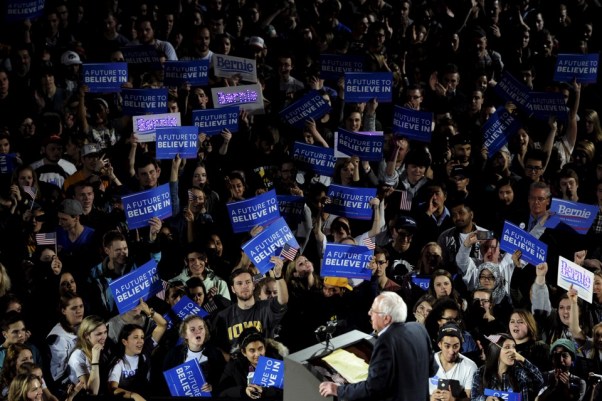
A cheering crowd greeted Sanders at a Pennsylvania rally in April. (Photo: Penn State/flickr/cc)

By Nika Knight

A new poll released Wednesday found that a majority of registered Democrats want presidential hopeful Bernie Sanders to stay in the race.

The national survey of 2,001 voters by Morning Consult found that 57 percent of all Democrats polled want Sanders to keep running, while 33 percent want him to drop out. Ten percent have no opinion.

The findings contradict the pressure from prominent Democratic politicians and centrist pundits on Sanders to drop out of the presidential race—some of whom even argue that he’s already lost—despite the fact that several states (including delegate-rich California) and U.S. territories have yet to hold their primaries. (Polls also show Sanders and Clinton in a dead heat in California, which votes on June 7.)

Common Dreams

Bernie Sanders Declares War

“Bernie Sanders just declared war on the Democratic establishment”

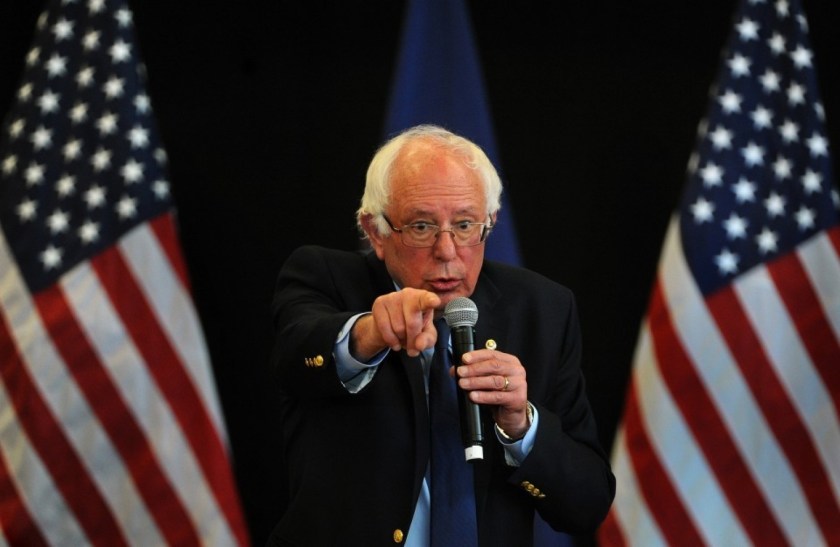
Presidential candidate Bernie Sanders Photo credit: Michael S. Williamson/The Washington Post
Presidential candidate Bernie Sanders
Photo credit: Michael S. Williamson/The Washington Post

By Chris Cillizza

If you want to make a politician really, really angry, endorse their primary opponent. That’s exactly what Bernie Sanders did Saturday to Democratic National Committee Chairwoman Debbie Wasserman Schultz.

“Clearly, I favor her opponent,” Sanders said in an interview with CNN’s Jake Tapper set to air today. “His views are much closer to mine than as to Wasserman Schultz’s. Let me also say this, in all due respect to the current chairperson: If [I am] elected president, she would not be reappointed chairwoman of the DNC.”

That puts Sanders on the side of Tim Canova, a former Capitol Hill staffer who has enjoyed considerable fundraising success — he’s raised more than $1 million — thanks to an anti-establishment message in his primary challenge to Wasserman Schultz.

And it ensures that the nastiness between Sanders and his supporters and Wasserman Schultz and the mainstream Democrats she represents will now surge into a full-blown battle.

You can be certain that Wasserman Schultz has spent the past 12 hours making sure that every one of her colleagues is aware of what Sanders has done. If he is willing to do this to me, don’t fool yourself into thinking he won’t do it to you too, she’ll argue. Yes, that’s a fundraising ploy. But, it also speaks to the very real threat that a free radical like Sanders presents to the established order.

That’s exactly how Sanders likes it. His brand is shaking up the establishment — just as he has done in the presidential race against Hillary Clinton. His supporters will love that he is willing to put some political capital on the line against Wasserman Schultz, who many of them believe is rigging the race for Clinton behind the scenes.

The Washington Post

Big Union Leaders Betray Sanders and Workers

 Democratic presidential candidate Senator Bernie Sanders waves as he marches with supporters in the Labor Day parade. (Photo: AP/Jim Cole)
Democratic presidential candidate Senator Bernie Sanders waves as he marches with supporters in the Labor Day parade. (Photo: AP/Jim Cole)

By Ralph Nader

Around a conference table inside the large Washington headquarters of the AFL-CIO, a furious exchange occurred between labor union presidents. It was late February and up for decision by the Executive Council was whether the country’s principal labor federation was going to make a primary season endorsement of Hillary Clinton as favored by the leaders of the largest unions.

According to insiders, tempers flared when smaller unions challenged the Hillary-endorsing big unions such as AFSCME (public employees), the American Federation of Teachers, the National Education Association, the Service Employees (SEIU) and the Food and Commercial Workers (UFCW). These large unions came out for Clinton in late 2015 and early 2016 before they sensed the growing rank and file workers’ preference for the lifetime advocate for workers and union backer, Bernie Sanders.

Listening to the nurses union head speak out for Sanders’ strong pro-labor history, Lee Saunders, president of AFSCME, interrupted her, exclaiming: “I will not allow you to do a commercial for Sanders.” She retorted, “You mean for the only candidate who has a 100% labor record?”

A union leader of postal workers charged the unions backing Hillary as being “completely out of touch with their workers.” AFL-CIO President Richard Trumka then cut off their microphones.

All over the country, the observation by the postal workers’ leader rings true. Even as Lee Saunders read the names of the Democratic presidential contenders at a large Washington state AFSCME membership meeting last October, “only Sanders’ name brought loud, sustained applause,” according to Bloomberg News.

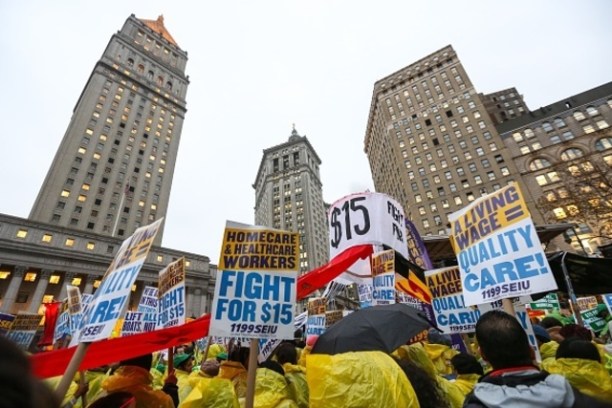
Few union leaders allow a worker referendum to make the endorsement decisions. The 700,000-member Communications Workers of America (CWA) does, and the result was a “decisive endorsement of Sanders,” reported Rafael Navar, the union’s political director. Whether it is the level of enthusiasm, campaigning to get out the vote or talking up their candidate’s record on such issues as minimum wage increases, abolition of public university and college tuition, full Medicare for all (single payer system) and credibility in standing up to Wall Street, Hillary’s votes and statements do not come close to respecting the working families of America compared to Bernie’s consistent 30-year record.

Common Dreams

U.S. Companies, Try This: Raise Your Minimum Pay

And protests like this might disappear.  Photographer: Cem Ozdel/Anadolu Agency/Getty Images
And protests like this might disappear. Photographer: Cem Ozdel/Anadolu Agency/Getty Images

By Noah Smith

Recently, McDonald’s decided to raise wages for many of its hourly restaurant workers. The rise is modest, from about $9 to about $10, but already the company’s executives claim that they are seeing improvements in service quality:

“It has done what we expected it to — 90 day turnover rates are down, our survey scores are up—we have more staff in restaurants,” McDonald’s U.S. president Mike Andres told analysts at a UBS conference… “So far we’re pleased with it.”

So far the company’s financial results haven’t suffered — just the opposite; sales are rising.

With stagnant wages one of the hottest topics these days, and calls to raise minimum wages resounding across the country, stories like this one are obviously eye-catching. If raising wages improves worker performance enough to help the bottom line, then there’s no tradeoff between how much companies can afford to pay workers — at least within reason — and how many workers they can afford to employ. Obviously if you raise wages high enough — imagine mandating $1,000 an hour! — a lot of people will be put out of work. But it could be that most American companies are in a safe zone where hiking wages modestly makes economic sense.

Bloomberg View

Hillary Clinton’s Link to a Nasty Piece of Work in Honduras

Democratic presidential candidate Hillary Clinton speaks during a campaign event at Hillside High School in Durham, N.C., Thursday, March 10, 2016. (AP Photo/Carolyn Kaster)

By Marjorie Cohn

A critical difference between Bernie Sanders and Hillary Clinton is their position on whether children who fled violence in Central American countries, particularly Honduras, two years ago should be allowed to stay in the United States or be returned.

Sanders states unequivocally that they should be able to remain in the U.S.

Clinton disagrees. She would guarantee them “due process,” but nothing more.

By supporting the June 28, 2009, coup d’état in Honduras when she was secretary of state, Clinton helped create the dire conditions that caused many of these children to flee. And the assassination of legendary Honduran human rights leader Berta Cáceres earlier this month can be traced indirectly to Clinton’s policies.

During the Feb. 11 Democratic debate in Milwaukee, Clinton said that sending the children back would “send a message.” In answer to a question by debate moderator Judy Woodruff of PBS, she said, “Those children needed to be processed appropriately, but we also had to send a message to families and communities in Central America not to send their children on this dangerous journey in the hands of smugglers.”

Sanders retorted, “Who are you sending a message to? These are children who are leaving countries and neighborhoods where their lives are at stake. That was the fact. I don’t think we use them to send a message. I think we welcome them into this country and do the best we can to help them get their lives together.”

In the March 9 debate in Miami between the two Democratic candidates, Sanders accurately told moderator Jorge Ramos of Univision, “Honduras and that region of the world may be the most violent region in our hemisphere. Gang lords, vicious people torturing people, doing horrible things to families.” He added, “Children fled that part of the world to try, try, try, try, maybe, to meet up with their family members in this country, taking a route that was horrific, trying to start a new life.”

The violence in Honduras can be traced to a history of U.S. economic and political meddling, including Clinton’s support of the coup, according to American University professor Adrienne Pine, author of “Working Hard, Drinking Hard: On Violence and Survival in Honduras.”

Pine, who has worked for many years in Honduras, told Dennis Bernstein of KPFA radio in 2014 that the military forces that carried out the coup were trained at the Western Hemisphere Institute for Security Cooperation (formerly called the U.S. Army School of the Americas) in Fort Benning, Ga. Although the coup was supported by the United States, it was opposed by the United Nations and the Organization of American States (OAS). The U.N. and the OAS labeled President Manuel Zelaya’s ouster a military coup.

“Hillary Clinton was probably the most important actor in supporting the coup [against the democratically elected Zelaya] in Honduras,” Pine noted. It took the United States two months to even admit that Honduras had suffered a coup, and it never did admit it was a military coup. That is, most likely, because the Foreign Assistance Act prohibits the U.S. from aiding a country “whose duly elected head of government is deposed by military coup or decree.”

Truthdig

The American Fascist

(Photo: Matt Johnson/flickr/cc.)

By Robert Reich

I’ve been reluctant to use the “f” word to describe Donald Trump because it’s especially harsh, and it’s too often used carelessly.

But Trump has finally reached a point where parallels between his presidential campaign and the fascists of the first half of the 20th century – lurid figures such as Benito Mussolini, Joseph Stalin, Adolf Hitler, Oswald Mosley, and Francisco Franco – are too evident to overlook.

It’s not just that Trump recently quoted Mussolini (he now calls that tweet inadvertent) or that he’s begun inviting followers at his rallies to raise their right hands in a manner chillingly similar to the Nazi “Heil” solute (he dismisses such comparison as “ridiculous.”)

The parallels go deeper.

As did the early twentieth-century fascists, Trump is focusing his campaign on the angers of white working people who have been losing economic ground for years, and who are easy prey for demagogues seeking to build their own power by scapegoating others.

Trump’s incendiary verbal attacks on Mexican immigrants and Muslims – even his reluctance to distance himself from David Duke and the Ku Klux Klan – follow the older fascist script.

That older generation of fascists didn’t bother with policy prescriptions or logical argument, either. They presented themselves as strongmen whose personal power would remedy all ills.

They created around themselves cults of personality in which they took on the trappings of strength, confidence, and invulnerability – all of which served as substitutes for rational argument or thought.

Common Dreams

Democratic National Committee Vice-Chair Resigns in Endorsement of Bernie Sanders

Congresswoman Tulsi Gabbard (D) Hawaii

From “Hawaii Congresswoman Tulsi Gabbard: ‘I’m resigning from the DNC so that I can support Bernie Sanders’” Raw Story

Democratic National Committee vice-chair Tulsi Gabbard resigned from her post on Sunday to endorse Democratic presidential hopeful Bernie Sanders.

The Democrats Face a Revolution

The crowd cheers as U.S. Democratic presidential candidate Bernie Sanders speaks at a campaign rally and concert at the University of Iowa in Iowa City, Iowa January 30, 2016. REUTERS/Mark Kauzlarich - RTX24R4K
The crowd cheers as U.S. Democratic presidential candidate Bernie Sanders speaks at a campaign rally and concert at the University of Iowa in Iowa City, Iowa January 30, 2016. REUTERS/Mark Kauzlarich – RTX24R4K

By Molly Ball

MASON CITY, Iowa—They say this Democratic candidate for president—the one running against Hillary Clinton—can’t possibly win a national election. But Susan Sarandon, the Oscar-winning liberal actress, was here to remind the people of this small Iowa town that they’d heard that line before.

“Last time, the people of Iowa didn’t listen to the machine,” Sarandon said, russet-colored hair framing her famous face as she looked out on the Music Man Square, an indoor fake streetscape commemorating the birthplace of the famous musical’s author. “They said he was unelectable—a black man with a funny last name. Well, here we are again, facing the machine.”

In Sarandon’s telling, the unkempt socialist senator from Vermont is the Barack Obama of 2016. To many Sanders supporters, Obama’s successes—from the Iowa caucuses to tough [sic] two national elections—render moot the argument Clinton is once again making that she’s the only one who can win.

“I think he’s more radical than the other people we’ve had, and I like that about him,” Taylor Raska, a 28-year-old bartender with a nose ring, mismatched earrings, and lines of cursive writing tattooed on her arms, told me. An ardent environmentalist who’s tired of politicians, Raska believes the old system must be smashed for a new order to take its place. “Everything’s going to change!” she said, savoring the beautiful thought. “We are in this amazing period—it’s awesome to be a part of. Everything is changing!”

People who feel like they’re struggling against long odds are fed up with the solutions that have been tried. There was a plant in Mason City that made filters, but it went to Mexico some years ago, a 62-year-old named Sue McKee told me. She teaches the GED class that the laid-off men in their 40s, 50s, and 60s come to, desperate to work again and needing a high-school diploma for the first time in their lives. “We shouldn’t make it so hard for people,” she said. On Monday, she planned to register with the Democratic Party and caucus for the first time in her life.

Read more at The Atlantic

What the GOP Gets Wrong About ISIS

48376511.cached
Mike Blake/Reuters

Seen from the ground in Syria, the positions staked out by Republican politicians are crazy. And that’s because they have no real alternative to Obama’s policies.

By Patrick Hilsman

As we come to the end of a year of terror—actually, of horror—and we enter a year of terrible campaigning by some horrible candidates for the presidency of the United States, one might wish the Republican frontrunners would step back from the path of religious zealotry, racist paranoia, and torture envy. But … no.

As the debates in mid-December and the sparring since have showed us, they are detached from many realities, but especially the reality on the ground in Syria, which I have been covering firsthand with frequent trips there since 2012.

So, now, back in the United States, I watch in consternation the nauseating spin about Radical Islam, carpet bombing, waterboarding, surveillance of everyone, blaming refugees. The Republican “strategies” for dealing with the so-called Islamic State sound like a laundry list of the monumental failures from the 9/11 decade.

Was it “political correctness” that knocked down the twin towers and kidnapped and tortured my friends? No, it was something much more sinister, and something much more sophisticated than these candidates seem to realize, or to be.

There is a reason, of course, for them to deflect questions about military tactics against ISIS. There are no easy answers, and even the difficult options are severely limited. No realistic proposal for tackling the jihadi group will play well with primary voters and all of the candidates know it. Presumably, this is why the Republican candidates have taken the discussion into the realm of paranoid fantasy and insinuation, where they seem much more comfortable.

Read more at The Daily Beast

Why Asian Americans don’t vote Republican

(Credit: AP/Matt Rourke)

By Cecilia Hyunjung Mo

During the recent No Labels-hosted Problem Solver Convention in New Hampshire, things got a little uncomfortable.

When Joseph Choe, an Asian American college student, stood up to ask a question about South Korea, Donald Trump cut him off and wondered aloud: “Are you from South Korea?”

Choe responded, “I’m not. I was born in Texas, raised in Colorado.” His answer prompted laughter from the audience, and nothing more than a shrug from the GOP presidential candidate.

Although Trump probably did not intend to offend, this interaction likely reminded Choe and other Asian American voters that being Asian often translates to being perceived by fellow Americans as a foreigner.

However innocuous Trump’s question may seem, this is exactly the sort of exchange that could, in part, be pushing Asian Americans – the highest-income, most-educated, and fastest-growing segment of the United States – toward the Democratic Party by landslide margins.

In the 2012 presidential election, Barack Obama won 73 percent of the Asian American vote. That exceeded his support among traditional Democratic Party constituencies like Hispanics (71 percent) and women (55 percent).

Read more at The Washington Post

And just guess who it is that Asian American voters overwhelmingly favor?