The movement that dare not speak its name in Israel

Vocal opposition to the war in Gaza can be hard to express in Israel, where campaigner Gideon Levy says people ‘leave their liberalism’ at the 1967 border

Thousands of people gathered in Tel Aviv to protest against attacks on Gaza, 26 July 2014. Photograph: Anadolu Agency/Getty

By Giles Fraser in The Guardian

Gideon Levy doesn’t want to meet in a coffee bar in Tel Aviv. He is fed up with being hassled in public and spat at, with people not willing to share the table next to him in restaurants. And now he is fed up with the constant presence of his bodyguards, not least because they too have started giving him a hard time about his political views. So he doesn’t go out much any more and we sit in the calm of his living room, a few hundred yards from the Yitzhak Rabin Centre. Rabin’s assassination by a rightwing Orthodox Jew in 1995 is itself a sobering reminder of the personal cost of peacemaking in Israel.

In his column in Haaretz, Levy has long since banged the drum for greater Israeli empathy towards the suffering of the Palestinians. He is a well-known commentator on the left, and one of the few prepared to stick his head above the parapet. Consequently, he is no stranger to opposition from the right. But this time it is different. Yariv Levin, coalition chairman of the Likud-Beytenu faction in the Knesset, recently called for him to be put on trial for treason – a crime which, during wartime, is punishable by death.

“It is time we stop regarding despicable phenomena like this with tolerance,” Levin said of Levy. Soon after that interview, Eldad Yaniv, a former political adviser to ex-prime minister Ehud Barack, wrote on his Facebook page: “The late Gideon Levy. Get used to it.”

Levy’s unpardonable crime is vocal opposition to the war and to the bombing of Gaza. According to recent polls, support for the military operation in Gaza among the Jewish Israeli public stands somewhere between 87% (Channel 10 News) and 95% (Israel Democracy Institute). Even those who are secretly against the war are cautious about voicing their opinion openly.

Read more at The Guardian

The next time you hear an American politician refer to Israel as a free and democratic society, please, stop and think. It isn’t true.
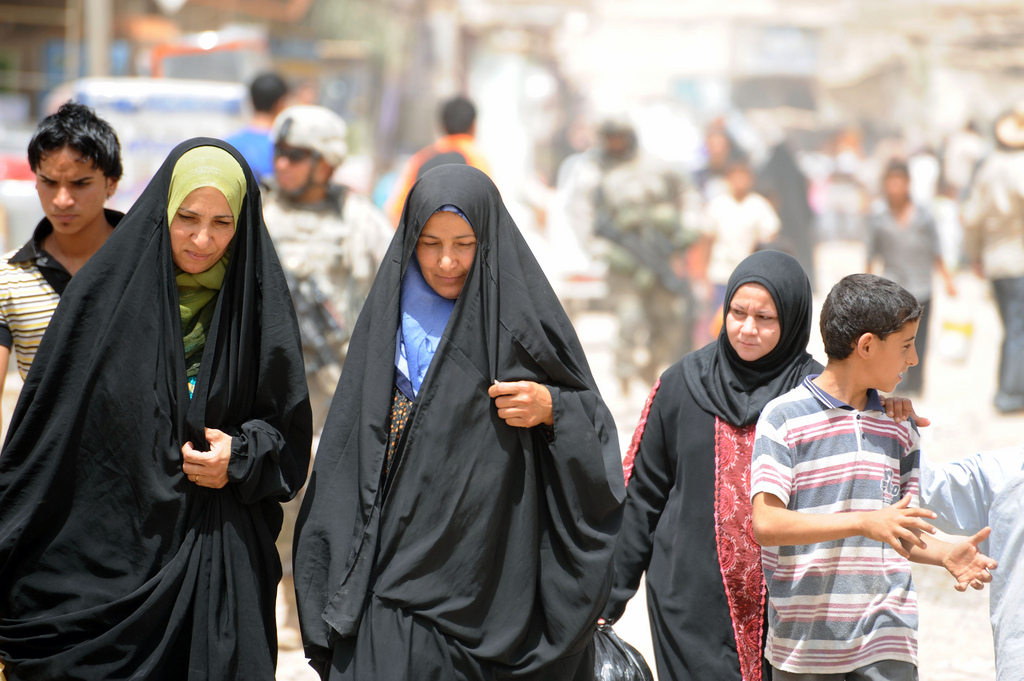
Women Victims of Unmet Western Promises in Islamic Countries

Credit: Photo via Irrationally Bound

By Marianna Karakoulaki

A Capitalist Argument for Clean Energy: The Rise of Green Banks

(Andy Potts)

By Nancy Cook in the National Journal

About three years ago, Connecticut changed its approach to promoting renewable energy: It decided to act more like a bank than like a state government. Gone were many of the subsidies that had propped up the regional clean-energy market for years. In their place, Connecticut officials started to lend money to fund commercially viable green projects. The goal was to combine public financing with private loans from community banks and other financial institutions to help create a renewable-energy marketplace.

This marks a shift in the argument for clean energy from a moral to a capitalist one. “Connecticut is trying to demonstrate that clean energy is an arena where money can be made,” says Daniel Esty, the former commissioner of the Connecticut Department of Energy and Environmental Protection and a professor at Yale Law School. “It’s not just a story about clean energy. It’s a story about cheaper, cleaner energy, and that has much broader appeal.”

Read more at the National Journal

Jobless Claims in U.S. Unexpectedly Drop to Eight-Year Low

Michigan, New Jersey and Ohio were among states that reported the biggest decrease in claims in the week ended July 12 amid fewer firings in manufacturing and transportation industries. That may indicate more auto plants than usual remained open this year to meet improving demand. photographer: Jeff Kowalsky/Bloomberg

By Nina Glinski and Victoria Stilwell in Bloomberg News

The number of Americans filing applications for unemployment benefits dropped last week to the lowest level in more than eight years, reflecting what could be a pickup in auto making during a typically slow time of year.

Jobless claims fell by 19,000 to 284,000 in the week ended July 19, the fewest since February 2006 and lower than any economist surveyed by Bloomberg forecast, a Labor Department report showed today in Washington. Applications can be volatile in July because of auto plant shutdowns, even as state data showed nothing inconsistent with prior years, a Labor Department spokesman said as the data was released to the press.

Fewer claims signal employers are reluctant to let go of staff as the talent pool shrinks and sales improve. A tightening labor market could lift wages and spur consumer spending, which accounts for about 70 percent of the economy.

The four-week average of jobless claims, considered a less volatile measure than the weekly figure, decreased to 302,000, the lowest since May 2007, from 309,250 in the prior week.

The number of people continuing to receive jobless benefits declined by 8,000 to 2.5 million in the week ended July 12, the fewest since June 2007. The unemployment rate among people eligible for benefits held at 1.9 percent, today’s report showed. These data are reported with a one-week lag.

Employers added 288,000 jobs in June, lifting the average monthly advance so far in 2014 to almost 231,000. If that pace is sustained, it would be the best year since 1999.

Read more at Bloomberg News

Israeli Parliament Deputy Speaker Calls For “Ethnic Cleansing” of Gaza

Moshe Feiglin

“A refreshingly open call for ethnic cleansing of Palestinians from an Israeli deputy speaker”

By Katie Halper in The Raw Story

I’ve always said that I like my ethnic cleansers like my men: honest, direct, and with a plan. Sadly, like good men, honest and open ethnic cleansers are few and far between. As the Israeli government, and those who blindly defend it, claim that the attacks in Gaza are for self-defense, and self-defense alone, one man has the courage to admit that the real goal is to rid the area of Palestinians and populate it with Jews. And that man is Moshe Feiglin, Deputy speaker and member of Knesset (Israel’s parliament).

Read more at The Raw Story

U.S. Religious Leaders Embrace Cause of Immigrant Children

Father Jack Barker of St. Martha’s Catholic Church in Murrieta, Calif., spoke at a vigil.
Credit Monica Almeida/The New York Times

By Michael Paulson in The New York Times

After protesters shouting “Go home” turned back busloads of immigrant mothers and children in Murrieta, Calif., a furious Cardinal Timothy M. Dolan, the Roman Catholic archbishop of New York, sat down at his notepad and drafted a blog post detailing his shame at the episode, writing, “It was un-American; it was unbiblical; it was inhumane.”

When the governor of Iowa, Terry E. Branstad, said he did not want the migrants in his state, declaring, “We can’t accept every child in the world who has problems,” clergy members in Des Moines held a prayer vigil at a United Methodist Church to demonstrate their desire to make room for the refugees.

The United States’ response to the arrival of tens of thousands of migrant children, many of them fleeing violence and exploitation in Central America, has been symbolized by an angry pushback from citizens and local officials who have channeled their outrage over illegal immigration into opposition to proposed shelter sites. But around the nation, an array of religious leaders are trying to mobilize support for the children, saying the nation can and should welcome them.

Russell Moore, a Southern Baptist Convention leader, recently took other officials to visit children at Texas detention centers. Credit Jennifer Whitney for The New York Times

“We’re talking about whether we’re going to stand at the border and tell children who are fleeing a burning building to go back inside,” said Rabbi Asher Knight of Temple Emanu-El in Dallas, who said leaders of more than 100 faith organizations in his city had met last week to discuss how to help. He said that in his own congregation, some were comparing the flow of immigrant children to the Kindertransport, a rescue mission in the late 1930s that sent Jewish children from Nazi Germany to Britain for safekeeping.

“The question for us is: How do we want to be remembered, as yelling and screaming to go back, or as using the teachings of our traditions to have compassion and love and grace for the lives of God’s children?” Rabbi Knight said.

The backlash to the backlash is broad, from Unitarian Universalists and Quakers to evangelical Protestants. Among the most agitated are Catholic bishops, who have long allied with Republican politicians against abortion and same-sex marriage, and leaders of the Southern Baptist Convention, whose adherents tend to lean right.

“This is a crisis, and not simply a political crisis, but a moral one,” said Russell Moore, president of the Ethics and Religious Liberty Commission of the Southern Baptist Convention. On Tuesday, Mr. Moore led a delegation of Southern Baptist officials to visit refugee children at detention centers in San Antonio and McAllen, Tex. In an interview after the visit, Mr. Moore said that “the anger directed toward vulnerable children is deplorable and disgusting” and added: “The first thing is to make sure we understand these are not issues, these are persons. These children are made in the image of God, and we ought to respond to them with compassion, not with fear.”

Read more at The New York Times

Rebel Leader: Malaysia Plane Filled with Already Dead Bodies

Igor Girkin (AP Photo / Dmitry Lovetsky)

From the Associated Press

MOSCOW (AP) — A top pro-Russia rebel commander in eastern Ukraine has given a bizarre version of events surrounding the Malaysian jetliner crash — suggesting many of the victims may have died days before the plane took off.

The pro-rebel website Russkaya Vesna on Friday quoted Igor Girkin as saying he was told by people at the crash site that “a significant number of the bodies weren’t fresh,” adding that he was told they were drained of blood and reeked of decomposition..

The Malaysia Airlines Boeing-777 was shot down Thursday, killing all 298 people aboard. The plane was flying 10,000 meters above an area where Ukrainian forces have been fighting separatist rebels. Each side accuses the other of downing the plane.

U.S. intelligence authorities said a surface-to-air missile brought down the plane, and U.S. Ambassador Samantha Power told the U.N. Security Council in New York on Friday that the missile was likely fired from a rebel-held area near the Russian border.

Read more at Talking Points Memo

War Comes to Ukraine

The Consequences of the Crash in Donetsk

The site of a Malaysia Airlines Boeing 777 plane crash is seen near the settlement of Grabovo in the Donetsk region, July 17, 2014. (Maxim Zmeyev / Courtesy Reuters)

By Alexander J. Motyl in Foreign Affairs

Yesterday afternoon, by most accounts, pro-Russian separatists shot down Malaysia Airlines flight 17 over eastern Ukraine. The attackers ostensibly thought that the Boeing 777 was a Ukrainian plane about to enter Russian airspace. Soon after the attack, Igor Girkin, the self-styled commander of the Donetsk People’s Army, bragged on his website that “We just shot down an AN-26 plane near Torez; it’s scattered somewhere around the Progress mine. We warned them not to fly in ‘our sky’.” Soon after, RIA Novosti, a Russian news agency, seconded Girkin’s claim.

After it became apparent that the plane was not Ukrainian, Girkin erased his post and Aleksandr Borodai, the prime minister of the self-proclaimed Donetsk People’s Republic, tried to put the blame for the attack, which killed 295, on Ukrainian authorities. Later in the day, Russian President Vladimir Putin stated that it was “unquestionable that the state over whose territory this took place is responsible for this terrible tragedy.”

The atrocity comes three days after Russian militants shot down a Ukrainian transport plane flying over Krasnodon district in Luhansk province and one day after a missile — which Ukrainian authorities believe was fired by Russia — brought down a Ukrainian SU-25 jet over Donetsk province.

This week also saw a major escalation of Russian military involvement in Ukraine; in the early morning hours of Sunday, July 13, about 100 Russian armored personnel carriers and other vehicles crossed from Russia into Luhansk province in Ukraine. Unlike earlier Russian deployments into Crimea and eastern Ukraine, these carriers were openly adorned with Russian insignia and flags. The flow of Russian tanks and soldiers into the area has since continued, and Ukrainian authorities estimate that up to 400 additional “little green men” (a term coined during the Crimea invasion for Russian troops without insignia) have infiltrated into eastern Ukraine’s Donbas.

Until yesterday, that escalation had gone relatively unremarked in Western media. But now, no matter who fired the missile, things are set to change. The downing of a civilian plane may conceivably qualify as a war crime, inasmuch as it entailed the unwarranted militarily destruction of a civilian target. At any rate, it was certainly an atrocity and an act of terrorism. And if Girkin — an ethnic Russian who hails from Russia and who, by some accounts, is still an officer in the Russian military intelligence service, which would make him officially subordinate to Russia’s president — really was involved, Putin might arguably be politically responsible for the crime.

Read more at Foreign Affairs

Israel’s Bloody Status Quo

By Michiel Coxcie, Pieter Coecke van Aelst, Cornelis Floris, Cornelis Bos (circle of) [Public domain], via Wikimedia Commons
By Roger Cohen in The New York Times

LONDON — Sheldon Adelson’s right-wing Israel Hayom, the biggest-selling newspaper in Israel, has called for Gaza to be “returned to the Stone Age.” During the last Israeli bombing campaign in Gaza, in 2012, a government minister called for Gaza to be consigned “to the Middle Ages.” Before that, there was the Gaza War of 2008-2009, in which 1,166 Palestinians died and 13 Israelis, according to the Israel Defense Forces.

The story goes on and on. There is no denouement. Gaza, a small place jammed with 1.8 million people, does not recess to the Stone, Iron, Middle or other Ages. It does not get flattened, as Ariel Sharon’s son once proposed. The death toll is overwhelmingly skewed against Palestinians. Hamas, with its militia and arsenal of rockets, continues to run Gaza. The dead die for nothing.

Israel could send Gaza back to whichever age it wishes. Its military advantage, its general dominance, over the Palestinians has never been greater since 1948. But it chooses otherwise. Prime Minister Benjamin Netanyahu’s talk of a ground invasion is empty. The last thing Israel wants, short of a cataclysm, is to go into Gaza and get stuck.

What Israel wants is the status quo (minus Hamas rockets). Israel is the Middle East’s status quo power par excellence. It seeks a calm Gaza under Hamas control, a divided Palestinian movement with Fatah running the West Bank, a vacuous “peace process” to run down the clock, and continued prosperity. Divide and rule. Hamas is useful to Israel as long as it is quiescent.

Read more at The New York Times

Tales from Gaza: What is life really like in ‘the world’s largest outdoor prison’?

With its sandy beaches and sumptuous seafood, it could be a holiday resort. But life in Gaza, post-Israeli sanctions and with 50 per cent unemployment, has never been more difficult. Alistair Dawber meets the people trying to survive on the Palestinian coast.

By Alistair Dawber in The Independent

The guide books warn that it’s very unstable and that tourists shouldn’t go there; the Foreign Office tells Brits that there’s a high threat from terrorism – don’t visit any part of the territory, it says, and if you do, there is no ‘our man’ there to help you out.

In truth, it is pretty difficult to get into Gaza anyway. Unless you are a journalist or work for an NGO, the likelihood is that you will get stopped at Israel’s airport-terminal-like border post at Erez, which governs who is allowed to enter the Palestinian territory and, more importantly in Israeli eyes, who is allowed out.

But once you do get permission to go to Gaza, you realise that it is not like anywhere else. After getting the necessary stamps in your passport, you take a long walk through an 800-metre or so long cage, overlooked by Israeli army gun posts and balloons fixed with cameras that keep an eye over what’s going on. Locals call it “the world’s biggest prison”, and it’s not difficult to understand why.

Palestinian Abu Ameera poses for a photograph with children at Shati refugee camp Saleh Jadallah

Gaza is about 5,000 years old and one of the world’s oldest cities. In that time it has been both a thriving port and, as it is today, a sprawling mess of refugee camps and poverty. According to the United Nations, 1.5 million people call it home, making Gaza one of the most densely populated areas on the planet. Of the 1.5 million inhabitants, 1.1 million are refugees; those who lived in what is now Israel before 1948 refuse to give up the belief that one day they’ll return to their former homes.

Read more at The Independent