The ugliest, most appalling spectacle in American politics

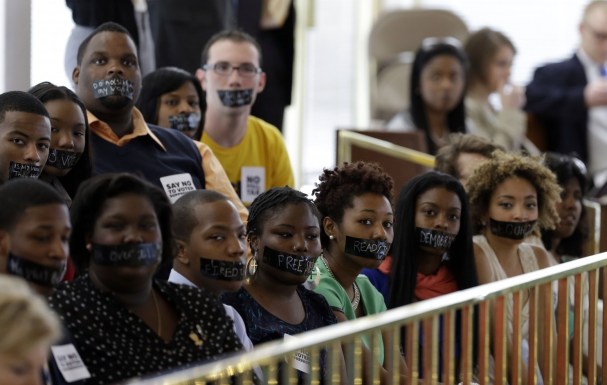
Members of North Carolina student chapters of the NAACP. Photo credit: Geery Broome/Associated Press)
Members of North Carolina student chapters of the NAACP. Photo credit: Geery Broome/Associated Press

By Eugene Robinson

Every once in a while, the curtains part and we get a glimpse of the ugliest, most shameful spectacle in American politics: the Republican Party’s systematic attempt to disenfranchise African Americans and other minorities with voter-ID laws and other restrictions at the polls.

If you thought this kind of discrimination died with Jim Crow, think again. Fortunately, federal courts have blocked implementation of some of the worst new laws, at least for now. But the most effective response would be for black and brown voters to send the GOP a message by turning out in record numbers, no matter what barriers Republicans try to put in our way.

The ostensible reason for these laws is to solve a problem that doesn’t exist: voter fraud by impersonation. Four years ago, you may recall, a Republican Pennsylvania legislator let slip the real reason for his state’s new voter-ID law: to “allow” Mitt Romney to win the state. In the end, Romney didn’t. But Republicans tried mightily to discourage minorities, most of whom vote Democratic, from going to the polls.

Now, thanks to documents that surfaced in a lawsuit, we have an even clearer and more egregious example of attempted disenfranchisement, this time in North Carolina. As The Post reported, the documents show “that North Carolina GOP leaders launched a meticulous and coordinated effort to deter black voters, who overwhelmingly vote for Democrats.”

The article continued, “The law, created and passed entirely by white legislators, evoked the state’s ugly history of blocking African Americans from voting — practices that had taken a civil rights movement and extensive federal intervention to stop.”

The Washington Post

What Does Black Lives Matter Want?

Black-power-pencil_feature_0-1

By Robin D. G. Kelley

On August 1 the Movement for Black Lives (M4BL), a coalition of over sixty organizations, rolled out “A Vision for Black Lives: Policy Demands for Black Power, Freedom & Justice,” an ambitious document described by the press as the first signs of what young black activists “really want.” It lays out six demands aimed at ending all forms of violence and injustice endured by black people; redirecting resources from prisons and the military to education, health, and safety; creating a just, democratically controlled economy; and securing black political power within a genuinely inclusive democracy. Backing the demands are forty separate proposals and thirty-four policy briefs, replete with data, context, and legislative recommendations.

But the document quickly came under attack for its statement on Palestine, which calls Israel an apartheid state and characterizes the ongoing war in Gaza and the West Bank as genocide. Dozens of publications and media outlets devoted extensive coverage to the controversy around this single aspect of the platform, including The Guardian, the Washington Post, The Times of Israel, Haaretz, and the St. Louis Post-Dispatch. Of course, M4BL is not the first to argue that Israeli policies meet the UN definitions of apartheid. (The 1965 International Convention for the Elimination of All Forms of Racial Discrimination and the 1975 International Convention on the Suppression and Punishment of the Crime of Apartheid define it as “inhuman acts committed for the purpose of establishing and maintaining domination by one racial group of persons over any other racial group of persons and systematically oppressing them.”) Nor is M4BL the first group to use the term “genocide” to describe the plight of Palestinians under occupation and settlement. The renowned Israeli historian Ilan Pappe, for example, wrote of the war on Gaza in 2014 as “incremental genocide.” That Israel’s actions in Gaza correspond with the UN definition of genocide to “destroy, in whole or in part, a national, ethnical, racial or religious group” by causing “serious bodily or mental harm” to group members is a legitimate argument to make.

The few mainstream reporters and pundits who considered the full M4BL document either reduced it to a laundry list of demands or positioned it as an alternative to the platform of the Democratic Party—or else focused on their own benighted astonishment that the movement has an agenda beyond curbing police violence. But anyone following Black Lives Matter from its inception in the aftermath of the George Zimmerman verdict should not be surprised by the document’s broad scope. Black Lives Matter founders Alicia Garza, Patrisse Cullors, and Opal Tometi are veteran organizers with a distinguished record of fighting for economic justice, immigrant rights, gender equity, and ending mass incarceration. “A Vision for Black Lives” was not a response to the U.S. presidential election, nor to unfounded criticisms of the movement as “rudderless” or merely a hashtag. It was the product of a year of collective discussion, research, collaboration, and intense debate, beginning with the Movement for Black Lives Convening in Cleveland last July, which initially brought together thirty different organizations. It was the product of some of the country’s greatest minds representing organizations such as the Black Youth Project 100, Million Hoodies, Black Alliance for Just Immigration, Dream Defenders, the Organization for Black Struggle, and Southerners on New Ground (SONG). As Marbre Stahly-Butts, a leader of the M4BL policy table explained, “We formed working groups, facilitated multiple convenings, drew on a range of expertise, and sought guidance from grassroots organizations, organizers and elders. As of today, well over sixty organizations and hundreds of people have contributed to the platform.”

The result is actually more than a platform. It is a remarkable blueprint for social transformation that ought to be read and discussed by everyone. The demands are not intended as Band-Aids to patch up the existing system but achievable goals that will produce deep structural changes and improve the lives of all Americans and much of the world. Thenjiwe McHarris, an eminent human rights activist and a principle coordinator of the M4BL policy table, put it best: “We hope that what has been created carries forward the legacy of our elders and our ancestors while imagining a world and a country profoundly different than what currently exists. For us and for those that will come after us.” The document was not drafted with the expectation that it will become the basis of a mass movement, or that it will replace the Democratic Party’s platform. Rather it is a vision statement for long-term, transformative organizing. Indeed, “A Vision for Black Lives” is less a political platform than a plan for ending structural racism, saving the planet, and transforming the entire nation—not just black lives.

Boston Review

By 4 To 1 Margin, Business Economists Say Clinton Would Manage Economy Better Than Trump

(Photo by Brian Blanco/Getty Images)

By Maggie McGrath

Throughout his presidential campaign, Donald J. Trump has pledged to put “America first,” suggesting that the country’s estimated 11 million undocumented immigrants should be deported and flatly rejecting the concept of globalism. But because of the potential economic consequences of these stances, a group of business economists is now flatly rejecting him.

A policy survey of National Association for Business Economics (NABE) members released Monday shows that 55% of business economists feel that former Secretary of State Hillary Clinton would do the best job as president of managing the U.S. economy. The candidate with the next-largest percentage of the vote was Libertarian candidate Gary Johnson: 15% of NABE members said he’d do the best job managing the economy. Another 15% or respondents said they didn’t know who would be best or that they didn’t have an opinion.

Just 14% chose Donald Trump.

The survey results are remarkable because NABE members aren’t your average ivory tower-dwelling, left-leaning egg heads. They work for businesses, trade associations and government agencies across the country. As NABE director and survey chair LaVaughn Henry put it, these are people who have skin in the game.

Forbes

Pieces of Silver

 Donald Trump at a rally in Fayetteville, N.C., on Tuesday. Credit Travis Dove for The New York Times
Donald Trump at a rally in Fayetteville, N.C., on Tuesday. Credit Travis Dove for The New York Times

By Paul Krugman

By now, it’s obvious to everyone with open eyes that Donald Trump is an ignorant, wildly dishonest, erratic, immature, bullying egomaniac. On the other hand, he’s a terrible person. But despite some high-profile defections, most senior figures in the Republican Party — very much including Paul Ryan, the speaker of the House, and Mitch McConnell, the Senate majority leader — are still supporting him, threats of violence and all. Why?

One answer is that these were never men and women of principle. I know that many in the news media are still determined to portray Mr. Ryan, in particular, as an honest man serious about policy, but his actual policy proposals have always been transparent con jobs.

Another answer is that in an era of intense partisanship, the greatest risk facing many Republican politicians isn’t that of losing in the general election, it’s that of losing to an extremist primary challenger. This makes them afraid to cross Mr. Trump, whose ugliness channels the true feelings of the party’s base.

The New York Times

GOP senator Susan Collins: Why I cannot support Trump

United States Senator Susan Collins (R) Maine
United States Senator Susan Collins (R) Maine (Photo credit: Evan Vucci/AP)

By Susan Collins

I will not be voting for Donald Trump for president. This is not a decision I make lightly, for I am a lifelong Republican. But Donald Trump does not reflect historical Republican values nor the inclusive approach to governing that is critical to healing the divisions in our country.

When the primary season started, it soon became apparent that, much like Sen. Bernie Sanders (I-Vt.), Mr. Trump was connecting with many Americans who felt that their voices were not being heard in Washington and who were tired of political correctness. But rejecting the conventions of political correctness is different from showing complete disregard for common decency. Mr. Trump did not stop with shedding the stilted campaign dialogue that often frustrates voters. Instead, he opted for a constant stream of denigrating comments, including demeaning Sen. John McCain’s (R-Ariz.) heroic military service and repeatedly insulting Fox News host Megyn Kelly.

With the passage of time, I have become increasingly dismayed by his constant stream of cruel comments and his inability to admit error or apologize. But it was his attacks directed at people who could not respond on an equal footing — either because they do not share his power or stature or because professional responsibility precluded them from engaging at such a level — that revealed Mr. Trump as unworthy of being our president.

The Washington Post

Father of deceased Muslim soldier to Trump: “You’ve sacrificed nothing”

Khizr Khan, father of deceased Army Captain Humayun S. M. Khan, spoke Thursday at the 2016 Democratic National Convention in Philadelphia. Captain Khan was one of 14 American Muslims who died serving the United States in the decade after 9/11.

What I Saw Last Friday in Hebron

Palestinians asked American Jews to join them in a ‘Freedom Summer.’ The result was extraordinary.

Peace activists clean around Palestinian houses as Israeli army soldiers stand guard in Tal Rumaida, Hebron, West Bank, July 15, 2016. Credit: Mussa Qawasma, Reuters

By Peter Beinart

Jawad Abu Aisha owns a cluttered yard in H2, the sector of Hebron that falls under direct Israeli control. He’d like to turn it into a cinema. Many local Palestinians — lacking recreational opportunities — would like to help him. But Abu Aisha says that Jewish settlers, and the Israeli military, prevent him from developing the space. In a democracy, if your neighbors impede construction on your property, you can appeal to local authorities. But for Palestinians in Hebron, Israel is not a democracy. They can’t vote for its government. They live under military law. So when settlers disrupt Palestinian construction on privately owned Palestinian land — as part of their effort to make Palestinian life in H2 so unbearable that Palestinians leave — the army and police do their bidding. The army and police, after all, are accountable to Israeli citizens. And in Hebron, as throughout the West Bank, Jewish settlers are citizens. Palestinians are subjects.

I saw this firsthand last Friday when I left a family vacation in Israel to join 52 Jewish activists, mostly from the Diaspora, on a trip to Hebron organized by the Center for Jewish Nonviolence and the anti-occupation collective, All That’s Left. We came at the request of a group called Youth Against Settlements. It’s burly, charismatic leader, a student of Gandhi and Martin Luther King named Issa Amro, asked Diaspora Jews to come and help clear Abu Aisha’s yard. He didn’t need American Jewish muscle. He needed American Jewish privilege, the privilege that gives American Jews protection from the Israeli state. Issa hoped that privilege would buy his group a few hours of uninterrupted yard work. He also hoped it would bring them publicity.

Think of Issa as a Palestinian Robert Moses. By 1964, the Student Nonviolent Coordinating Committee had been working for years to register African Americans in Mississippi to vote. But local whites brutalized them, often aided by the police. So Moses recruited northern white kids to come south for “Freedom Summer.” He hoped the media would follow, and that once white Americans saw segregation’s true face, they’d push their politicians to support civil rights. Among the more than 1,000 activists who heeded Moses’ call were Michael Schwerner and Andrew Goodman, college students from New York whose murder, alongside African American James Chaney, has become American Jewish legend.

I’ll never know what it felt like to be in Mississippi in 1964. But last Friday, watching dozens of twenty-something American Jewish kids (and a few older activists) haul junk in Abu Aisha’s yard in Hebron, I felt an unusual sensation: hope.

I felt hope because American Jewish Millennials are different. My generation, which came of age in the 1990s, didn’t build a single organization that challenged the American Jewish establishment on Israel. That’s partly because, during the Oslo era, we thought American, Israeli and Palestinian leaders would create a two-state solution on their own. But it’s also because the 1990s were a lost decade for the American activist left, an “ice age,” in Cornel West’s words.

Haaretz

President Obama on the fatal shootings of Alton Sterling and Philando Castile

Sanders wins concessions in Dem draft platform

 Photo credit: Greg Nash
Photo credit: Greg Nash

By Ben Kamisar

Bernie Sanders won a handful of concessions in the Democratic National Committee’s platform, with the party lining up behind his vision on the minimum wage, financial regulation and other issues.

A draft version of the platform was released Friday, amid an ongoing battle to get Sanders to end his presidential campaign and endorse presumptive Democratic nominee Hillary Clinton.

The platform explicitly calls for a $15 minimum wage, a position long espoused by Sanders.

“Democrats believe that the current minimum wage is a starvation wage and must be increased to a living wage,” the text reads.

“We believe that Americans should earn at least $15 an hour and have the right to form or join a union. We applaud the approaches taken by states like New York and California. We should raise and index the minimum wage, give all Americans the ability to join a union regardless of where they work, and create new ways for workers to have power in the economy.”

The Hill

The interesting thing that happened when Kansas cut taxes and California hiked them

imrs.php
Presidential candidate Bernie Sanders poses for a photograph with workers… (Photo by Matt McClain/The Washington Post)

In 2012, voters in California approved a measure to raise taxes on millionaires, bringing their top state income tax rate to 13.3 percent, the highest in the nation. Conservative economists predicted calamity, or at least a big slowdown in growth. Also that year, the governor of Kansas signed a series of changes to the state’s tax code, including reducing income and sales tax rates. Conservative economists predicted a boom.

Neither of those predictions came true. Not right away — California grew just fine in the year the tax hikes took effect — and especially not in the medium term, as new economic data showed this week.

Now, correlation does not, as they say, equal causation, and two examples are but a small sample. But the divergent experiences of California and Kansas run counter to a popular view, particularly among conservative economists, that tax cuts tend to supercharge growth and tax increases chill it.

California’s economy grew by 4.1 percent in 2015, according to new numbers from the Bureau of Economic Analysis, tying it with Oregon for the fastest state growth of the year. That was up from 3.1 percent growth for the Golden State in 2014, which was near the top of the national pack.

The Kansas economy, on the other hand, grew 0.2 percent in 2015. That’s down from 1.2 percent in 2014, and below neighboring states such as Nebraska (2.1 percent) and Missouri (1.2 percent). Kansas ended the year with two consecutive quarters of negative growth — a shrinking economy. By a common definition of the term, the state entered 2016 in recession.

The Washington Post