Have Republicans Forgotten Who We Are?

How immigration will save America and Social Security too.
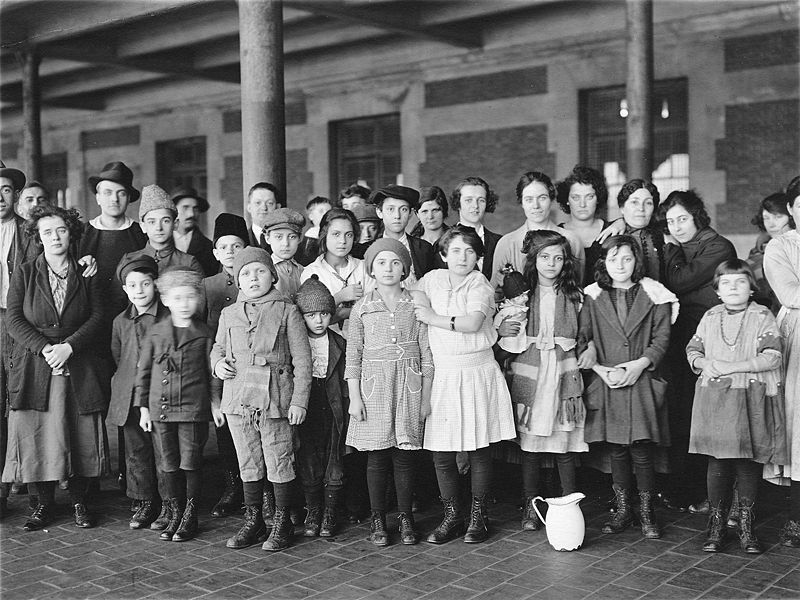
Immigrant children, Ellis Island, New York.

The Christian Science Monitor​ recently published a very interesting and informative article about the current debate in the United States Senate over the future of Social Security disability benefits.

Reallocating one year’s funding for Social Security retirement to disability would ensure that both programs remain fully funded until 2033. Although this has been done many times before, the current congressional Republican majority is opposed, preferring instead to begin cutting benefits for disabled Americans by as much as 20% next year. Republicans complain that Democrats are refusing to address the serious, looming fiscal crisis of the program.

But while Social Security certainly has future funding problems, they are not as daunting as Republicans wish to portray them. The Republican leadership’s motivation is purely ideological. They desire to destroy the Social Security program. And they want to begin by reducing payments to disabled Americans next year. The average disability recipient receives about $1250 a month in benefits. I’d like to see even one Republican Senator live on that budget, or cut their own pay by 20% next year.

Over one million veterans returned home injured from the wars in Iraq and Afghanistan. Many of them so severely injured that they may never work again. And many of these gravely injured soldiers returned home to waiting spouses and children. Republicans are now threatening to cut the disability benefits for those veterans and their families.

Interestingly, the prospectus for the future funding of Social Security programs is not as bleak as Republicans would like the American public to believe. And there is a very simple explanation for this that is directly related to the reason that Social Security is facing future deficits in the first place: population demographics.

More people are withdrawing benefits from the system than are paying into it. But American society is preparing to undergo a surprising demographic shift as an unexpected consequence of immigration. As increasing numbers of young immigrants join the American labor force in the coming decades–and as inevitable immigration reforms provide the necessary pathways to citizenship for young, undocumented immigrants–Social Security revenues will likely see a significant increase relative to program expenditures.

America has always been a nation of immigrants. It’s who we are. And immigration has always been a major source of strength for America and a boon to our economy. So why, in God’s name, are so many Americans opposed to it now? Perhaps it’s because they have forgotten, or maybe never understood at all, who we are as a people, and the vital role that immigration has always played in our nation’s history.

© 2015 by konigludwig

Tales from Gaza: What is life really like in ‘the world’s largest outdoor prison’?

With its sandy beaches and sumptuous seafood, it could be a holiday resort. But life in Gaza, post-Israeli sanctions and with 50 per cent unemployment, has never been more difficult. Alistair Dawber meets the people trying to survive on the Palestinian coast.

By Alistair Dawber in The Independent

The guide books warn that it’s very unstable and that tourists shouldn’t go there; the Foreign Office tells Brits that there’s a high threat from terrorism – don’t visit any part of the territory, it says, and if you do, there is no ‘our man’ there to help you out.

In truth, it is pretty difficult to get into Gaza anyway. Unless you are a journalist or work for an NGO, the likelihood is that you will get stopped at Israel’s airport-terminal-like border post at Erez, which governs who is allowed to enter the Palestinian territory and, more importantly in Israeli eyes, who is allowed out.

But once you do get permission to go to Gaza, you realise that it is not like anywhere else. After getting the necessary stamps in your passport, you take a long walk through an 800-metre or so long cage, overlooked by Israeli army gun posts and balloons fixed with cameras that keep an eye over what’s going on. Locals call it “the world’s biggest prison”, and it’s not difficult to understand why.

Palestinian Abu Ameera poses for a photograph with children at Shati refugee camp Saleh Jadallah

Gaza is about 5,000 years old and one of the world’s oldest cities. In that time it has been both a thriving port and, as it is today, a sprawling mess of refugee camps and poverty. According to the United Nations, 1.5 million people call it home, making Gaza one of the most densely populated areas on the planet. Of the 1.5 million inhabitants, 1.1 million are refugees; those who lived in what is now Israel before 1948 refuse to give up the belief that one day they’ll return to their former homes.

Read more at The Independent

7 Bipartisan Reasons to Raise the Minimum Wage

The minimum wage debate is back. Since last year, historically unorganized workers at fast food and big-box retailers across the country have been demanding a higher minimum wage and better working conditions. They are gaining popular support as they become more visible, rallying in big cities and during attention-getting events such as Black Friday.

President Obama, liberals in Congress, and liberals seeking office are making the federal minimum wage a central plank in the effort to combat runaway inequality—now at levels unseen since the 1920s—and push back poverty. Obama has called for increasing the minimum wage from $7.25 per hour to $10.10, with a built-in cost-of-living adjustment tied to inflation. He later announced an executive order requiring federal contractors to observe the $10.10 minimum. And activists at the state and local levels have gone further. California may vote this year on raising its minimum wage to $12.

Increases enjoy wide public support. Recent polls find 76 percent of Americans support a $9 minimum wage. Republicans are split, with 50 percent backing an increase.

There are at least seven reasons voters, if not politicians, in both parties favor a higher minimum wage. They involve concerns about inequality and poverty, about responses to poor wage growth, and about the status of work as well as community. These reasons sometimes conflict, but overall they explain why the minimum wage will continue to play an important role in politics and policy.

Read more at the Boston Review

The Magical World Where McDonald’s Pays $15 an Hour? It’s Australia

Even in countries with a high minimum wage, the golden arches manage to turn a profit. Here’s how.

Last week, fast-food workers around the United States yet again walked off the job to protest their low pay and demand a wage hike to $15 an hour, about double what many of them earn today. In doing so, they added another symbolic chapter to an eight-month-old campaign of one-day strikes that, so far, has yielded lots of news coverage, but not much in terms of tangible results.

So there’s a certain irony that in Australia, where the minimum wage for full-time adult workers already comes out to about $14.50 an hour, McDonald’s staffers were busy scoring an actual raise. On July 24, the country’s Fair Work Commission approved a new labor agreement between the company and its employees guaranteeing them up to a 15 percent pay increase by 2017.

And here’s the kicker: Many Australian McDonald’s workers were already making more than the minimum to begin with.

The land down under is, of course, not the only high-wage country in the world where McDonald’s does lucrative business. The company actually earns more revenue out of Europe than than it does from the United States. France, with its roughly $12.00 hourly minimum, has more than 1,200 locations. (Australia has about 900).

So how exactly do McDonald’s and other chains manage to turn a profit abroad while paying an hourly wage their American workers can only fantasize about while picketing? Part of the answer, as you might expect, boils down to higher prices. Academic estimates have suggested that, worldwide, worker pay accounts for at least 45 percent of a Big Mac’s cost. In the United States, industry analysts tend to peg the figure a bit lower—labor might make up anywhere from about a quarter of all expenses at your average franchise to about a third.* But generally speaking, in countries where pay is higher, so is the cost of two all-beef patties, as shown in the chart below by Princeton economist Orley Ashenfelter. Note Western Europe way out in the upper-right hand corner, with its high McWages and high Big Mac prices.

Read more at The Atlantic

Too many of America’s working poor have become victims of a bizarre kind of socioeconomic Stockholm Syndrome. I’m talking about poor people who vote the interests of rich people. They’re like dogs begging for scraps from the table of a master who has no intention of sharing anything. But I’m being unfair to dog owners. Most dog owners treat their pets better than some of America’s wealthiest treat their fellow citizens.

Why Bankrolling Israel Prevents Peace in the Middle East

An Israeli soldier stands beside a tank in Avivim near the Israel-Lebanon border (Reuters/Baz Ratner)

We Americans have funny notions about foreign aid. Recent polls show that, on average, we believe 28 percent of the federal budget is eaten up by it, and that, in a time of austerity, this gigantic bite of the budget should be cut back to 10 percent. In actual fact, barely 1 percent of the federal budget goes to foreign aid of any kind.

In this case, however, truth is at least as strange as fiction. Consider that the top recipient of US foreign aid over the past three decades isn’t some impoverished land filled with starving kids, but a wealthy nation with a per-head gross domestic product on par with the European Union average, and higher than that of Italy, Spain or South Korea.

Consider also that this top recipient of such aid—nearly all of it military since 2008—has been busily engaged in what looks like a nineteenth-century-style colonization project. In the late 1940s, our beneficiary expelled some 700,000 indigenous people from the land it was claiming. In 1967, our client seized some contiguous pieces of real estate and ever since has been colonizing these territories with nearly 650,000 of its own people. It has divided the conquered lands with myriad checkpoints and roads accessible only to the colonizers and is building a 440-mile wall around (and cutting into) the conquered territory, creating a geography of control that violates international law.

“Ethnic cleansing” is a harsh term, but apt for a situation in which people are driven out of their homes and lands because they are not of the right tribe. Though many will balk at leveling this charge against Israel—for that country is, of course, the top recipient of American aid and especially military largesse—who would hesitate to use the term if, in a mirror-image world, all of this were being inflicted on Israeli Jews?

Read more at The Nation

Support quality journalism. Subscribe to The Nation.

Republican Congressional Candidate Touts Progressive Minimum Wage Fix

GOP nominee in FL-13 David Jolly CREDIT: AP

An unlikely advocate for one of the most progressive minimum wage proposals emerged last week: Republican congressional candidate David Jolly.

Democratic nominee Alex Sink supports raising the minimum wage to $10.10, as is currently being considered in Congress, while Jolly opposes it. However, in explaining his position to the Tribune, Jolly actually advocated another progressive proposal: indexing the minimum wage so it automatically increases every year.

“Minimum wage should be indexed to inflation or subject to a cost-of-living adjustment like any other federal income program,” Jolly said. “That means some years it may go up, other years it may stay static. Barack Obama is not an economist, neither is the Congress.”

The purchasing power of the minimum wage has significantly lagged the rate of inflation over the past four decades. In 1968, the federal minimum wage was $1.60 per hour. Had it kept up with inflation since then, it would currently be set at $10.50, 45 percent higher than its current rate of $7.25.

In addition, if Jolly preferred tying the minimum wage to increases in worker productivity, it would currently be $18.30 per hour, according to a study from the Economic Policy Institute.

Indexing the minimum wage is a strongly progressive proposal because it would give low-income workers a raise every year without having to rely on Congress, which has only voted for an increase once in the last decade.

Read more at ThinkProgress

Support quality journalism. Subscribe to ThinkProgress

Marx Is Back

The global working class is starting to unite — and that’s a good thing.


The inscription on Karl Marx’s tombstone in London’s Highgate Cemetery reads, “Workers of all lands, unite.” Of course, it hasn’t quite ended up that way. As much buzz as the global Occupy movement managed to produce in a few short months, the silence is deafening now. And it’s not often that you hear of shop workers in Detroit making common cause with their Chinese brethren in Dalian to stick it to the boss man. Indeed, as global multinational companies have eaten away at labor’s bargaining power, the factory workers of the rich world have become some of the least keen on helping out their fellow wage laborers in poor countries. But there’s a school of thought — and no, it’s not just from the few remaining Trotskyite professors at the New School — that envisions a type of global class politics making a comeback. If so, it might be time for global elites to start trembling. Sure, it doesn’t sound quite as threatening as the original call to arms, but a new specter may soon be haunting the world’s 1 percent: middle-class activism.

Karl Marx saw an apocalyptic logic to the class struggle. The battle of the vast mass against a small plutocracy had an inevitable conclusion: Workers 1, Rich Guys 0. Marx argued that the revolutionary proletarian impulse was also a fundamentally global one — that working classes would be united across countries and oceans by their shared experience of crushing poverty and the soullessness of factory life. At the time Marx was writing, the idea that poor people were pretty similar across countries — or at least would be soon — was eminently reasonable. According to World Bank economist Branko Milanovic, when The Communist Manifesto was written in 1848, most income inequality at the global level was driven by class differences within countries. Although some countries were clearly richer than others, what counted as an income to make a man rich or condemn him to poverty in England would have translated pretty neatly to France, the United States, even Argentina.

But as the Industrial Revolution gained steam, that parity changed dramatically over the next century — one reason Marx’s prediction of a global proletarian revolution turned out to be so wrong. Just a few years after The Communist Manifesto was published, wages for workers in Britain began to climb. The trend followed across the rest of Europe and North America. The world entered a period of what Harvard University economist Lant Pritchett elegantly calls “divergence, big time.” The Maddison Project database of historical statistics suggests that per capita GDP in 1870 (in 1990 dollars, adjusting for purchasing power) was around $3,190 in Britain — compared with an African average of $648. Compare that with Britain in 2010, which had a per capita GDP of $23,777; the African average was $2,034. One hundred and forty years ago, the average African person was about one-fifth as rich as his British comrade. Today, he’s worth less than one-tenth.

Although many Americans get worked up about absurdly inflated CEO salaries and hedge fund bonuses, a hard economic fact has been overlooked: As the West took off into sustained growth, the gap in incomes among countries began to dwarf the income gaps within countries. That means a temp in East London may still struggle to make ends meet, but plop her down in Lagos and she’ll live like a queen. If you’re feeling bad about your nonexistent year-end bonus, consider this: Milanovic estimates that the average income of the richest 5 percent in India is about the same as that of the poorest 5 percent in the United States.

Like banks and multinationals, wealth and poverty are now globalized. The lowest municipal workers in Europe and the United States are far richer than their counterparts in poor developing countries (even when purchasing power parity is taken into account), and they’re almost infinitesimally better off than the majority of people in those countries who still survive off the earnings of small farms or microenterprises.

Read more at Foreign Policy

Support quality journalism. Subscribe to Foreign Policy

The War on Poverty

http://www.youtube.com/watch?v=oWvHr-0BXhc&feature=plcp
Syrian refugees in Lebanon (image via Wikipedia Commons)

Poor people are being murdered, beheaded, raped and terrorized by well armed gangs of mostly young men in Syria and in Mexico. What do these places and people have in common? Almost nothing. Is it about religion? Obviously not. I will bet you that most Mexican drug cartel members consider themselves Christians and have Christian symbols tattooed on their bodies. Muslims and Buddhists are no different, and depending upon where you are in the world, a Buddhist is as likely as a Muslim or a Christian to be involved in the murder or persecution of another person simply because they are of another ethnic or religious identification. The common denominator here is poverty. That’s what it is really all about. These people have no hope, no chance at a good education, a good job, or a decent life. They are hopelessly ignorant. Violence and criminality are their only alternatives. Recognizing and understanding this simple fact, we can see that the real war is of the wealthy against the poor, and that this war is an international war that knows no borders and no boundaries. By understanding and joining forces with ordinary people around the world who are also struggling for existence, we take the just fight to a higher level. When we help a poor person in Egypt, we help ourselves. When we help the poorest among us, we help ourselves. Sounds like something Jesus would have said, doesn’t it? That’s because he did. “What you do unto the least of my brothers…”

© 2014 by Paul Kennedy

I Wear the Badge of Socialist With Honor

The full text of the new Seattle city council member’s inauguration speech.

kshama_sawant_inauguration_ap_img

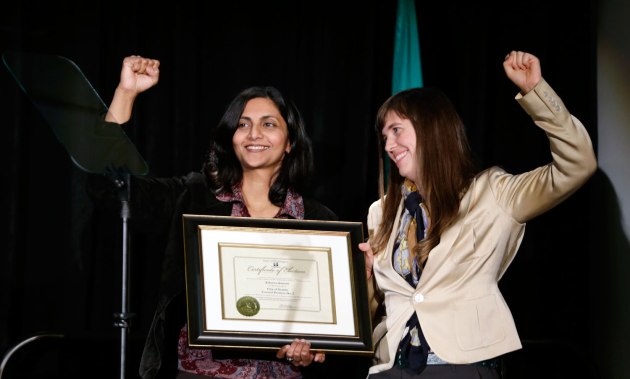
New Seattle Council member Kshama Sawant, left, stands with Nicole Grant, who assisted in a ceremonial swearing-in. (AP Photo/Elaine Thompson)

Editor’s note: At a ceremonial swearing-in on Monday, Kshama Sawant became Seattle’s first socialist city council member in almost a century. The full text of her inauguration speech is below.

My brothers and sisters,

Thank you for your presence here today.

This city has made glittering fortunes for the super wealthy and for the major corporations that dominate Seattle’s landscape. At the same time, the lives of working people, the unemployed and the poor grow more difficult by the day. The cost of housing skyrockets, and education and healthcare become inaccessible.

This is not unique to Seattle. Shamefully, in this, the richest country in human history, fifty million of our people—one in six—live in poverty. Around the world, billions do not have access to clean water and basic sanitation and children die every day from malnutrition.

This is the reality of international capitalism. This is the product of the gigantic casino of speculation created by the highway robbers on Wall Street. In this system the market is God, and everything is sacrificed on the altar of profit. Capitalism has failed the 99%.

Despite recent talk of economic growth, it has only been a recovery for the richest 1%, while the rest of us are falling ever farther behind.

The Nation

Pope Francis Hurts The Tender Feelings Of A Billionaire Republican

Pope Francis has hurt the delicate feelings of Home Depot billionaire and Republican Ken Langone just by preaching the message of Jesus. Awww… Image: jfxgillis

If Pope Francis ever finds himself in need of a hammer and some nails, he may want to consider avoiding Home Depot. Ken Langone, founder of the company, has been whining kvetching pissing and moaning grumpy about Pope Francis having the gall to promote the message of Jesus. In recent months, the Pope has been on a verbal rampage against the horrors that the unrestrained greed of “savage capitalism” has wrought across the globe. He’s been preaching that the message of Jesus was not to get rich by screwing the poor but to serve them. This has deeply offended poor Langone’s tender sensibilities.

Just who the hell does Pope Francis think he is? The Pope or something?
Via CNBC.com:

Langone said he’s raised the issue more than once with Cardinal Timothy Dolan, archbishop of New York, most recently at a breakfast in early December at which he updated him on fundraising progress.

“I’ve told the cardinal, ‘Your Eminence, this is one more hurdle I hope we don’t have to deal with. You want to be careful about generalities. Rich people in one country don’t act the same as rich people in another country,’ ” he said.

Well, he’s right about that. The United States has some of the greediest rich people on the planet. And Pope Francis knows it. Not only did Wall Street executives destroy the economy and throw millions out of work, they gave themselves HUGE bonuses using tax payer dollars. And then spent the next several years screwing those very same tax payers in every conceivable way.

Read more at Addicting Info