After Barbara Simons left her abusive husband and the house they lived in together six years ago, she had nowhere to go. She was without a job and her daughter, Jamie, was struggling with mental health issues. She ended up in Salt Lake City, Utah, and feared she’d become homeless.
Then she heard about a program run by the state that would pay for her and Jamie to get an apartment with no strings attached. The Housing First program started in 2005, and Simons says it might have saved her life.
“I don’t know if I’d be alive,” Simons told Mic by phone. “Or I’d be alive and living on the street. It just helped me get back on my feet. It showed that people cared about you.”
Even though Utah is one of the most conservative states in the nation, it has become a leader in progressive policies meant to help the homeless. By proving that a conservative state could solve its chronic homelessness problem for less money than traditional homelessness policies, Utah has become a model for towns, cities and states across the nation.
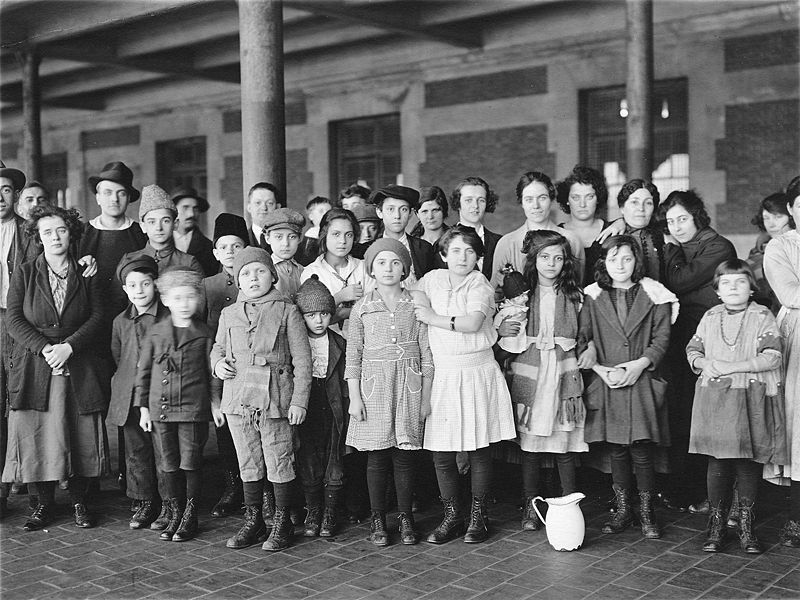
How immigration will save America and Social Security too.
Immigrant children, Ellis Island, New York.
The Christian Science Monitor recently published a very interesting and informative article about the current debate in the United States Senate over the future of Social Security disability benefits.
Reallocating one year’s funding for Social Security retirement to disability would ensure that both programs remain fully funded until 2033. Although this has been done many times before, the current congressional Republican majority is opposed, preferring instead to begin cutting benefits for disabled Americans by as much as 20% next year. Republicans complain that Democrats are refusing to address the serious, looming fiscal crisis of the program.
But while Social Security certainly has future funding problems, they are not as daunting as Republicans wish to portray them. The Republican leadership’s motivation is purely ideological. They desire to destroy the Social Security program. And they want to begin by reducing payments to disabled Americans next year. The average disability recipient receives about $1250 a month in benefits. I’d like to see even one Republican Senator live on that budget, or cut their own pay by 20% next year.
Over one million veterans returned home injured from the wars in Iraq and Afghanistan. Many of them so severely injured that they may never work again. And many of these gravely injured soldiers returned home to waiting spouses and children. Republicans are now threatening to cut the disability benefits for those veterans and their families.
Interestingly, the prospectus for the future funding of Social Security programs is not as bleak as Republicans would like the American public to believe. And there is a very simple explanation for this that is directly related to the reason that Social Security is facing future deficits in the first place: population demographics.
More people are withdrawing benefits from the system than are paying into it. But American society is preparing to undergo a surprising demographic shift as an unexpected consequence of immigration. As increasing numbers of young immigrants join the American labor force in the coming decades–and as inevitable immigration reforms provide the necessary pathways to citizenship for young, undocumented immigrants–Social Security revenues will likely see a significant increase relative to program expenditures.
America has always been a nation of immigrants. It’s who we are. And immigration has always been a major source of strength for America and a boon to our economy. So why, in God’s name, are so many Americans opposed to it now? Perhaps it’s because they have forgotten, or maybe never understood at all, who we are as a people, and the vital role that immigration has always played in our nation’s history.
I am not against using violence in self-defense. I don’t even call it violence when it’s self-defense, I call it intelligence. —Malcolm X
The grand jury’s decision to forgo indictment of Ferguson police officer Darren Wilson in the killing of Michael Brown compels us yet again to recognize that there is more to violence than its dictionary definition.
In clinical terms, violence is physical force intended to cause injury. But when officer Wilson shot and killed Michael Brown this past August, he did not engage in violence. He engaged in self-defense. He was justified.
After the jury’s decision was announced, black Americans and their supporters, who see in the non-indictment a form of impunity, took to the streets of Ferguson and St. Louis. Their righteous indignation amounted to a “night of violence,” according to The Guardian and USA Today. KSDK, a St. Louis NBC affiliate, used a common volcanic metaphor: “Violence erupts in Ferguson: Fire, looting, arrests.” Look at any of the major news outlets—shattered store windows and overturned police cruisers. That is violence, and there need be no inquiry into its justification.
Violence is a moral category, not an act. Where aggression is presumptively unjustified, it is violent. Where it is deemed acceptable by the norms of the community in which it occurs, it is not violence.
It is perilous to extrapolate too greatly from a single case, but that peril is not at issue in Ferguson, where Brown’s shooting reflects a widespread and historically endless pattern of white lawmen, and white men acting under cover of law, injuring and killing black men without engaging in what the society calls violence. Here again, the court asked what the victim did to warrant his fate. But the political problem, which courts can’t consider, is who has access to justification.
“A militant in the guise of a journalist — a shameless woman. Know your place!” This is how three-term Turkish prime minister Recep Tayyip Erdogan chose to describe Amberin Zaman, the Economist’s longtime Turkey correspondent, during a campaign rally on Aug. 7, just three days before he won the country’s first-ever direct presidential election. Erdogan lashed out at Zaman for having allegedly “insulted” Muslims in an interview with opposition leader Kemal Kilicdaroglu on the 24-hour TV news channel CNN Turk — and she was likewise vilified in the conservative press and aggressively harassed online by Erdogan supporters.
The next day, Enis Berberoglu, editor in chief of Hurriyet, one of the country’s highest-circulating dailies, abruptly resigned. Because Hurriyet is owned by Dogan, the same media group that owns CNN Turk, many doubted that Berberoglu’s move was coincidental. Erdogan went on to win the election with 52 percent of the vote. By the time of his inauguration at the end of August, several journalists at other newspapers had also lost their jobs — for reasons widely regarded as political.
These events followed a pattern that has become disturbingly familiar in recent years. As Erdogan’s Justice and Development Party (AKP) has grown increasingly entrenched since it first came to power in 2002, the space for free expression has narrowed perceptibly. This trend has been particularly evident over the past 15 months, starting with the protests that began in Istanbul’s Gezi Park and which then swept the country in the summer of 2013, when dozens of journalists were fired or forced to resign after expressing critical viewpoints. Most recently, Turkey’s trouble with press freedom made headlines this weekend when Erdogan denounced the New York Times for, he said, implying that the Turkish state was connected with Islamic State (IS) militants.
In 2013, Turkey remained the world’s top jailer of journalists (followed by Iran and China) for the second year in a row. As of the end of the year there were 40 reporters behind bars — one of several factors that led Freedom House to downgrade the country from “partly free” to “not free” in its 2014 press freedom rankings. Turkey came in 134th out of 197 countries.
Social media has not been spared. In the lead-up to local elections on March 30, the Turkish government shut down Twitter for two weeks and YouTube for 67 days in an effort to suppress the leak of damning wiretapped recordings that surfaced in a police and judicial investigation into government corruption at the highest levels.
“The main problem is that pro-AKP media is not only the dominant media, it’s the obligatory media,” said one Turkish journalist who asked not to be named. “If you’re not with them, you’re against them.”
With its sandy beaches and sumptuous seafood, it could be a holiday resort. But life in Gaza, post-Israeli sanctions and with 50 per cent unemployment, has never been more difficult. Alistair Dawber meets the people trying to survive on the Palestinian coast.
By Alistair Dawber in The Independent
The guide books warn that it’s very unstable and that tourists shouldn’t go there; the Foreign Office tells Brits that there’s a high threat from terrorism – don’t visit any part of the territory, it says, and if you do, there is no ‘our man’ there to help you out.
In truth, it is pretty difficult to get into Gaza anyway. Unless you are a journalist or work for an NGO, the likelihood is that you will get stopped at Israel’s airport-terminal-like border post at Erez, which governs who is allowed to enter the Palestinian territory and, more importantly in Israeli eyes, who is allowed out.
But once you do get permission to go to Gaza, you realise that it is not like anywhere else. After getting the necessary stamps in your passport, you take a long walk through an 800-metre or so long cage, overlooked by Israeli army gun posts and balloons fixed with cameras that keep an eye over what’s going on. Locals call it “the world’s biggest prison”, and it’s not difficult to understand why.
Palestinian Abu Ameera poses for a photograph with children at Shati refugee camp Saleh Jadallah
Gaza is about 5,000 years old and one of the world’s oldest cities. In that time it has been both a thriving port and, as it is today, a sprawling mess of refugee camps and poverty. According to the United Nations, 1.5 million people call it home, making Gaza one of the most densely populated areas on the planet. Of the 1.5 million inhabitants, 1.1 million are refugees; those who lived in what is now Israel before 1948 refuse to give up the belief that one day they’ll return to their former homes.
A new survey suggests that many Asians, Africans, Middle Easterners, young people, Muslims, and Hindus believe that facts about the genocide have been distorted. Child survivors photographed at Auschwitz in 1945. (Wikimedia)
Only 54 percent of the world’s population has heard of the Holocaust.
54 percent.
This is the most staggering statistic in a new survey by the Anti-Defamation League (ADL) of more than 53,000 people in over 100 countries, conducted by First International Resources. But that figure speaks to only those who have heard of it: Only a third of the world’s population believe the genocide has been accurately described in historical accounts. Some said they thought the number of people who died has been exaggerated; others said they believe it’s a myth. Thirty percent of respondents said it’s probably true that “Jews still talk too much about what happened to them in the Holocaust.”
Seventy years after the liberation of Auschwitz, two-thirds of the world’s population don’t know the Holocaust happened—or they deny it.
The Koch brothers and large utilities have allied to reverse state policies that favor renewable energy. Environmentalists are pushing back, but the fight is spreading and intensifying.
Americans for Prosperity, run by David Koch, shown here, and his brother, Charles, has led the effort to overturn a law in Kansas that requires 20% of the state’s electricity to come from renewable sources. (Phelan M. Ebanhack / Associated Press / August 30, 2013)
WASHINGTON — The political attack ad that ran recently in Arizona had some familiar hallmarks of the genre, including a greedy villain who hogged sweets for himself and made children cry.
But the bad guy, in this case, wasn’t a fat-cat lobbyist or someone’s political opponent.
He was a solar-energy consumer.
Solar, once almost universally regarded as a virtuous, if perhaps over-hyped, energy alternative, has now grown big enough to have enemies.
The Koch brothers, anti-tax activist Grover Norquist and some of the nation’s largest power companies have backed efforts in recent months to roll back state policies that favor green energy. The conservative luminaries have pushed campaigns in Kansas, North Carolina and Arizona, with the battle rapidly spreading to other states.
Alarmed environmentalists and their allies in the solar industry have fought back, battling the other side to a draw so far. Both sides say the fight is growing more intense as new states, including Ohio, South Carolina and Washington, enter the fray.
At the nub of the dispute are two policies found in dozens of states. One requires utilities to get a certain share of power from renewable sources. The other, known as net metering, guarantees homeowners or businesses with solar panels on their roofs the right to sell any excess electricity back into the power grid at attractive rates.
Net metering forms the linchpin of the solar-energy business model. Without it, firms say, solar power would be prohibitively expensive.
Even in countries with a high minimum wage, the golden arches manage to turn a profit. Here’s how.
Last week, fast-food workers around the United States yet again walked off the job to protest their low pay and demand a wage hike to $15 an hour, about double what many of them earn today. In doing so, they added another symbolic chapter to an eight-month-old campaign of one-day strikes that, so far, has yielded lots of news coverage, but not much in terms of tangible results.
So there’s a certain irony that in Australia, where the minimum wage for full-time adult workers already comes out to about $14.50 an hour, McDonald’s staffers were busy scoring an actual raise. On July 24, the country’s Fair Work Commission approved a new labor agreement between the company and its employees guaranteeing them up to a 15 percent pay increase by 2017.
And here’s the kicker: Many Australian McDonald’s workers were already making more than the minimum to begin with.
The land down under is, of course, not the only high-wage country in the world where McDonald’s does lucrative business. The company actually earns more revenue out of Europe than than it does from the United States. France, with its roughly $12.00 hourly minimum, has more than 1,200 locations. (Australia has about 900).
So how exactly do McDonald’s and other chains manage to turn a profit abroad while paying an hourly wage their American workers can only fantasize about while picketing? Part of the answer, as you might expect, boils down to higher prices. Academic estimates have suggested that, worldwide, worker pay accounts for at least 45 percent of a Big Mac’s cost. In the United States, industry analysts tend to peg the figure a bit lower—labor might make up anywhere from about a quarter of all expenses at your average franchise to about a third.* But generally speaking, in countries where pay is higher, so is the cost of two all-beef patties, as shown in the chart below by Princeton economist Orley Ashenfelter. Note Western Europe way out in the upper-right hand corner, with its high McWages and high Big Mac prices.
Too many of America’s working poor have become victims of a bizarre kind of socioeconomic Stockholm Syndrome. I’m talking about poor people who vote the interests of rich people. They’re like dogs begging for scraps from the table of a master who has no intention of sharing anything. But I’m being unfair to dog owners. Most dog owners treat their pets better than some of America’s wealthiest treat their fellow citizens.
Exposing troubling ties in the U.S. to overt Nazi and fascist protesters in Ukraine.
U.S. Senator John McCain, right, meets Ukrainian opposition leaders Arseniy Yatsenyuk, left, and Oleh Tyahnybok in Kiev, Ukraine, Saturday, Dec. 14, 2013. Image via Business Insider
As the Euromaidan protests in the Ukrainian capitol of Kiev culminated this week, displays of open fascism and neo-Nazi extremism became too glaring to ignore. Since demonstrators filled the downtown square to battle Ukrainian riot police and demand the ouster of the corruption-stained, pro-Russian President Viktor Yanukovich, it has been filled with far-right streetfighting men pledging to defend their country’s ethnic purity.
White supremacist banners and Confederate flags were draped inside Kiev’s occupied City Hall, and demonstrators have hoisted Nazi SS and white power symbols over a toppled memorial to V.I. Lenin. After Yanukovich fled his palatial estate by helicopter, EuroMaidan protesters destroyed a memorial to Ukrainians who died battling German occupation during World War II. Sieg heil salutes and the Nazi Wolfsangel symbol have become an increasingly common site in Maidan Square, and neo-Nazi forces have established “autonomous zones” in and around Kiev.
An Anarchist group called AntiFascist Union Ukraine attempted to join the Euromaidan demonstrations but found it difficult to avoid threats of violence and imprecations from the gangs of neo-Nazis roving the square. “They called the Anarchists things like Jews, blacks, Communists,” one of its members said. “There weren’t even any Communists, that was just an insult.”
“There are lots of Nationalists here, including Nazis,” the anti-fascist continued. “They came from all over Ukraine, and they make up about 30% of protesters.”
One of the “Big Three” political parties behind the protests is the ultra-nationalist Svoboda, whose leader, Oleh Tyahnybok, has called for the liberation of his country from the “Muscovite-Jewish mafia.” After the 2010 conviction of the Nazi death camp guard John Demjanjuk for his supporting role in the death of nearly 30,000 people at the Sobibor camp, Tyahnybok rushed to Germany to declare him a hero who was “fighting for truth.” In the Ukrainian parliament, where Svoboda holds an unprecedented 37 seats, Tyahnybok’s deputy Yuriy Mykhalchyshyn is fond of quoting Joseph Goebbels – he has even founded a think tank originally called “the Joseph Goebbels Political Research Center.” According to Per Anders Rudling, a leading academic expert on European neo-fascism, the self-described “socialist nationalist” Mykhalchyshyn is the main link between Svoboda’s official wing and neo-Nazi militias like Right Sector.
In Kiev on Saturday, opposition members, including Vitaly Klitschko, top right, celebrated as Ukraine’s Parliament voted to remove President Viktor F. Yanukovych from office hours after he abandoned his office to protesters and denounced what he described as a coup. Reuters
KIEV, Ukraine — Abandoned by his own guards and reviled across the Ukrainian capital but still determined to recover his shredded authority, President Viktor F. Yanukovych fled Kiev on Saturday to denounce what he called a violent coup, as his official residence, his vast, colonnaded office complex and other once impregnable centers of power fell without a fight to throngs of joyous citizens stunned by their triumph.
As President Yanukovych’s nemesis, former Prime Minister Yulia V. Tymoshenko, was released from a penitentiary hospital, Parliament found the president unable to fulfill his duties and exercised its constitutional powers to set an election for May 25 to select his replacement. But with both President Yanukovych and his Russian patrons speaking of a “coup” carried out by “bandits” and “hooligans,” it was far from clear that the day’s lightning-quick events were the last act in a struggle that has not just convulsed Ukraine but expanded into an East-West confrontation reminiscent of the Cold War.
In the capital, protesters carrying clubs and some wearing masks were in control of the entryways to the presidential palace Saturday morning, and watched as thousands of citizens strolled through the grounds, gazing in wonder at the mansions, zoo, golf course and enclosure for rare pheasants, set in a birch forest on a bluff soaring above the Dnieper River.
“This commences a new life for Ukraine,” said Roman Dakus, a protester-turned-guard, who was wearing a ski helmet and carrying a length of pipe as he blocked a doorway at the palace. “This is only a start,” he added. “We need now to make a new structure and a new system, a foundation for our future, with rights for everybody, and we need to investigate who ordered the violence.”




 The Progressive Democrat

You must be logged in to post a comment.