China Revises Environmental Law

FILE – Commuters wearing masks make their way amid thick haze in the morning in Beijing. China’s north is suffering a pollution crisis, with the capital Beijing itself shrouded in acrid smog. Authorities have introduced anti-pollution policies.

HONG KONG — After almost two years of debate, China’s parliament has passed a new law that analysts say is a positive step in addressing the country’s systemic problems with the environment. Environmental groups say that although implementation may prove difficult, the revision gives them a legal framework to challenge polluters.

The new law gives more punitive powers to environmental authorities, allows a broader range of actions for environmental organizations and defines geographical “red lines” where the area’s ecology requires special protection.

It is the first time the environmental protection law has been revised since 1989.

Lawmaker Xin Chunying, told a news briefing Thursday that the revision will have an important effect on the future of China’s environmental protection efforts. “The revision of the environmental law is a heavy blow [in the fight against] our country’s harsh environmental realities, and an important systemic construct,” said Xin.

China has suffered from the effects of its rapid development, which has lifted hundreds of millions of people out of poverty but heavily damaged the environment.

Air, water and soil pollution have reached alarming levels, becoming one of the key sources of discontent for many Chinese.

Despite official pronouncements to put the environment first, local governments have for decades been judged solely on their economic performance.

Read more at Voice of America

Mistrust and Hate: The Frightening New Lives of Homosexuals in Uganda

By Jan Puhl in Kampala, Uganda

image-684265-square353-kcnx
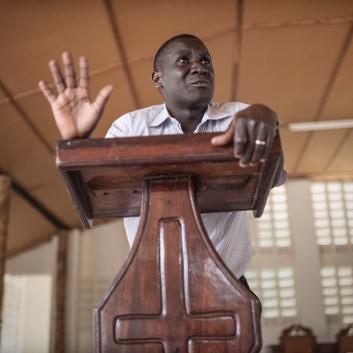
On February 24, Ugandan President Yoweri Museveni signed a law allowing for life sentences for homosexuals. Michael Kawuba is one of the many in the country who supports the measure. He spends much of his free time preaching against what he sees as the evils of homosexuality.

Michael Kawuba is sitting in his church office reflecting on tumescence. “We Ugandans get an erection when we see a beautiful woman,” he says. “Anything else is unnatural.”

During the day, Kawuba works as a financial advisor, but once he is finished, he rejoins the battle against homosexuality. A friendly man of 31, Kawuba is married and has three children — and he is not one to rant. But every second Sunday, he preaches to the Kakumba congregation. “The Bible forbade homosexuality. God rained down fire onto Sodom and Gomorrah” — he continues in this vein for hours at a time, standing behind a wooden pulpit. The sanctuary is spacious with a roof made of palm fronds. A band including guitar, bass and drums players pumps out gospel music while worshippers sing along, sway to the rhythm and stretch their arms heavenward as they call out “praise the Lord!”

On Feb. 24, God would seem to have finally heard their entreaties. That was the day that President Yoweri Museveni signed a law making “aggravated homosexuality” punishable with sentences of up to life in prison. A first draft of the law had even called for the death penalty. Michael Kawuba invited friends over for the event and they watched their head of state sign the new statute. “We cheered like we were watching football,” Kawuba says.

According to one survey, 96 percent of all Ugandans find homosexuality unacceptable and many are in favor of locking away gays, lesbians and transsexuals. Uganda has long been a model country in Africa: Though the regime is authoritarian, the country is stable and economically successful. Now, it has one of the most draconian anti-gay laws on the continent, trailing only Nigeria’s Muslim north, Mauretania, Somalia and Sudan. Now, homosexuality is a punishable offense in 36 of Africa’s 54 countries.

Afraid of Attacks

The international community was horrified: The United States slashed development aid to Uganda, the Europe Union threatened to impose sanctions and the United Nations warned the country to uphold human rights. But the reactions have done little to help the gays and lesbians in Uganda: Many have gone into hiding or fled the country. They believe that a wave of arrests is pending. Most of all, though, they are afraid of attacks from anti-gay activists.

There are thousands of congregations like that of lay-preacher Michael Kawuba. They tend to be small, but are often radical. Many of them, including Kakumba Church, maintain close contacts with evangelicals in the US whose self-proclaimed mission is that of bashing homosexuals. In 2009, for example, the ultra-right-wing activist Scott Lively traveled to Uganda claiming, among other things, that gays are to be blamed for the Holocaust.

The new law, following years of debate, has led to an increase in hate in the country. Though homosexuality has long been forbidden in Uganda, and gays and lesbians were often the target of abuse, nobody was locked away for it. There were even bars and clubs where they could go undisturbed. But that has now changed.

‘No Chance Against a Mob’

Attacks against gays and lesbians now occur on an almost daily basis, with human rights activists counting more than 70 cases since the law was signed. Dennis Wamala’s boyfriend, an actor, decided to stay in France following a theater trip to the country — out of fear. “We aren’t so much afraid of the police,” Wamala says. “When you get arrested, you can get yourself a lawyer. But you don’t have a chance against a mob. Many in Uganda would prefer to see us dead.” He says that the new legislation is a green light for people to take the law into their own hands.

Read more at Der Spiegel

A Brief History of Big Tax Breaks for Oil Companies

There will be subsidies: Nine decades later, “perhaps the most glaring loophole” in the tax code is still going strong.

Oil derricks and a “lake” of spilled crude in Santa Barbara, California, in 1935. Associated Press

Over the past century, the federal government has pumped more than $470 billion into the oil and gas industry in the form of generous, never-expiring tax breaks.

1926 Congress approves the “depletion allowance,” which lets oil producers deduct more than a quarter of their gross revenues. Texas Sen. Tom Connally, who sponsored the break, later admits, “We could have taken a 5 or 10 percent figure, but we grabbed 27.5 percent because we were not only hogs but the odd figure made it appear as though it was scientifically arrived at.”

1985 President Reagan takes aim at federal tax breaks. Oil and gas is one of few industries to emerge unscathed from the "showdown at Gucci Gulch." He fails to convince Congress to kill the depletion allowance for most oil wells.

1995 President Bill Clinton signs the Deep Water Royalty Relief Act, letting oil companies drill in federal waters without paying any royalties. More than 1,000 leases omit a promised price trigger, costing billions.

2005 With oil prices on the rise, President George W. Bush states, “With $55 [a barrel] oil, we don’t need incentives to oil and gas companies to explore.” But a few months later, he signs the Energy Policy Act, which expands the depletion allowance to apply to more drillers. It also lets companies write off exploration costs over two years instead of one.

2007 Illinois Sen. Barack Obama introduces the Oil sense (Subsidy Elimination for New Strategies on Energy) Act, which would repeal the depletion allowance and suspend royalty-free leases in the Gulf of Mexico. The bill dies in the Democratic-controlled Senate Finance Committee. A House bill that would have expanded tax credits for renewable energy and energy conservation also dies.

2013 Despite talk of everything being “on the table,” oil’s tax perks survive the fiscal-cliff negotiations.
Congressional Democrats introduce five bills targeting tax giveaways for oil and gas companies. Their death is all but assured, especially in the Republican-controlled House.
In April, Obama introduces his 2014 budget, which includes $23 billion for renewable energy and energy efficiency over 10 years and permanent tax cuts for renewable power generation. It also would end “inefficient fossil fuel subsidies.” In contrast, the gop budget proposed by Wisconsin Rep. Paul Ryan targets “federal intervention and corporate-welfare spending” by cutting subsidies for renewables. Tax breaks for oil are left untouched.

Read more at Mother Jones

Support quality journalism. Donate to Mother Jones.

Conservative heavyweights have solar industry in their sights

The Koch brothers and large utilities have allied to reverse state policies that favor renewable energy. Environmentalists are pushing back, but the fight is spreading and intensifying.

Americans for Prosperity, run by David Koch, shown here, and his brother, Charles, has led the effort to overturn a law in Kansas that requires 20% of the state’s electricity to come from renewable sources. (Phelan M. Ebanhack / Associated Press / August 30, 2013)

WASHINGTON — The political attack ad that ran recently in Arizona had some familiar hallmarks of the genre, including a greedy villain who hogged sweets for himself and made children cry.

But the bad guy, in this case, wasn’t a fat-cat lobbyist or someone’s political opponent.

He was a solar-energy consumer.

Solar, once almost universally regarded as a virtuous, if perhaps over-hyped, energy alternative, has now grown big enough to have enemies.

The Koch brothers, anti-tax activist Grover Norquist and some of the nation’s largest power companies have backed efforts in recent months to roll back state policies that favor green energy. The conservative luminaries have pushed campaigns in Kansas, North Carolina and Arizona, with the battle rapidly spreading to other states.

Alarmed environmentalists and their allies in the solar industry have fought back, battling the other side to a draw so far. Both sides say the fight is growing more intense as new states, including Ohio, South Carolina and Washington, enter the fray.

At the nub of the dispute are two policies found in dozens of states. One requires utilities to get a certain share of power from renewable sources. The other, known as net metering, guarantees homeowners or businesses with solar panels on their roofs the right to sell any excess electricity back into the power grid at attractive rates.

Net metering forms the linchpin of the solar-energy business model. Without it, firms say, solar power would be prohibitively expensive.

Read more at the Los Angeles Times.

Support quality journalism. Subscribe to the Los Angeles Times.

Obama Punts On Keystone Pipeline

A decision to give executive agencies more time to review plans for the controversial pipeline could push a final decision to after the midterm elections

President Barack Obama gestures as he speaks at Rev. Al Sharpton’s National Action Network’s conference in New York, April 11, 2014 (Carolyn Kaster—AP)

The Obama Administration is extending its review of the controversial Keystone XL pipeline that has become an election-year minefield.

The State Department said Friday that while the public comment period will not be extended, executive agencies need more time to review the submitted comments as well as consider a Nebraska court case surrounding the pipeline. The indefinite extension could put off a decision on the pipeline, which would carry crude oil from Canadian tar sands to American refineries, until after November’s midterm elections.

“On April 18, 2014, the Department of State notified the eight federal agencies specified in Executive Order 13337 we will provide more time for the submission of their views on the proposed Keystone Pipeline Project,” the department said in a statement. “Agencies need additional time based on the uncertainty created by the on-going litigation in the Nebraska Supreme Court which could ultimately affect the pipeline route in that state. In addition, during this time we will review and appropriately consider the unprecedented number of new public comments, approximately 2.5 million, received during the public comment period that closed on March 7, 2014.

“The Permit process will conclude once factors that have a significant impact on determining the national interest of the proposed project have been evaluated and appropriately reflected in the decision documents,” the State Department statement continued. “The Department will give the agencies sufficient time to submit their views.”

The pipeline has become a focus of Republican critics of the Obama Administration’s regulatory process. Senate Minority Leader Mitch McConnell blasted the White House Friday after news of the decision broke.

Read more at TIME

Syria: the story behind one of the most shocking images of the war | World news | The Guardian

From the archives of the Pulitzer Prize winning English newspaper, The Guardian.
Originally published 3-10-2013.

The Progressive Democrat offers its sincerest congratulations to The Guardian.

Bodies revealed by the Queiq river’s receding waters. Photo: Thomas Rassloff/EPA

It is already one of the defining images of the Syrian civil war: a line of bodies at neatly spaced intervals lying on a river bed in the heart of Syria’s second city Aleppo. All 110 victims have been shot in the head, their hands bound with plastic ties behind their back. Their brutal execution only became apparent when the winter high waters of the Queiq river, which courses through the no man’s land between the opposition-held east of the city and the regime-held west, subsided in January.

It’s a picture that raises so many questions: who were these men? How did they die? Why? What does their story tell us about the wretched disintegration of Syria? A Guardian investigation has established a grisly narrative behind the worst – and most visible – massacre to have taken place here. All the men were from neighbourhoods in the eastern rebel-held part of Aleppo. Most were men of working age. Many disappeared at regime checkpoints. They may not be the last to be found. Locals have since dropped a grate from a bridge, directly over an eddy in the river. Corpses were still arriving 10 days after the original discovery on January 29, washed downstream by currents flushed by winter rains.

Read more atThe Guardian.

Support excellence in journalism. Subscribe to The Guardian.

Inside the Turkish Government’s Propaganda Machine

By Kate O’Sullivan and Laura Benitez Apr 8 2014

A Turkish protest for internet freedom in February. Photos by Charles Emir Richards

“Journalists wanted for international news agency,” read the Guardian job ad. As an editor in an industry where legitimate opportunities are few and far between, you apply for pretty much any full-time job you see, so apply we did. A couple of months later, we arrived in Ankara, Turkey, ready to “write history” as the first international journalists to be welcomed into the Anadolu Agency (AA) family.

We joined the agency in January, supposedly to edit English-language news, but quickly found ourselves becoming English-language spin doctors. The AA’s editorial line on domestic politics—and Syria—was so intently pro-government that we might as well have been writing press releases. Two months into the job, we listened to Deputy Prime Minister Bülent Arınç talking some shit about press freedom from an event at London’s Chatham House, downplaying the number of imprisoned journalists in Turkey. Soon after that, we got the chance to visit London on business. We grabbed it and resigned as soon as we hit UK soil.

Established in 1920, the AA was once a point of national pride. Today, it’s at the end of one of the many sets of strings in the ruling AK Party’s puppet parade. Most of Turkey’s TV stations are heavily influenced by the state, and the few opposition channels can expect to have their licenses revoked at any time or be banned from broadcasting key events, such as live election footage or anything that might detract from how fantastic the government is doing.

For example, Turkey’s media regulator, RTUK, fined the networks that aired footage of last year’s Gezi Park protests. Funnily enough, the watchdog is made up of nine “elected” members nominated by political parties—and the more seats in parliament a faction has, the more influence it possesses.

Media outlets that aren’t being hounded by RTUK can always look forward to direct intervention from Prime Minister Tayyip Erdogan himself. In 2009, independent mogul Aydin Dogan’s media group—made up of various newspapers and TV channels, CNN Türk, and a news agency—was fined $2.5 billion for evading taxes. Incidentally, the audit came just after one of the group’s platforms published news on the Lighthouse charity scandal, which saw a German court convict three Turkish businessmen for funnelling $28.3 million into their personal accounts.

In one recent leaked recording, Erdogan is heard asking his former justice minister to ensure that Dogan be punished. Since then, the Dogan empire has been bound and gagged accordingly.

Police crack down on a free speech protest in Istanbul in February.

The international media relies increasingly on local sources when reporting domestic affairs overseas. The Gezi protests aside—which had nearly as many “live blogs” as protesters—much of Turkey’s English-language news came via Today’s Zaman, the largest English-language newspaper in Turkey. The leadership of the Zaman newsgroup is closely linked with the Islamic teacher and international education mogul Fethullah Gulen, a former ally of the AK Party who now lives in self-imposed exile in Pennsylvania.

Read more at VICE

Paul Ryan Has a Plan for the Poor. It’s Terrible.

How his 2015 budget could sink America’s neediest deeper into poverty.

Tony Alter/ Flickr

House budget committee chairman Paul Ryan (R-Wis.) has lately rebranded himself as an advocate for the poor, albeit with his own makers-versus-takers, Ayn Randian twist. He recently issued a lengthy study of federal anti-poverty programs and over the past year and a half he has embarked on a “listening tour” to hear from low-income Americans. On Tuesday, Ryan issued the House GOP’s 2015 budget proposal, which would make major changes to two of the federal government’s primary anti-poverty programs, food stamps and Medicaid. Using as his model the supposedly successful welfare reform effort of the 1990s, Ryan envisions turning these programs into block grants that are handed over to the states to administer. But his plan to “help families in need lead lives of dignity” is likely to make matters worse for America’s neediest. Here’s why.

In 1996, Congress reengineered the federal program that provided cash assistance to the poorest families. Along with imposing stiff work requirements, Congress turned the old entitlement program, whose budget rose and fell automatically with need, into a block grant with a fixed budget. The grant was then distributed to the states, with few strings attached, under the premise that they were “laboratories of innovation” that would revolutionize the way the government helped the poor.

But as welfare reform has shown, giving states this sort of flexibility in how they spend federal money can lead to a lot of abuse that Republicans are so keen on rooting out.

According to data crunched by the Center on Budget and Policy Priorities, states have diverted billions of dollars of welfare block grants for uses these funds were not intended to support. In the first year of welfare reform, about 70 percent of the Temporary Assistance for Needy Families (TANF) block grant went to pay for basic cash assistance for poor families. By 2012, that number had fallen to 29 percent and states were spending just 8 percent on providing transportation, job training, and other services intended to help people transition from welfare into the workforce.

The numbers are even more dismal in some individual states. In 2012, Louisiana spent 7 percent of its $261 million in TANF funds on basic assistance, down from 36 percent in 2001. Just 4 percent of the funds went to programs to help welfare recipients get back into the workforce. A mere 2 percent of the funds paid for child care, another critical component of a reform effort that was geared toward nudging women with small children into low-wage jobs.

What happened to the rest of the money? According to CBBP, 71 percent of it went to other services, including “other nonassistance,” a nebulous category used to mask payments for a hodgepodge of programs that the state didn’t want to spend its own tax revenues on.

Read more at Mother Jones

Support quality journalism. Subscribe to Mother Jones.

And if you feel like you need still more Paul Ryan, you can check out Michael Thomasky’s article in the The Daily Beast: Paul Ryan: Still a Total Jerk

The Supreme Court’s Ideology: More Money, Less Voting

by Ari Berman

The Supreme Court. (AP Photo/Evan Vucci)

In the past four years, under the leadership of Chief Justice John Roberts, the Supreme Court has made it far easier to buy an election and far harder to vote in one.

First came the Court’s 2010 decision in Citizens United v. FEC, which brought us the Super PAC era.

Then came the Court’s 2013 decision in Shelby County v. Holder, which gutted the centerpiece of the Voting Rights Act.

Now we have McCutcheon v. FEC, where the Court, in yet another controversial 5-4 opinion written by Roberts, struck down the limits on how much an individual can contribute to candidates, parties and political action committees. So instead of an individual donor being allowed to give $117,000 to campaigns, parties and PACs in an election cycle (the aggregate limit in 2012), they can now give up to $3.5 million, Andy Kroll of Mother Jones reports.

The Court’s conservative majority believes that the First Amendment gives wealthy donors and powerful corporations the carte blanche right to buy an election but that the Fifteenth Amendment does not give Americans the right to vote free of racial discrimination.

These are not unrelated issues—the same people, like the Koch brothers, who favor unlimited secret money in US elections are the ones funding the effort to make it harder for people to vote. The net effect is an attempt to concentrate the power of the top 1 percent in the political process and to drown out the voices and votes of everyone else.

Read more at The Nation

Support quality journalism. Subscribe to The Nation.

NAFTA at 20: “A Vehicle To Increase Profits at the Expense of Democracy”

Thursday the AFL-CIO released a new report, NAFTA at 20. The report makes the point that, “On the whole, NAFTA-style agreements have proved to be primarily a vehicle to increase corporate profits at the expense of workers, consumers, farmers, communities, the environment and even democracy itself.”

In a press release accompanying the report AFL-CIO President Richard Trumka says that working people and democratic governance on all sides of NAFTA’s borders are now worse off, and Congress should recognize this before approving any more “NAFTA-style” trade agreements.

“There is no success story for workers to be found in North America 20 years after NAFTA,” said Trumka. “The NAFTA model focuses on lifting corporations out of reach of democratic governance, rather than solely reducing tariffs. This report should serve as a cautionary tale to the Obama Administration and Congress as they consider negotiating and implementing new trade deals.”

Trade Agreements Should Stop Following The NAFTA Model

Preceding the report, Trumka gave a major speech on trade at the Center for American Progress. He talked about the history of “a disastrous, outdated, failed model of global economic policies.” He said that trade agreements should abandon the NAFTA model and instead offer a “global new deal … to bring the basic infrastructure of modern society—electricity, water, schools, roads, internet access—to everyone on Earth.”

The Report

A summary of the report contains these points about NAFTA:

– It’s a flawed model that promotes the economic interests of a very few and at the expense of workers, consumers, farmers, communities, the environment and even democracy itself.
– While the overall volume of trade within North America due to NAFTA has increased and corporate profits have skyrocketed, wages have remained stagnant in all three countries.
– Productivity has increased, but workers’ share of these gains has decreased steadily, along with unionization rates.
– NAFTA pushed small Mexican farmers off their lands, increasing the flow of desperate undocumented migrants.
– It exacerbated inequality in all three countries.
– And the NAFTA labor side agreement has failed to accomplish its most basic mandate: to ensure compliance with fundamental labor rights and enforcement of national labor laws.

The NAFTA architecture of deregulation coupled with investor protections allowed companies to move labor intensive components of their operations to locations with weak laws and lax enforcement. This incentivized local, state and federal authorities to artificially maintain low labor costs by ignoring–or in some cases actively interfering with–such fundamental rights as the rights to organize, strike and be free from discrimination. This dynamic undermined organizing and bargaining efforts even in areas with relatively robust labor laws. Today, it is commonplace for employers to threaten to move south—whether to South Carolina or Tijuana—if workers do not agree to cuts in wages and benefits.

See the report at NAFTA at 20.

The Speech

In his speech Trumka began by outlining how NAFTA failed regular people by killing jobs and keeping wages down, which enriching an already-wealthy few – setting the stage for the 2008 financial collapse.

Read more at Truthout

Truthout is an independent news organization funded by individual donations. Support independent journalism. Please donate to Truthout.

Related stories: Mexico’s tomato-farm workers toil in ‘circle of poverty’ and America’s War on Immigrants