A new survey suggests that many Asians, Africans, Middle Easterners, young people, Muslims, and Hindus believe that facts about the genocide have been distorted. Child survivors photographed at Auschwitz in 1945. (Wikimedia)
Only 54 percent of the world’s population has heard of the Holocaust.
54 percent.
This is the most staggering statistic in a new survey by the Anti-Defamation League (ADL) of more than 53,000 people in over 100 countries, conducted by First International Resources. But that figure speaks to only those who have heard of it: Only a third of the world’s population believe the genocide has been accurately described in historical accounts. Some said they thought the number of people who died has been exaggerated; others said they believe it’s a myth. Thirty percent of respondents said it’s probably true that “Jews still talk too much about what happened to them in the Holocaust.”
Seventy years after the liberation of Auschwitz, two-thirds of the world’s population don’t know the Holocaust happened—or they deny it.
Archaeology correspondent David Keys reveals a remarkable discovery off the coast of Haiti
More than five centuries after Christopher Columbus’s flagship, the Santa Maria, was wrecked in the Caribbean, archaeological investigators think they may have discovered the vessel’s long-lost remains – lying at the bottom of the sea off the north coast of Haiti. It’s likely to be one of the world’s most important underwater archaeological discoveries.
“All the geographical, underwater topography and archaeological evidence strongly suggests that this wreck is Columbus’ famous flagship, the Santa Maria,” said the leader of a recent reconnaissance expedition to the site, one of America’s top underwater archaeological investigators, Barry Clifford.
“The Haitian government has been extremely helpful – and we now need to continue working with them to carry out a detailed archaeological excavation of the wreck,” he said.
So far, Mr. Clifford’s team has carried out purely non-invasive survey work at the site – measuring and photographing it.
Tentatively identifying the wreck as the Santa Maria has been made possible by quite separate discoveries made by other archaeologists in 2003 suggesting the probable location of Columbus’ fort relatively nearby. Armed with this new information about the location of the fort, Clifford was able to use data in Christopher Columbus’ diary to work out where the wreck should be.
Rising Temperatures 1991-2012 average temperature compared with 1901-1960 average
The effects of human-induced climate change are being felt in every corner of the United States, scientists reported Tuesday, with water growing scarcer in dry regions, torrential rains increasing in wet regions, heat waves becoming more common and more severe, wildfires growing worse, and forests dying under assault from heat-loving insects.
Such sweeping changes have been caused by an average warming of less than 2 degrees Fahrenheit over most land areas of the country in the past century, the scientists found. If greenhouse gases like carbon dioxide and methane continue to escalate at a rapid pace, they said, the warming could conceivably exceed 10 degrees by the end of this century.
“Climate change, once considered an issue for a distant future, has moved firmly into the present,” the scientists declared in a major new report assessing the situation in the United States.
“Summers are longer and hotter, and extended periods of unusual heat last longer than any living American has ever experienced,” the report continued. “Winters are generally shorter and warmer. Rain comes in heavier downpours. People are seeing changes in the length and severity of seasonal allergies, the plant varieties that thrive in their gardens, and the kinds of birds they see in any particular month in their neighborhoods.”
The report is the latest in a series of dire warnings about how the effects of global warming that had been long foreseen by climate scientists are already affecting the planet. Its region-by-region documentation of changes occurring in the United States, and of future risks, makes clear that few places will be unscathed — and some, like northerly areas, are feeling the effects at a swifter pace than had been expected.
Alaska in particular is hard hit. Glaciers and frozen ground in that state are melting, storms are eating away at fragile coastlines no longer protected by winter sea ice, and entire communities are having to flee inland — a precursor of the large-scale changes the report foresees for the rest of the United States.
The study, known as the National Climate Assessment, was prepared by a large scientific panel overseen by the government and received final approval at a meeting Tuesday.
FILE – Commuters wearing masks make their way amid thick haze in the morning in Beijing. China’s north is suffering a pollution crisis, with the capital Beijing itself shrouded in acrid smog. Authorities have introduced anti-pollution policies.
HONG KONG — After almost two years of debate, China’s parliament has passed a new law that analysts say is a positive step in addressing the country’s systemic problems with the environment. Environmental groups say that although implementation may prove difficult, the revision gives them a legal framework to challenge polluters.
The new law gives more punitive powers to environmental authorities, allows a broader range of actions for environmental organizations and defines geographical “red lines” where the area’s ecology requires special protection.
It is the first time the environmental protection law has been revised since 1989.
Lawmaker Xin Chunying, told a news briefing Thursday that the revision will have an important effect on the future of China’s environmental protection efforts. “The revision of the environmental law is a heavy blow [in the fight against] our country’s harsh environmental realities, and an important systemic construct,” said Xin.
China has suffered from the effects of its rapid development, which has lifted hundreds of millions of people out of poverty but heavily damaged the environment.
Air, water and soil pollution have reached alarming levels, becoming one of the key sources of discontent for many Chinese.
Despite official pronouncements to put the environment first, local governments have for decades been judged solely on their economic performance.
On February 24, Ugandan President Yoweri Museveni signed a law allowing for life sentences for homosexuals. Michael Kawuba is one of the many in the country who supports the measure. He spends much of his free time preaching against what he sees as the evils of homosexuality.
Michael Kawuba is sitting in his church office reflecting on tumescence. “We Ugandans get an erection when we see a beautiful woman,” he says. “Anything else is unnatural.”
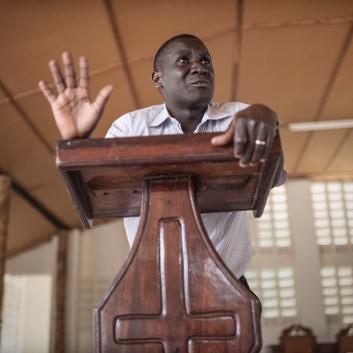
During the day, Kawuba works as a financial advisor, but once he is finished, he rejoins the battle against homosexuality. A friendly man of 31, Kawuba is married and has three children — and he is not one to rant. But every second Sunday, he preaches to the Kakumba congregation. “The Bible forbade homosexuality. God rained down fire onto Sodom and Gomorrah” — he continues in this vein for hours at a time, standing behind a wooden pulpit. The sanctuary is spacious with a roof made of palm fronds. A band including guitar, bass and drums players pumps out gospel music while worshippers sing along, sway to the rhythm and stretch their arms heavenward as they call out “praise the Lord!”
On Feb. 24, God would seem to have finally heard their entreaties. That was the day that President Yoweri Museveni signed a law making “aggravated homosexuality” punishable with sentences of up to life in prison. A first draft of the law had even called for the death penalty. Michael Kawuba invited friends over for the event and they watched their head of state sign the new statute. “We cheered like we were watching football,” Kawuba says.
According to one survey, 96 percent of all Ugandans find homosexuality unacceptable and many are in favor of locking away gays, lesbians and transsexuals. Uganda has long been a model country in Africa: Though the regime is authoritarian, the country is stable and economically successful. Now, it has one of the most draconian anti-gay laws on the continent, trailing only Nigeria’s Muslim north, Mauretania, Somalia and Sudan. Now, homosexuality is a punishable offense in 36 of Africa’s 54 countries.
Afraid of Attacks
The international community was horrified: The United States slashed development aid to Uganda, the Europe Union threatened to impose sanctions and the United Nations warned the country to uphold human rights. But the reactions have done little to help the gays and lesbians in Uganda: Many have gone into hiding or fled the country. They believe that a wave of arrests is pending. Most of all, though, they are afraid of attacks from anti-gay activists.
There are thousands of congregations like that of lay-preacher Michael Kawuba. They tend to be small, but are often radical. Many of them, including Kakumba Church, maintain close contacts with evangelicals in the US whose self-proclaimed mission is that of bashing homosexuals. In 2009, for example, the ultra-right-wing activist Scott Lively traveled to Uganda claiming, among other things, that gays are to be blamed for the Holocaust.
The new law, following years of debate, has led to an increase in hate in the country. Though homosexuality has long been forbidden in Uganda, and gays and lesbians were often the target of abuse, nobody was locked away for it. There were even bars and clubs where they could go undisturbed. But that has now changed.
‘No Chance Against a Mob’
Attacks against gays and lesbians now occur on an almost daily basis, with human rights activists counting more than 70 cases since the law was signed. Dennis Wamala’s boyfriend, an actor, decided to stay in France following a theater trip to the country — out of fear. “We aren’t so much afraid of the police,” Wamala says. “When you get arrested, you can get yourself a lawyer. But you don’t have a chance against a mob. Many in Uganda would prefer to see us dead.” He says that the new legislation is a green light for people to take the law into their own hands.
Parents mourn at the grave of their son after they spared the life of their son’s convicted murderer. (ARASH KHAMOOSHI/AFP/Getty Images)
With eyes covered and a noose around his neck, a young man identified only as Balal was “screaming and praying loudly before he just went silent,” Iranian Students’ News Agency (ISNA) photographer Arash Khamooshi, who was photographing a public execution in Iran told CNN.
Saeed Kamali Dehghan of The Guardian reports Balal, who is in his 20s, was convicted of killing 18-year-old Abdollah Hosseinzadeh with a knife during a street brawl in 2007. He was arrested by police after fleeing the crime scene and, after six years, was given a death sentence.
The crowd watched as Samereh Alinejad, Hosseinzadeh’s mother, approached. Time writes: “According to some interpretations of sharia law, the victim’s family participates in the punishment by pushing the chair from under the condemned man.”
But instead of pushing the chair from underneath him and execute him, Alinejad slapped him in the face.
Khamooshi told CNN that, after slapping Balal, the mother told the crowd that she had forgiven him, and helped Hosseinzadeh’s father take the noose off.
From the archives of the Pulitzer Prize winning English newspaper, The Guardian.
Originally published 3-10-2013.
The Progressive Democrat offers its sincerest congratulations to The Guardian.
Bodies revealed by the Queiq river’s receding waters. Photo: Thomas Rassloff/EPA
It is already one of the defining images of the Syrian civil war: a line of bodies at neatly spaced intervals lying on a river bed in the heart of Syria’s second city Aleppo. All 110 victims have been shot in the head, their hands bound with plastic ties behind their back. Their brutal execution only became apparent when the winter high waters of the Queiq river, which courses through the no man’s land between the opposition-held east of the city and the regime-held west, subsided in January.
It’s a picture that raises so many questions: who were these men? How did they die? Why? What does their story tell us about the wretched disintegration of Syria? A Guardian investigation has established a grisly narrative behind the worst – and most visible – massacre to have taken place here. All the men were from neighbourhoods in the eastern rebel-held part of Aleppo. Most were men of working age. Many disappeared at regime checkpoints. They may not be the last to be found. Locals have since dropped a grate from a bridge, directly over an eddy in the river. Corpses were still arriving 10 days after the original discovery on January 29, washed downstream by currents flushed by winter rains.
By KHALED HOSSEINI APRIL 11, 2014There are now 2.5 million refugees from Syria, 1.2 million of them children. Photo credit; Lynsey Addario for The New York Times
SOMETHING about the boy was not right. He seemed disoriented, detached from his surroundings. He barely spoke, and when he did, it was in flat monosyllables, his eyes unfocused and downcast, as if too heavy to roll up from the weight of all they had seen. He was the picture of quiet devastation, of a childhood forever splintered.
He was 14 years old, a Syrian refugee, sitting with his family in a small room in the registration building of the United Nations High Commissioner for Refugees in Erbil, northern Iraq. In the crowded, noisy offices downstairs, scores of newly arrived refugees queued to register, including an exhausted-looking, dust-sheathed family of Dom Gypsies and a Syrian woman with a club foot, who limped about the hallways and pleaded with every passer-by to give her asylum in Germany.
In the upstairs office, the boy’s father sat across a table from me. A supple, boyish-looking 36-year-old, he recounted, with admirable calm, the story of his family’s harrowing escape, two weeks earlier, from their hometown, Aleppo, and their subsequent trip across the Turkish border and into the Kurdistan region of Iraq.
Before the war, he said, he worked at a shoe store, and his three children excelled at school. It was a modest but happy middle-class life. But then came war, and suddenly rocket-propelled grenades were whooshing in all day and Aleppo was honeycombed by falling bombs. He lost his job and his children’s school closed; they would lose two full years of schooling before the family’s eventual escape.
Soon, there was no electricity, no telephone service, no food. The father sold the family’s belongings, down to the last piece of furniture. When the money ran out, he borrowed flour from neighbors for his wife to make bread.
“Sometimes we weren’t eating for two or three days, but just giving the bread and water to the children to eat to survive,” he said.
At some point this year, Syria will overtake my native country, Afghanistan, as the world’s largest refugee-producing state. There are now 2.5 million refugees from Syria, 1.2 million of them children. Two-thirds of Syrian refugee children, and nearly three million children inside the country, are out of school.
They face a broken future. Syria is on the verge of losing a generation. This is perhaps the most dooming consequence of this terrible war.
Expect soaring global food prices, monsoons in India, drought in Indonesia, and bush fires in Australia.El Niño, warmer than average waters in the “Niño3.4” region of the tropical Pacific Ocean, affects weather around the world. NOAA Visualization Lab
The odds are increasing that an El Niño is in the works for 2014—and recent forecasts show it might be a big one.
That’s an incredibly powerful tool, especially if you are one of the billions who live where El Niño tends to hit hardest—Asia and the Americas. If current forecasts stay on track, El Niño might end up being the biggest global weather story of 2014.
The most commonly accepted definition of an El Niño is a persistent warming of the so-called “Niño3.4” region of the tropical Pacific Ocean south of Hawaii, lasting for at least five consecutive three-month “seasons.” A recent reversal in the direction of the Pacific trade winds appears to have kicked off a warming trend during the last month or two. That was enough to prompt US government forecasters to issue an El Niño watch last month.
Forecasters are increasingly confident in a particularly big El Niño this time around because, deep below the Pacific Ocean’s surface, off-the-charts warm water is lurking:
That giant red blob is a huge sub-surface wave of anomalously warm water that currently spans the tropical Pacific Ocean—big enough to cover the United States 300 feet deep. That’s a lot of warm water. Australia Bureau of Meteorology
As that blob of warm water moves eastward, propelled by the anomalous trade winds, it’s also getting closer to the ocean’s surface. Once that happens, it will begin to interact with the atmosphere, boosting temperatures and changing weather patterns.
A Turkish protest for internet freedom in February. Photos by Charles Emir Richards
“Journalists wanted for international news agency,” read the Guardian job ad. As an editor in an industry where legitimate opportunities are few and far between, you apply for pretty much any full-time job you see, so apply we did. A couple of months later, we arrived in Ankara, Turkey, ready to “write history” as the first international journalists to be welcomed into the Anadolu Agency (AA) family.
We joined the agency in January, supposedly to edit English-language news, but quickly found ourselves becoming English-language spin doctors. The AA’s editorial line on domestic politics—and Syria—was so intently pro-government that we might as well have been writing press releases. Two months into the job, we listened to Deputy Prime Minister Bülent Arınç talking some shit about press freedom from an event at London’s Chatham House, downplaying the number of imprisoned journalists in Turkey. Soon after that, we got the chance to visit London on business. We grabbed it and resigned as soon as we hit UK soil.
Established in 1920, the AA was once a point of national pride. Today, it’s at the end of one of the many sets of strings in the ruling AK Party’s puppet parade. Most of Turkey’s TV stations are heavily influenced by the state, and the few opposition channels can expect to have their licenses revoked at any time or be banned from broadcasting key events, such as live election footage or anything that might detract from how fantastic the government is doing.
For example, Turkey’s media regulator, RTUK, fined the networks that aired footage of last year’s Gezi Park protests. Funnily enough, the watchdog is made up of nine “elected” members nominated by political parties—and the more seats in parliament a faction has, the more influence it possesses.
Media outlets that aren’t being hounded by RTUK can always look forward to direct intervention from Prime Minister Tayyip Erdogan himself. In 2009, independent mogul Aydin Dogan’s media group—made up of various newspapers and TV channels, CNN Türk, and a news agency—was fined $2.5 billion for evading taxes. Incidentally, the audit came just after one of the group’s platforms published news on the Lighthouse charity scandal, which saw a German court convict three Turkish businessmen for funnelling $28.3 million into their personal accounts.
In one recent leaked recording, Erdogan is heard asking his former justice minister to ensure that Dogan be punished. Since then, the Dogan empire has been bound and gagged accordingly.
Police crack down on a free speech protest in Istanbul in February.
The international media relies increasingly on local sources when reporting domestic affairs overseas. The Gezi protests aside—which had nearly as many “live blogs” as protesters—much of Turkey’s English-language news came via Today’s Zaman, the largest English-language newspaper in Turkey. The leadership of the Zaman newsgroup is closely linked with the Islamic teacher and international education mogul Fethullah Gulen, a former ally of the AK Party who now lives in self-imposed exile in Pennsylvania.




 The Progressive Democrat
You must be logged in to post a comment.